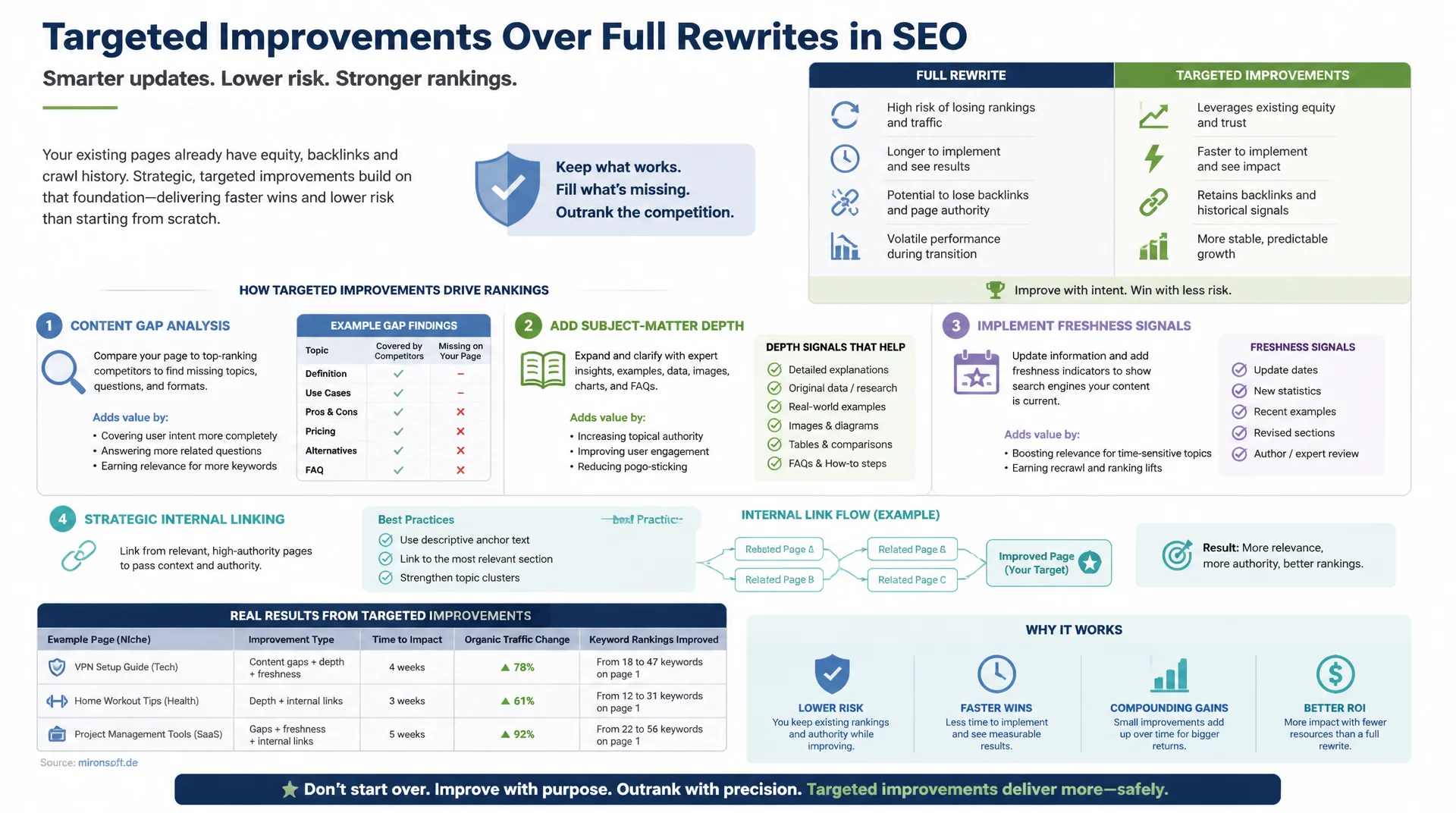
Content updates that actually move rankings
A full rewrite costs time, ranking history, and trust built up with Google when an existing page really just needs targeted improvements. Using content gap analysis against ranking competitors, added subject-matter depth, clean freshness signals, and smartly placed internal links usually improves rankings faster and with far less risk than a complete rebuild.
Table of Contents
- 1. When optimizing pays off and when a rewrite is necessary
- 2. Content gap analysis against ranking pages
- 3. Adding subject-matter depth without slipping into keyword stuffing
- 4. Maintaining freshness signals properly: date and recency
- 5. Expanding internal linking with purpose
- 6. Re-checking on-page basics: title, meta, headings, schema
- 7. Structuring content for featured snippets
- 8. Monitoring after optimization: Search Console and rankings
- 9. Before/after: checklist for content optimization
- 10. Summary
- 11. FAQ
1. When optimizing pays off and when a rewrite is necessary
Optimizing an existing page is, in most cases, the better default decision because it preserves the ranking history, existing backlinks, and accumulated click and user signals built up over months or years. A complete rewrite effectively resets those signals: Google has to re-evaluate the page, and temporary ranking fluctuations during the transition are the rule, not the exception. If the page's underlying search intent still matches the target keyword and only individual pieces of content are outdated, such as wrong version numbers or stale screenshots, a targeted optimization is almost always the right call.
A rewrite pays off instead when the search intent behind the target keyword has fundamentally shifted, when the existing structure is aimed at the wrong question altogether, or when the page demonstrably has little organic value to preserve. A simple check beforehand: review the last twelve months of Search Console data for impressions, clicks, and backlinks. If meaningful backlinks or a stable, even if weak, click history exist, optimization almost always outweighs the risk of a complete restart.
2. Content gap analysis against ranking pages
A content gap analysis reveals which subtopics the pages currently ranking in the top positions cover that the existing page is missing. The practical starting point: open the top three to five ranking pages for the target keyword and note every H2 and H3 heading, supplemented with the questions from the "People also ask" box in the search results. This list reliably shows which entities and subtopics Google considers relevant for the topic, regardless of how the existing page has structured the subject so far.
The query report in Search Console also provides valuable signals: queries where the existing page already ranks in positions 11 to 20 mark subtopics that are already present but not yet developed enough. The most practical implementation is a spreadsheet with the page's own headings in one column and each competitor's headings in additional columns. Every gap gets added as its own new H2 or H3 section, not as an incidental sentence buried in an existing paragraph, so Google can clearly associate the heading structure with topical coverage.
3. Adding subject-matter depth without slipping into keyword stuffing
Depth means concretely answering the "why" and "how", with real numbers, traceable examples, and, where relevant, working code, instead of stringing together keyword variations. Google's language systems today evaluate semantic relevance and topical coverage, not raw keyword density. Artificially repeated phrasing hurts readability for people and, combined with other signals, can even be recognized as a spam pattern, which produces exactly the opposite of the intended effect.
The practical approach: place the target keyword naturally once or twice in the heading and intro, then consistently focus on related entities and synonyms that a subject-matter expert would use naturally. Additional depth comes from concrete version numbers, real code examples, solid figures, and case examples drawn from actual project experience. Thanks to passage-based indexing, a single, well-structured paragraph can already rank for a specific query, even if the page overall targets a broader topic.
<!-- Before: shallow paragraph with no depth, structure, or internal links -->
<p>Magento caching is important for fast stores. There are various
cache types in Magento that should be configured.</p>

<!-- After: concrete depth, its own heading, internal link, real numbers -->
<h3 id="varnish-fpc">Configuring the Varnish Full Page Cache correctly</h3>
<p>The Full Page Cache reduces server response time (TTFB) on category
and product pages from an average of 400-600 ms to under 50 ms,
provided <code>bin/magento cache:enable full_page</code> is active and
dynamic blocks like the mini cart counter are loaded via AJAX instead
of a full page reload. Details on ESI configuration can be found in the
<a href="/blog/seo-core-web-vitals-for-magento-stores#magento">Core Web
Vitals article</a>.</p>
4. Maintaining freshness signals properly: date and recency
The visible "last updated" date and the dateModified field in structured data markup are signals that matter most for time-sensitive queries, where Google applies what's known as Query Deserves Freshness scoring. Crucially, updating the date without any accompanying content change counts as a manipulative pattern and can be detected by Google's systems. A date update is only legitimate and effective when substantive content has actually been changed, expanded, or corrected.
A practical checklist before every date update: replace outdated version numbers and screenshots, update prices and statistics, remove features that no longer apply or clearly flag them as deprecated, and add at least one new, relevant subsection identified from the gap analysis. The dateModified field in the JSON-LD gets updated in the process, while datePublished stays untouched so the page's original publication history isn't distorted.
{
  "@context": "https://schema.org",
  "@type": "Article",
  "headline": "Magento Caching Fundamentals",
  "datePublished": "2024-03-12",
  "dateModified": "2026-07-11",
  "author": { "@type": "Organization", "name": "Mironsoft", "url": "https://mironsoft.de" },
  "publisher": { "@type": "Organization", "name": "Mironsoft", "url": "https://mironsoft.de" },
  "mainEntityOfPage": { "@type": "WebPage", "@id": "https://mironsoft.de/blog/magento-caching-fundamentals" }
}
5. Expanding internal linking with purpose
Internal links added deliberately to and from a freshly optimized page distribute link equity within the domain and signal to Google the topical context the page sits in. The first step is a quick sitemap review to find topically related pages that are weakly linked or entirely orphaned. From there, contextual links get added with descriptive anchor text that clearly names the target topic, instead of generic phrases like "click here" or "learn more".
At least as important as outbound links are inbound internal links from already authoritative, well-ranking existing pages pointing to the optimized page, since those links pass on more link equity than links from weak pages. Restraint with anchor text matters here: too many exact-match anchors across multiple links looks unnatural and can be flagged as over-optimization. A natural variation of phrasing that still clearly points to the topic is the safer path.
<!-- CMS block reference: insert related articles right below the content -->
<referenceContainer name="content">
    <block class="Magento\Cms\Block\Block" name="related.articles.block">
        <arguments>
            <argument name="block_id" xsi:type="string">related_articles_caching</argument>
        </arguments>
    </block>
</referenceContainer>

<!-- Inside the CMS block: descriptive anchor text instead of "click here" -->
<!-- <a href="/blog/seo-optimizing-existing-pages-instead-of-rewriting">Run a
     content gap analysis against ranking pages</a> -->
6. Re-checking on-page basics: title, meta, headings, schema
Even well-established pages often carry outdated title tags and meta descriptions that reflect neither the current search intent nor click-worthy copy. Every optimization is a good opportunity to re-check title length, position the primary keyword as close to the front as possible, and rewrite the meta description so it actually motivates a click instead of just stringing keywords together. Comparing against the snippets of currently ranking competitors often reveals which phrasing stands out in the search results and which blends into the crowd.
In parallel, the heading hierarchy gets validated: exactly one H1, a logically nested H2/H3 structure that reflects the subtopics uncovered in the gap analysis. Structured data such as Product, Article, or FAQPage schema must be checked again against the visible content after optimization. If the schema diverges from the actual page content, Google often silently revokes rich-snippet eligibility, undercutting the effect of the entire optimization effort.
7. Structuring content for featured snippets
Featured snippets appear in three formats: a short text paragraph, a list, or a table, depending on which format fits the specific query. For question-based queries, it's worth placing a compact, self-contained paragraph of roughly 40 to 60 words directly under the matching H2 or H3 heading that answers the question immediately, before the deeper explanation follows. This structure increases the odds that Google extracts exactly that paragraph as a snippet.
For comparison and step-by-step content, cleanly marked-up ordered lists and tables are noticeably more snippet-friendly than plain prose, since Google can extract structured markup elements more easily. Additional subheadings that directly pick up common user questions like "how", "what", or "why" unlock extra long-tail snippet opportunities, without needing a separate new article for each one.
8. Monitoring after optimization: Search Console and rankings
After deploying the changes, the performance report in Search Console for the affected page and its relevant queries should be watched weekly for four to eight weeks. Short-term fluctuations in the first few days are normal, since Google has to recrawl the page and adjust its relevance scoring before a stable new ranking settles in.
The URL inspection tool in Search Console allows a manual request for reindexing, while the crawl stats report confirms that Google has actually revisited the page. A before/after comparison of average position and click-through rate per query shows whether the optimization is taking effect. Additional rank tracking on the target keywords catches regressions early, not just improvements, so an unexpected drop can be addressed quickly.
# URL Inspection API: request reindexing after a content update
curl -X POST \
  "https://searchconsole.googleapis.com/v1/urlInspection/index:inspect" \
  -H "Authorization: Bearer ${GSC_ACCESS_TOKEN}" \
  -H "Content-Type: application/json" \
  -d '{
    "inspectionUrl": "https://mironsoft.de/blog/magento-caching-fundamentals",
    "siteUrl": "https://mironsoft.de/"
  }'

# Compare the word count of the own page against the top 3 competitors
for url in "$@"; do
  words=$(curl -s "$url" | sed 's/<[^>]*>//g' | wc -w)
  echo "$url: $words words"
done
// Content gap report: crawl the own sitemap and diff headings against
// competitor URLs to surface missing subtopics
async function extractHeadings(url) {
  const html = await (await fetch(url)).text();
  const matches = [...html.matchAll(/<h[23][^>]*>(.*?)<\/h[23]>/gi)];
  return matches.map(m => m[1].replace(/<[^>]+>/g, '').trim());
}

async function buildGapReport(ownUrl, competitorUrls) {
  const ownHeadings = new Set((await extractHeadings(ownUrl)).map(h => h.toLowerCase()));
  const gaps = new Map();

  for (const url of competitorUrls) {
    const headings = await extractHeadings(url);
    for (const heading of headings) {
      if (!ownHeadings.has(heading.toLowerCase())) {
        gaps.set(heading, (gaps.get(heading) || 0) + 1);
      }
    }
  }

  // Sort by frequency: topics covered by multiple competitors come first
  return [...gaps.entries()].sort((a, b) => b[1] - a[1]);
}
9. Before/after: checklist for content optimization
The table below summarizes the most common weaknesses of existing pages and the concrete optimization that fixes each one.
| Element | Before (problem) | After (optimized) |
|---|---|---|
| Content depth | Shallow paragraph with no detail | Concrete numbers, code, case examples |
| Topic coverage | Subtopics from gap analysis missing | Own H2/H3 for each missing subtopic |
| Freshness | Date refreshed with no content change | dateModified only on real updates |
| Internal links | Page barely linked internally | Links from authoritative pages |
| Title/meta | Generic, no click incentive | Specific, keyword up front, compelling |
Mironsoft
Content audits, gap analyses, and on-page optimization for Magento stores
Ready to optimize your existing pages?
We analyze your underperforming pages against currently ranking competitors, identify concrete content gaps, and implement targeted optimizations, from gap analysis to internal linking.
Content gap analysis
Comparison against ranking competitors and Search Console data
On-page optimization
Sharpening title, meta, headings, and schema without rewrite risk
Internal linking
Planning link structure and directing link equity to target pages
10. Summary
Optimizing existing pages addresses a core problem: ranking history, backlinks, and user signals are preserved while targeted improvements fix the actual weak spot. A content gap analysis against currently ranking pages reliably shows which subtopics are missing. Subject-matter depth comes from concrete numbers, code, and case examples instead of keyword repetition, while clean freshness signals only get applied when substantive content has actually changed.
Internal linking from authoritative existing pages amplifies the effect further, as does a fresh check of title, meta description, heading hierarchy, and structured data. A full rewrite remains the exception, reserved for pages with a fundamentally wrong search intent or no organic value whatsoever. In every other case, targeted optimization combined with consistent Search Console monitoring delivers better results at significantly lower risk.
Content Optimization Instead of Rewriting - The Essentials at a Glance
Gap analysis first
Evaluate the top 3 competitors' headings and Search Console queries in positions 11-20.
Depth over stuffing
Concrete numbers, code, and case examples instead of repeated keyword variations.
Honest freshness
Update dateModified only on real content changes, keep datePublished fixed.
Purposeful internal links
Links from authoritative pages with descriptive, varied anchor text.