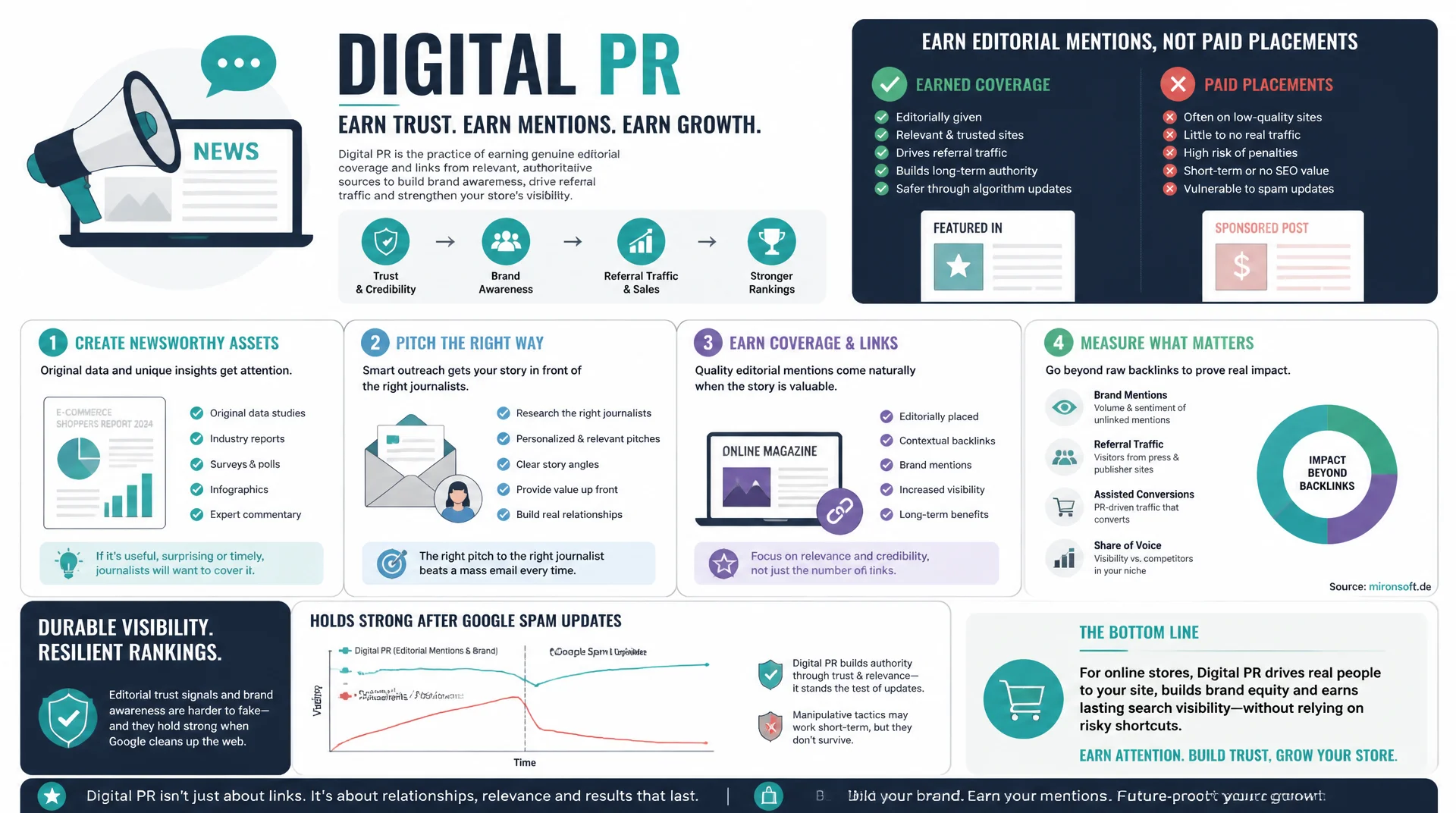
Sustainable backlinks through genuine editorial relevance
Digital PR combines press work with link building and earns online stores genuine editorial mentions instead of purchased placements on dubious press portals. Those who develop newsworthy data studies, approach journalists with a targeted pitch on a matching topic, and measure success beyond raw backlinks, tracking brand awareness and referral traffic, gain durable visibility and resilient rankings that hold up even after Google spam updates.
Table of Contents
- 1. Why digital PR is indispensable for online store link building
- 2. Digital PR fundamentals: newsworthy hooks instead of ad copy
- 3. Data studies as a link magnet: from idea to validated story
- 4. Expert commentary and journalist outreach in the HARO style
- 5. From idea to PR campaign: a process for online stores
- 6. Measuring digital PR ROI: more than just links
- 7. Tools and monitoring for brand mentions and share of voice
- 8. Pitfalls: avoiding low quality PR link building
- 9. Digital PR compared: low quality tactics vs. genuine digital PR
- 10. Summary
- 11. FAQ
1. Why digital PR is indispensable for online store link building
After several Google link spam updates, classic link building tactics such as article directories, purchased guest posts, or link exchange networks have become increasingly risky. Digital PR closes exactly this gap by generating genuine editorial attention: journalists link to a source because the content has its own news value, not because someone paid for it. For online stores, this means a strategic shift away from pure link buying toward content that gets picked up on its own merit. The key difference from classic public relations is that digital PR pursues an SEO goal from the outset and is planned accordingly, with keyword research, target pages, and a link attribute strategy.
For a specialist field such as e-commerce or Magento development, this approach is especially effective, because trade media are constantly looking for solid market data. A Magento service provider like Mironsoft, for example, can distill its own performance data from client projects into a study and get cited in trade publications instead of landing in generic directories. The resulting links come from topically relevant domains with real traffic, which improves both rankings and direct reach.
2. Digital PR fundamentals: newsworthy hooks instead of ad copy
At the core of digital PR is the newsworthy hook: an angle that has its own news value from an editor's point of view, independent of who sent it. Classic promotional copy almost always fails with journalists because it is irrelevant to the editorial audience. A hook works if it meets at least one of four criteria: timeliness tied to an ongoing industry topic, surprising or counterintuitive data, a tangible human angle, or a clear seasonal occasion.
For online stores, these hooks can usually be derived from their own operational data: ordering behavior, return rates, load times, or price trends provide raw material that no competitor holds in this exact form. The key is translating this raw data into a single, clearly communicable core statement that an editor can summarize in a headline. A hook such as "return rate in the German fashion trade rises to X percent" works with editors, while a generic announcement of a new product almost never does.
3. Data studies as a link magnet: from idea to validated story
A solid data study starts with a clear research question, not with a finished headline. Useful data sources for online stores include a company's own analytics and transaction data, anonymized customer surveys, publicly available industry data, or a combination of several sources for validation. Transparent methodology is essential: sample size, collection period, and calculation method should be communicated openly, otherwise journalists and readers lose trust in the numbers as soon as they ask questions.
For a study to remain citable and generate links over the long term, the results page should be set up as a standalone, permanently accessible URL, not a temporary campaign page. Structured data of type Dataset additionally makes the study machine readable for search engines and data aggregators and increases the chance of a rich snippet display. Visualizations such as bar charts or heatmaps make it much easier for editors to pick up the content, because ready made graphics rarely need to be recreated.
{
  "@context": "https://schema.org",
  "@type": "Dataset",
  "name": "Load Time Study: 500 German Online Stores in a Performance Comparison",
  "description": "Original survey of Core Web Vitals data from 500 German online stores, June 2026.",
  "creator": { "@type": "Organization", "name": "Mironsoft", "url": "https://mironsoft.de" },
  "datePublished": "2026-06-15",
  "license": "https://creativecommons.org/licenses/by/4.0/",
  "distribution": {
    "@type": "DataDownload",
    "encodingFormat": "CSV",
    "contentUrl": "https://mironsoft.de/studien/ladezeiten-2026.csv"
  },
  "variableMeasured": ["LCP", "INP", "CLS", "TTFB"],
  "citation": "https://mironsoft.de/blog/ladezeiten-studie-2026"
}
4. Expert commentary and journalist outreach in the HARO style
Besides original data studies, answering concrete journalist requests is the second core pillar of digital PR. Platforms such as Qwoted, JournoRequests, or Featured have taken over the role of the now discontinued HARO service and bundle daily requests from journalists on specific topics. Anyone who responds as an e-commerce or Magento development expert quickly, concretely, and with a usable quote regularly ends up in trade articles with a backlink to their own domain.
The success rate depends heavily on pitch quality: a personalized pitch that references a specific, recently published article by the journalist and delivers a concise, immediately usable quote has a significantly higher response rate than a generic mass email. Response times under 24 hours are decisive for most press requests, because journalists work under tight editorial deadlines and the first suitable answer often gets picked.
#!/usr/bin/env bash
# Personalized journalist pitch template for a data-driven PR story
# Placeholders are filled in by the outreach tool before sending

SUBJECT="New study: ${HOOK_STAT} based on ${SAMPLE_SIZE} online stores"

read -r -d '' BODY << 'EOF'
Hi ${FIRST_NAME},

I saw that you recently wrote about ${BEAT_TOPIC}.
We just finished a study of ${SAMPLE_SIZE} German online stores
and found a result that fits your beat:
${HOOK_STAT}.

I'm happy to share the full raw data, a chart package, and
a short statement from our analyst if that is relevant for
an article.

Best regards,
${SENDER_NAME}
EOF

echo "$SUBJECT"
echo "$BODY"
5. From idea to PR campaign: a process for online stores
A structured digital PR campaign typically runs through four phases: idea generation based on existing data and trends, preparation as a study or story with visualizations, building a target media list of five to ten suitable outlets, and finally the actual outreach with individualized pitches. This order prevents the most common problem in generic PR campaigns: finished content that ends up without a matching audience.
An often underestimated lever is the technical distribution of the study through an embeddable widget that partner sites can integrate directly into their article. Such embed snippets usually include an automatic source attribution with a backlink, which lets even editors without their own design resources pick up the study without extra effort. This considerably extends reach beyond the initial outreach list, because secondary sources spread the content on their own.
<!-- Embeddable widget: partner sites embed this snippet and it links back automatically -->
<div id="mironsoft-study-widget" data-study="ladezeiten-2026"></div>
<script defer src="https://mironsoft.de/embed/study-widget.js"></script>
<noscript>
  <a href="https://mironsoft.de/blog/ladezeiten-studie-2026">
    Source: Mironsoft Load Time Study 2026
  </a>
</noscript>

<!-- Attribution link included in the rendered widget markup -->
<p class="mironsoft-attribution">
  Data: <a href="https://mironsoft.de/blog/ladezeiten-studie-2026" rel="noopener">Mironsoft Load Time Study 2026</a>
</p>
6. Measuring digital PR ROI: more than just links
Anyone who measures digital PR solely by the number of backlinks earned significantly underestimates the real value of the discipline. Referral traffic from press placements can be attributed precisely to a single campaign through consistent UTM tracking, and it shows which publications actually deliver visitors rather than just a link. In addition, the development of search volume for the brand name after a larger campaign provides solid evidence of increased awareness, even if it does not show up as direct traffic.
Two further metrics belong in every digital PR report: unlinked brand mentions, which can be captured with monitoring tools and often converted into links afterward, and share of voice compared to direct competitors within the same topics. A store that is mentioned more often than the competition on a given trade topic builds an authority position that, over the long term, also shows up in rankings, recommendations, and purchase decisions.
// Build a UTM-tagged URL for outreach and press placements
function buildPrLink(baseUrl, source, campaign) {
  const url = new URL(baseUrl);
  url.searchParams.set('utm_source', source);
  url.searchParams.set('utm_medium', 'digital_pr');
  url.searchParams.set('utm_campaign', campaign);
  return url.toString();
}

// Example: link handed to a trade publication
const pressLink = buildPrLink(
  'https://mironsoft.de/blog/ladezeiten-studie-2026',
  't3n',
  'ladezeiten_studie_2026'
);

// Track referral sessions from PR placements in GA4
window.addEventListener('load', () => {
  const params = new URLSearchParams(window.location.search);
  if (params.get('utm_medium') === 'digital_pr') {
    gtag('event', 'pr_referral_visit', {
      utm_source: params.get('utm_source'),
      utm_campaign: params.get('utm_campaign')
    });
  }
});
7. Tools and monitoring for brand mentions and share of voice
A solid monitoring setup combines several types of tools: free baseline coverage through Google Alerts for the brand itself and key campaign terms, dedicated mention tracking tools like Mention or Brand24 for real time notifications including social media mentions, and SEO suites such as Ahrefs or Sistrix to analyze newly created backlinks and their domain authority. None of these tools covers every aspect on its own, which is why a combination proves effective in practice.
For share of voice analysis, a recurring quarterly export of mention counts for the brand and two or three direct competitors, always referenced to the same core topics, is worthwhile. This figure reveals whether a digital PR campaign is actually gaining share of media attention or whether competitors remain more visible despite the store's own activity. Automated feeds significantly reduce manual research effort.
<!-- Brand mention monitoring: feed configuration for tracked query terms -->
<monitoring>
    <query term="Mironsoft" match="brand" />
    <query term=""Ladezeiten-Studie 2026"" match="phrase" />
    <query term="mironsoft.de" match="domain" exclude-self="true" />
    <feed format="rss" delivery="daily-digest" />
    <alert channel="slack" webhook="https://hooks.example.com/mention-alerts" />
</monitoring>
8. Pitfalls: avoiding low quality PR link building
Not every activity labeled PR is genuine digital PR. Paid press portals without editorial review, where every submitted release gets published unchanged, mostly generate no-follow links with no meaningful SEO or reach value. If such portals are used in large numbers at the same time, an unnatural link pattern also emerges, one that Google's link spam systems can detect and devalue.
A second common problem is off topic mass syndication: a press release gets published on hundreds of portals that have no topical connection whatsoever, purely to increase link count. Such links visibly do not stem from organic editorial interest and contribute little to a domain's authority. As a rule of thumb, every PR activity should make sense even without an SEO goal, because it reaches real readers or viewers. If that is not the case, it is disguised link building rather than digital PR.
9. Digital PR compared: low quality tactics vs. genuine digital PR
The following overview contrasts risky PR link building tactics with the principles of a sustainable digital PR strategy and shows why the difference is decisive for rankings and brand building.
| Criterion | Low Quality Tactic | Genuine Digital PR | Consequence |
|---|---|---|---|
| Link source | Paid press portals without editorial review | Journalists and outlets with topical relevance | Determines SEO value and trust signal |
| Content | Generic press release with keyword anchor | Original data study with proprietary research | Determines citability and pickup rate |
| Distribution | Mass syndication across off topic portals | Targeted pitches to five to ten suitable outlets | Affects relevance and link profile naturalness |
| Success measurement | Link count and Domain Rating only | Referral traffic, brand mentions, share of voice | Shows real business value instead of a vanity metric |
| SEO risk | Unnatural link patterns, penalty risk | Organic, diversified link profile | Determines the sustainability of rankings |
In practice, the traits of genuine digital PR reinforce each other: an original data study simultaneously generates high quality links, brand mentions, and referral traffic, while low quality tactics rarely deliver more than one isolated, weak metric.
Mironsoft
Digital PR and sustainable link building for online stores
Ready for sustainable link building through genuine digital PR?
We develop newsworthy data studies from your store data, handle journalist outreach, and measure success through referral traffic, brand mentions, and share of voice, not just link count.
Data study development
From raw data analysis to a citable, structured study page
Journalist outreach
Target media research, personalized pitches, and HARO style request responses
PR success measurement
UTM tracking, brand mention monitoring, and share of voice reporting
10. Summary
Digital PR as a link building strategy solves a central problem of classic link building tactics: after several Google link spam updates, purchased placements and mass syndication have become risky, while genuine editorial mentions retain their value. Newsworthy data studies with transparent methodology, complemented by targeted journalist outreach in the HARO style, produce links that arise from real editorial interest and are therefore significantly more resilient against future algorithm updates.
The decisive difference between effective and ineffective digital PR lies in success measurement: anyone who only counts links overlooks most of the actual value. Referral traffic, brand mentions, and share of voice show whether a campaign is truly gaining a share of visibility. Consistent monitoring and a clear line against low quality tactics such as off topic syndication ensure that digital PR remains a sustainable investment instead of a short term risk.
Digital PR as a Link Building Strategy - The Essentials at a Glance
Newsworthy hooks
Timeliness, surprising data, a human angle, or seasonality instead of pure promotional messaging.
Data studies
Original Dataset research with transparent methodology produces the strongest, most durable backlinks.
ROI beyond links
Referral traffic, brand mentions, and share of voice show the real campaign value.
Avoiding low quality
Paid press portals and off topic syndication without editorial value risk penalties.