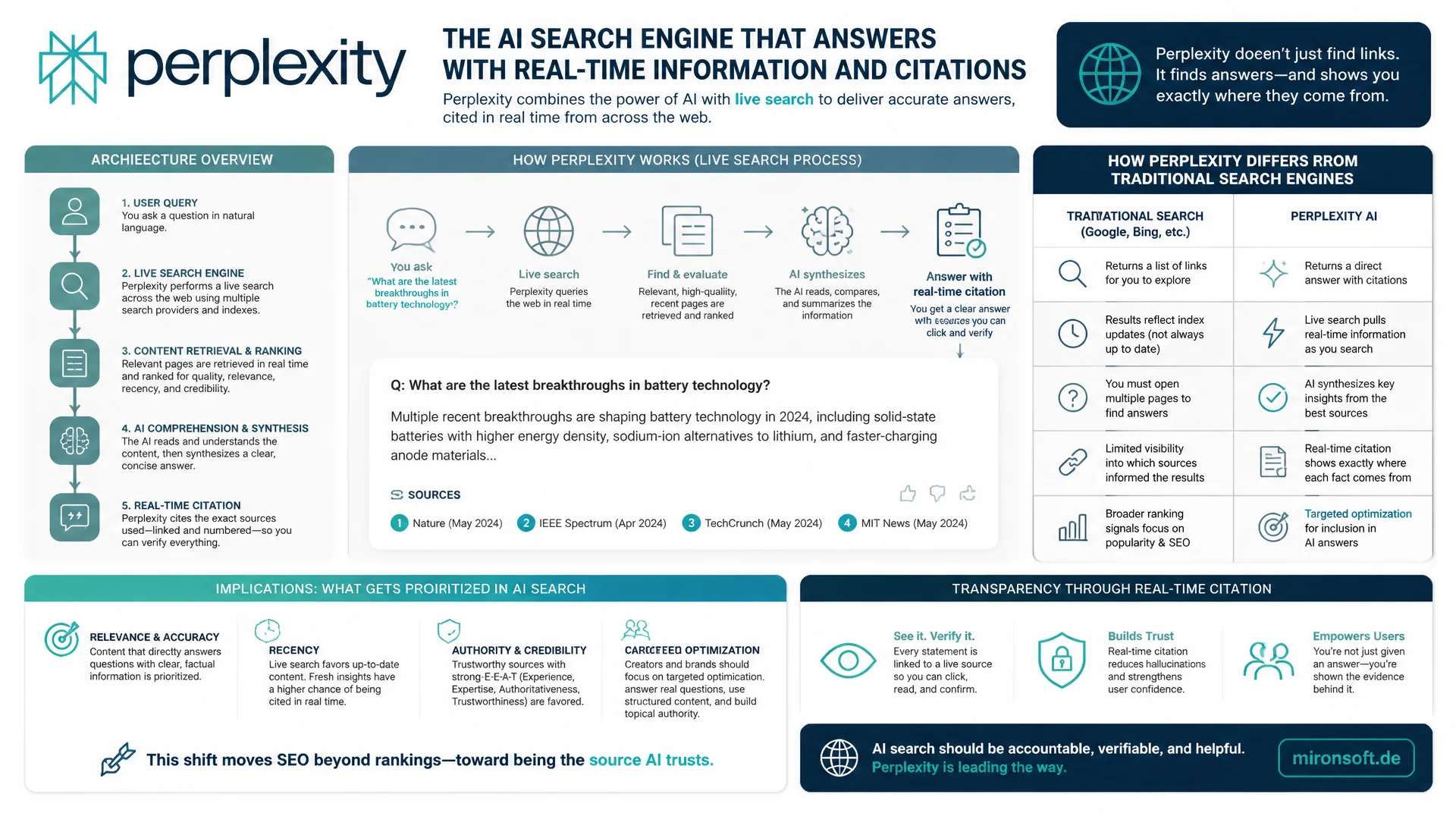
real-time retrieval instead of an index cache
Perplexity does not answer queries from a classic, pre-crawled index, it runs a live web search for almost every query and reads the most relevant pages in real time. This architecture fundamentally changes which content gets cited preferentially, and makes Perplexity one of the technically more transparent AI search engines for targeted optimization.
Table of contents
- 1. What Perplexity does differently as an AI search engine
- 2. The retrieval architecture behind Perplexity
- 3. PerplexityBot and crawl behavior
- 4. How Perplexity scores and weighs sources
- 5. Content formats Perplexity prefers to cite
- 6. Perplexity Pro, focus modes and Deep Research
- 7. Technical setup for PerplexityBot
- 8. Measuring visibility on Perplexity
- 9. Perplexity compared to Google
- 10. Summary
- 11. FAQ
1. What Perplexity does differently as an AI search engine
Perplexity explicitly positions itself as an "answer engine," not a classic search engine in the style of Google. Instead of a results list, Perplexity delivers a directly formulated answer for every query, complete with source references that typically number three to ten numbered citations, noticeably more than what is common for ChatGPT search. This higher citation count per answer is a structural difference that changes the competitive dynamic: more websites can be cited simultaneously for the same query, which lowers the entry barrier compared to systems with only two to three citations.
Founded in 2022, Perplexity has established itself as a standalone product, used through its own web interface, as a default browser search engine, or through API integration. Unlike Google or Bing, Perplexity deliberately forgoes classic advertising in search results, which shifts the business model more toward subscriptions and API usage and indirectly influences the selection logic too, since no commercial ad slots compete with organic citations.
A central distinguishing feature is the transparency of the research process: Perplexity visibly shows in many cases which sources are currently being searched before the final answer appears. This transparency makes it easier for website operators to understand why a page was or was not cited, an advantage over systems whose internal weighting stays fully hidden.
2. The retrieval architecture behind Perplexity
The technical foundation of Perplexity is a hybrid retrieval system that draws on both its own continuously updated index and live search queries through partner search engines. For most queries, Perplexity triggers a series of sub-queries, comparable to several parallel Google searches on sub-aspects of the original question, and then merges the results into a coherent answer. This mechanism explains why Perplexity often feels more current than pure RAG systems with a static index: a substantial part of the research effectively happens live at query time.
For scoring individual text passages, Perplexity also relies on embedding-based semantic similarity, combined with classic relevance signals such as domain trustworthiness and content freshness. An important difference from purely static RAG systems: because Perplexity actually crawls in real time for many queries instead of only consulting a pre-built index, even very new content only a few hours old can, under favorable circumstances, already get cited, provided the page is technically fast to reach and delivers clean HTML.
{
  "query": "How does Perplexity differ from Google?",
  "sub_queries_generated": [
    "Perplexity answer model how it works",
    "Perplexity number of citations per answer",
    "Perplexity vs Google search results difference"
  ],
  "sources_evaluated": 24,
  "sources_cited": 7,
  "retrieval_mode": "hybrid_live_plus_index",
  "note": "Illustrative structure, not a real API output format"
}
3. PerplexityBot and crawl behavior
PerplexityBot is the primary crawler Perplexity uses to build its own search index, and it can be controlled separately in robots.txt. Alongside it, Perplexity runs a second user agent, Perplexity-User, for real-time access triggered during a specific user query, similar to the ChatGPT-User pattern at OpenAI. Websites that block PerplexityBot but allow Perplexity-User can partly remain citable regardless, because individual queries can be fetched live, though with lower reliability than full crawl access.
Reports from several publishers have in the past shown that Perplexity in individual cases processed content even when PerplexityBot was explicitly blocked in robots.txt, which led to public criticism and subsequent adjustments to Perplexity's crawling practice. For website operators this means: robots.txt configuration remains important, but should be supplemented with technical access controls such as IP-based filtering when an exclusion must be enforced strictly.
4. How Perplexity scores and weighs sources
Beyond semantic match, a domain trust score flows into source selection on Perplexity, based among other things on established signals such as backlink profile, traffic volume and mentions on other trustworthy websites. Unlike purely passage-based systems, the overall domain's reputation plays a comparatively larger role on Perplexity, which tends to favor established media, trade publications and known brands over new, still unknown domains with excellent but not yet externally linked content.
At the same time, practice shows that well-structured, current content from smaller domains gets cited regularly too, especially for very specific, narrow questions where large publishers do not deliver a sufficiently precise answer. A niche blog with a detailed, up-to-date technical guide can get cited more often on Perplexity than a generally worded page from a large publisher, if the query is phrased very specifically and the niche blog delivers the more precise, more current answer.
<!-- Structure Perplexity tends to favor: precise, dated, sourced -->
<article>
  <p class="meta">Updated on July 20, 2026 by Author XY,
     10 years of experience in GEO</p>
  <h2>How many sources does Perplexity cite per answer?</h2>
  <p>
    Perplexity typically cites three to ten sources per answer,
    depending on the selected mode. The standard mode shows five
    to seven citations on average, Pro mode with extended
    retrieval often more.
  </p>
</article>
5. Content formats Perplexity prefers to cite
Analyses of citation patterns on Perplexity show a clear preference for content with explicit date stamps, numbered facts and clearly organized comparison structures. Unlike Google, where long, comprehensive guide articles often rank well, Perplexity tends to favor more compact, precisely worded sections that answer a question directly without much detour. Long introductions before the actual answer tend to have a negative effect on citation probability on Perplexity.
Comparison tables get extracted particularly often by Perplexity and reproduced as their own table in generated answers, provided the source table is implemented cleanly with HTML <table> elements instead of pure image or PDF representations. Numbered lists with concrete figures, such as "The five most important differences," also get cited disproportionately often, because they can easily be carried over into a structured answer without the model needing to rephrase or restructure the content itself.
6. Perplexity Pro, focus modes and Deep Research
Perplexity offers different search modes that each draw on different source pools and research scope. The "Academic" focus mode restricts search to scientific publications and preprint servers, while "Writing" deliberately skips web search and answers purely from model knowledge. The standard "Web" mode searches the open web broadly, while the "Deep Research" mode, available to Pro subscribers, evaluates noticeably more sources, sometimes over fifty pages per query, and generates a multi-page, more elaborate answer.
For GEO strategies, this mode diversity means: a website offering scientifically grounded content with study references additionally benefits from Academic mode, while practically oriented how-to content gets cited primarily in Web and Deep Research mode. Anyone serving both audiences should enrich content accordingly, for instance through references to primary studies alongside a practical, directly applicable presentation in the running text.
{
  "mode_comparison": [
    { "mode": "web", "sources_avg": 6, "response_length": "compact" },
    { "mode": "academic", "sources_avg": 9, "response_length": "compact" },
    { "mode": "deep_research", "sources_avg": 45, "response_length": "multi_page" }
  ],
  "note": "Illustrative comparison, not real Perplexity metrics"
}
7. Technical setup for PerplexityBot
The basic technical configuration resembles that of other AI crawlers: explicitly allow PerplexityBot in robots.txt, ensure clean, server-side rendered HTML output, and deliver fast response times. One detail that is particularly relevant for Perplexity: because a substantial share of queries get processed live at the moment of the user request, downtime periods or temporary server errors affect citability more immediately than in systems with purely index-based retrieval, where a once-successfully-crawled state stays in cache longer.
# robots.txt: allow the Perplexity crawlers explicitly
User-agent: PerplexityBot
Allow: /

User-agent: Perplexity-User
Allow: /

Sitemap: https://mironsoft.de/sitemap.xml

<!-- Structured data helps Perplexity classify content type -->
<script type="application/ld+json">
{
  "@context": "https://schema.org",
  "@type": "Article",
  "headline": "Optimizing for Perplexity as an AI search engine",
  "datePublished": "2026-07-23",
  "dateModified": "2026-07-23"
}
</script>
8. Measuring visibility on Perplexity
Perplexity offers, through its own API and publisher programs, some direct insight into citation frequency, which makes Perplexity more transparent for larger publishers than other AI search systems. For most websites, though, manual or tool-assisted sample checking remains the standard approach: relevant questions get asked regularly across all three modes, Web, Academic and Deep Research, and it gets documented in which mode and with which phrasing your own domain gets cited.
Server log analysis of PerplexityBot and Perplexity-User visits adds a technical signal for crawl frequency, while referral traffic from perplexity.ai in Google Analytics or comparable tools reflects the actual click rate from Perplexity's generated answers. A rise in referral traffic alongside a stable crawl frequency counts as a strong indicator of growing citation frequency.
// Filter server logs for PerplexityBot and Perplexity-User visits
const fs = require('fs');
const readline = require('readline');

async function trackPerplexityCrawlers(logFilePath) {
  const hits = { PerplexityBot: 0, 'Perplexity-User': 0 };
  const rl = readline.createInterface({ input: fs.createReadStream(logFilePath) });

  for await (const line of rl) {
    if (line.includes('PerplexityBot')) hits.PerplexityBot += 1;
    if (line.includes('Perplexity-User')) hits['Perplexity-User'] += 1;
  }
  return hits;
}

trackPerplexityCrawlers('/var/log/nginx/access.log').then(console.log);
// { PerplexityBot: 276, 'Perplexity-User': 152 }
9. Perplexity compared to Google
The table below sets out the most important structural differences between optimizing for Perplexity and classic Google SEO.
| Trait | Google SEO | Perplexity |
|---|---|---|
| Retrieval timing | Pre-crawled index | Often live crawl at query time |
| Number of citations | 10 organic results per page | 3 to 10 citations, mode-dependent |
| Advertising | Paid ads ahead of organic results | Deliberately no classic search ads |
| Special modes | One unified search index | Academic, Writing, Web, Deep Research |
| Source transparency | Position in results list visible | Research process partly visible live |
| Reaction speed | Weeks to months until effect | Partly measurable instantly with live retrieval |
The comparison shows: Perplexity behaves structurally closer to a research assistant than a classic search engine. Anyone optimizing for Perplexity should therefore rely less on pure ranking signals and more on freshness, precise phrasing and technical reachability at the moment of the query.
Another practical difference concerns update speed: while a change to Google rankings often takes weeks to months to show, a structural improvement to a page on Perplexity can, thanks to the live retrieval share, in theory take effect as soon as the next query. That allows faster test cycles, but also requires documenting changes carefully to trace effect back to cause later on.
Mironsoft
GEO optimization specifically for Perplexity and live retrieval systems
Want to get cited on Perplexity on a regular basis?
We set up PerplexityBot access correctly, structure content for precise live-retrieval extraction, and build comparison tables and dated expert content that stays citable across all Perplexity modes.
Technical setup
Optimize PerplexityBot access, load time and reachability
Citable structure
Dated, precise paragraphs and clean comparison tables
Mode coverage
Enrich content for Web, Academic and Deep Research mode
10. Summary
Perplexity differs from classic search engines and partly from other AI search systems through its hybrid, often real-time retrieval, its higher citation count per answer, and its specialized search modes for academic, practical and deeply researched queries. This architecture favors current, precise and dated content more strongly than purely index-based systems, because part of the evaluation actually happens at query time.
For website operators, optimizing for Perplexity primarily means: integrate PerplexityBot technically correctly, deliver short and precise answer paragraphs with date stamps, use clean HTML tables for comparisons, and, depending on the audience, also provide scientifically grounded content with primary sources to gain additional visibility in Academic mode.
Optimizing Perplexity: the essentials at a glance
Understand live retrieval
A substantial share of queries get crawled live at query time, not only pulled from a static index.
More citation slots
Three to ten citations per answer, noticeably more than typical for other AI search systems.
Favor the right format
Compact, dated paragraphs and clean HTML tables instead of long introductions.
Cover all modes
Academic, Web and Deep Research draw on different source pools, enrich content accordingly.