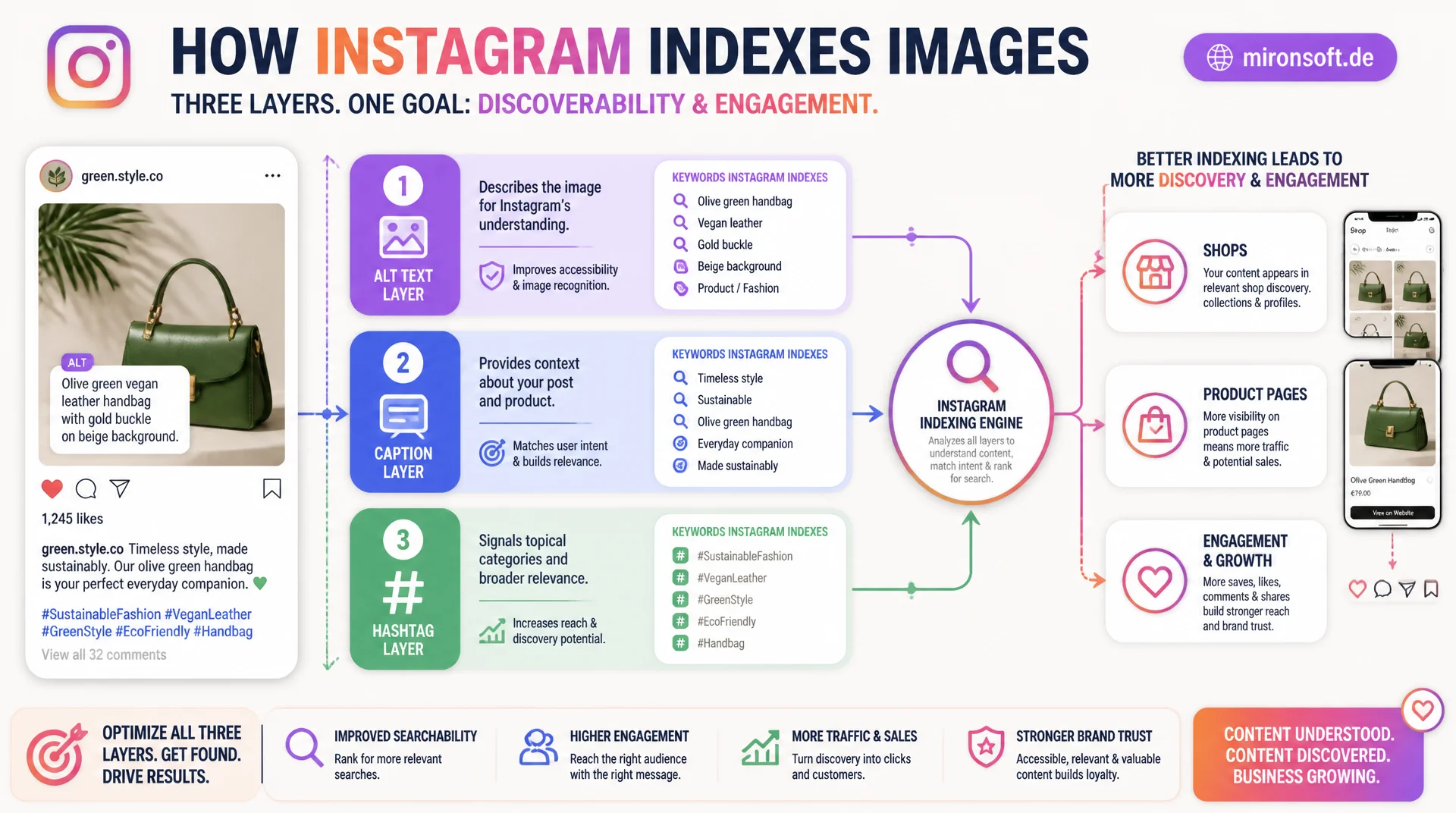
used correctly for more organic reach
Instagram now indexes images through several text sources at once: alt text, caption and hashtags. Brands that fill these three layers deliberately instead of automatically get found more reliably through both internal search and the Explore tab, and can route visitors more precisely toward shop and product pages.
Table of contents
- 1. Instagram as a visual search engine: context
- 2. How Instagram's internal search actually works
- 3. Alt text: purpose, best practice and SEO impact
- 4. Auto-generated versus manual alt text
- 5. Hashtag strategy 2026 on Instagram
- 6. Captions and keywords in body text
- 7. The Explore tab and the recommendation algorithm
- 8. Linking from Instagram to shop and product pages
- 9. Instagram SEO compared to Google image search
- 10. Summary
- 11. FAQ
1. Instagram as a visual search engine: context
Instagram has evolved from a pure photo app into a visual search engine with its own indexing logic. Instagram SEO describes the deliberate optimization of alt text, caption and hashtags so posts get found through both the internal search bar and the algorithmic Explore tab. Unlike TikTok, Instagram places a stronger emphasis on static images and carousel posts, which makes the text layers around a single image even more important.
For brands running their own online shop, Instagram SEO matters because product discovery increasingly happens directly in the feed or the Explore tab, often long before a user ever runs a Google search. A product image without clean alt text and without a precise caption loses twice: it is inaccessible to screen reader users, and it gives Instagram's systems less usable context for surfacing it to an interested audience.
An important nuance: Instagram SEO is not a replacement for classic product page SEO, it is an upstream discovery channel. Companies that work precisely here improve not only reach on the platform itself, but also the quality of traffic that gets forwarded from there to their own website.
2. How Instagram's internal search actually works
The Instagram search bar matches typed terms against several text fields: the account name, the username, the caption, the alt text and the hashtags used. Unlike the feed's pure recommendation algorithm, this is a genuine text search with relevance scoring, similar to TikTok. For Instagram SEO this means: a product name or industry term that appears in neither the caption nor the alt text is practically unfindable through search, even if the image content itself matches.
The search suggestions Instagram shows while typing are based on actual search behavior and give a solid first orientation for relevant terms among the target audience. The Reels tab additionally shows its own search surface with sometimes different trending terms, which is why a thorough Instagram SEO research process should cover both areas instead of relying on just one.
3. Alt text: purpose, best practice and SEO impact
Alt text was originally introduced purely for accessibility, to give screen readers a textual description of image content. For Instagram SEO, alt text today is additionally one of the most precise text sources, because unlike the caption it is not diluted by emojis, calls to action or brand phrasing, and is meant to deliver a factual description of the actual image content instead. Instagram uses this text both for internal search and for categorizing content in the Explore tab.
Good alt text describes concretely what is visible in the image, including relevant product details, instead of generic phrases like "photo" or "today's picture". The recommendation sits around 100 to 125 characters, long enough for context, short enough to avoid reading like a keyword list. Important: alt text should never contain plain hashtag chains, since that is useless for screen reader users and can be flagged by Instagram as a spam pattern.
<!-- Weak alt text: generic, no useful information -->
Alt text: "Photo"

<!-- Weak alt text: keyword stuffing disguised as description -->
Alt text: "Sneaker Shoes Fashion Style Outfit Streetwear Sale"

<!-- Strong alt text: factual, descriptive, product-relevant -->
Alt text: "White leather sneaker with blue sole, side view on a light wooden floor"
4. Auto-generated versus manual alt text
Instagram has generated automatic alt text via image recognition for years, visible under "Accessibility" in a post's advanced settings. For Instagram SEO, however, this automatic text is usually too generic: it recognizes broad categories such as "may contain shoes, indoor" but delivers no brand-specific or product-related details that would actually matter for search relevance.
Manual alt text can be set deliberately when publishing a post through "Advanced settings", independent of the visible caption. For companies with regular product content, a fixed editorial pattern pays off: product name, most important visual feature, context of the shot. Anyone posting through the Instagram Graph API can pass the custom alt text field directly at publish time, which integrates well into existing workflows for shops with high posting volume.
// Example: setting custom alt text when publishing via the Instagram Graph API
{
  "image_url": "https://cdn.example.com/products/sneaker-white-01.jpg",
  "caption": "The white leather sneaker for everyday wear. Now available in the shop.",
  "alt_text": "White leather sneaker with blue sole, side view on a light wooden floor",
  "access_token": "{{PAGE_ACCESS_TOKEN}}"
}
// Custom alt_text overrides Instagram's auto-generated description
Practical checklist: alt text for product images
- Alt text factually describes what is actually visible in the image
- Product name and most important visual feature are included
- Length falls within the 100 to 125 character range
- No plain hashtag or keyword chain
- Auto-generated alt text has been manually overridden
- Wording is meaningful and understandable for screen reader users
5. Hashtag strategy 2026 on Instagram
Hashtag logic on Instagram has shifted, similar to TikTok, from a pure reach tactic toward a more precise classification system. Instagram itself has explicitly recommended three to five precise hashtags instead of the previously common thirty for a few years now, because an excess of generic tags dilutes topical matching rather than sharpening it. For Instagram SEO the rule is: a hashtag with millions of unrelated posts delivers less than a specific niche hashtag with a few thousand topically relevant posts.
A solid structure combines a category hashtag, a product-specific hashtag and a branded hashtag. Industry-specific community hashtags where the target audience actively organizes itself often deliver more qualified reach than broad trending hashtags. Hashtags placed in an account's bio also work as a permanent topical classification, independent of individual posts.
<!-- Weak: 20+ generic tags, no topical focus -->
#instagood #photooftheday #style #fashion #ootd #love #instadaily #picoftheday

<!-- Strong: layered hashtag mix for Instagram SEO -->
#WhiteLeatherSneaker  <!-- product-specific tag -->
#SustainableSneakers  <!-- niche community tag -->
#Mironsoft             <!-- branded tag -->

<!-- 3-5 precise tags outperform 20+ generic ones for search relevance -->
6. Captions and keywords in body text
The caption adds context and tone on top of alt text and hashtags, and should also weave in the relevant main keyword naturally, ideally in the first line that stays visible before the "see more" cutoff. For Instagram SEO, what matters is that caption and alt text complement rather than repeat each other: the alt text factually describes the image, the caption delivers story, value and a call to action.
Questions in the caption demonstrably raise the comment rate, an important engagement signal for surfacing in the feed and the Explore tab. A structure built from a keyword-bearing hook line, a short context paragraph and a clear call to action works just as reliably on Instagram as on other platforms, but it should be adapted to the image-heavy nature of the format and not read like a blog article.
7. The Explore tab and the recommendation algorithm
The Explore tab runs on its own recommendation model that uses a user's previous interactions with topically similar posts as its most important signal. For Instagram SEO it matters that engagement quality is what counts here: saves and shares weigh considerably more than plain likes, because they signal a stronger interest. An image that gets saved frequently into collections, for example as an inspiration source, receives additional distribution as a result, regardless of its original reach.
Consistent topical focus for an account over a longer period improves the odds of appearing in the Explore tab of the right audience, because Instagram's model categorizes accounts topically. An account that constantly switches between completely unrelated topics makes this categorization harder, indirectly diluting its own Instagram SEO performance as a result.
8. Linking from Instagram to shop and product pages
Instagram only allows clickable links in a limited way, which is why shop tags, the link in bio, and story links form the central bridges between Instagram SEO and actual website traffic. Product tags placed directly in the image let a product be opened in the shop from the feed with just a few clicks, without the detour through the bio description. For shops with a connected product catalog, this direct link is the most reliable conversion path out of Instagram.
Every link that leads out of Instagram should consistently carry UTM parameters, to distinguish organic feed posts, story links and paid campaigns from each other inside the web analytics tool. Without this separation, the actual effect of Instagram SEO on sales is hard to tell apart from general social traffic.
| Text source | Primary purpose | SEO impact | Recommendation |
|---|---|---|---|
| Alt text | Accessibility | Very high, factual and precise | Set manually, not automatically |
| Caption | Context, story, CTA | High, keyword in the first line | Write to complement the alt text |
| Hashtags | Topic classification | Medium, supportive | 3 to 5 precise tags |
| Location tag | Local discoverability | Medium, for local relevance | Use for stores and events |
| Product tag | Direct conversion | Low for search, high for traffic | Add UTM parameters |
Practical checklist: linking to the shop from Instagram
- Product tags are set on all relevant feed posts
- Link in bio points to a current, well-maintained landing page
- Every outbound link carries complete UTM parameters
- Story links are used consistently for time-limited promotions
- Web analytics cleanly separates Instagram traffic from other social channels
- The conversion path from click to purchase has been tested end to end
9. Instagram SEO compared to Google image search
Google image search and Instagram SEO share the same basic principle, that text surrounding an image determines its discoverability, but they differ in technical implementation. Google relies primarily on the HTML alt attribute, file names and surrounding page text, while Instagram treats alt text, caption and hashtags as separate, platform-internal signals that never carry over to an external search engine, unless a post is publicly indexable and gets picked up separately by Google.
For brands with an e-commerce focus this means: maintaining both systems in parallel pays off, because they reach different audiences at different points in the buying journey. A product image deserves both clean alt text on its own product page for Google, and independently written alt text on Instagram, adapted to the search language used there by the target audience.
Mironsoft
Instagram visibility, alt text workflows and shop linking
Instagram posts that get found and convert?
We set up alt text workflows for your product content, build a lean hashtag structure, and connect shop tags with clean UTM tracking so Instagram SEO shows up in real sales.
Alt text audit
Review existing posts and build an editorial pattern for new product images
Hashtag structure
Precise category, niche and branded hashtags instead of generic tag lists
Shop linking
Product tags and UTM structure for measurable traffic from Instagram
10. Summary
Instagram SEO rests on three complementary text sources: alt text as a factual image description, caption as context and call to action, hashtags as topical classification. Auto-generated alt text is almost always too generic for targeted search, which is why setting it manually through advanced settings or the Graph API delivers the biggest effect.
Three to five precise hashtags outperform broad tag lists, and every link leaving Instagram should consistently carry UTM parameters, to make the actual effect of Instagram SEO on shop sales visible. Maintaining these three layers consistently improves accessibility, discoverability and the quality of traffic arriving from Instagram at the same time.
Instagram alt text and hashtags: the essentials at a glance
Set alt text manually
Auto-generated alt text is too generic. Override it precisely through "Advanced settings" or the Graph API.
Fewer, more precise hashtags
3 to 5 specific hashtags instead of 30 generic tags. Combine category, niche and brand.
Separate alt text and caption
Alt text describes the image factually, caption delivers context and a call to action, without repeating each other.
Track links consistently
Tag every link from Instagram with UTM parameters to make Instagram SEO effects measurable.