from click-through rate to multi-source synthesis
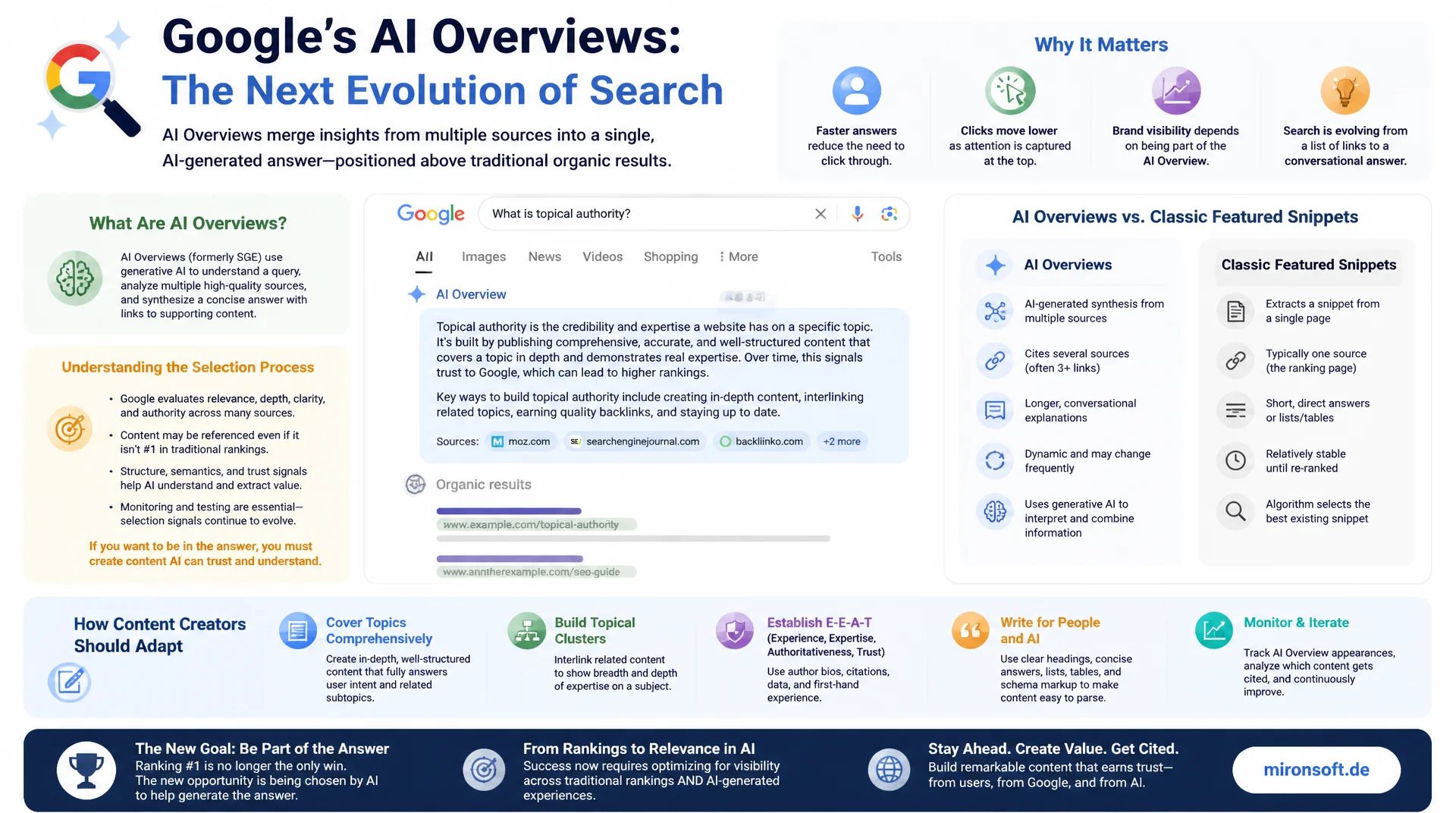
Google AI Overviews merge several sources into a generated answer above the classic organic results, changing how users interact with Google search. Anyone who understands how Google selects content for these summaries and how the structure differs from classic featured snippets can adapt their content strategy on purpose, instead of optimizing only for classic ranking.
Table of contents
- 1. What Google AI Overviews technically are
- 2. How Google selects content for AI Overviews
- 3. Difference from classic featured snippets
- 4. Content structure that favors AI Overviews
- 5. The multi-source synthesis principle
- 6. Which queries trigger AI Overviews
- 7. The traffic effect: zero-click and what remains
- 8. Monitoring appearances in AI Overviews
- 9. AI Overviews compared to the classic SERP
- 10. Summary
- 11. FAQ
1. What Google AI Overviews technically are
Google AI Overviews are AI-generated summaries Google shows above the classic organic search results when a query, in the system's judgment, benefits from a synthesized answer. The feature builds on an evolution of the Gemini model combined with Google's classic search infrastructure, and was rolled out in 2024 after a longer test phase as the Search Generative Experience, first in the US and later internationally. Google AI Overviews now appear for a substantial share of informational queries and have become a fixed part of the Google results page.
Technically, the system combines several sources into a single, coherent answer instead of showing just one text excerpt from one page like a featured snippet. This multi-source synthesis is the most important structural difference from all previous SERP features and means several websites can contribute to an answer simultaneously, even when none of them alone delivers the complete answer.
Google AI Overviews usually show four to eight source references as small cards below or beside the generated text, linking to their respective origin pages. This linking distinguishes Google AI Overviews from pure zero-click answers, since at least the theoretical possibility of a click remains, even though the actual click-through rate demonstrably comes in lower than for classic organic results.
For some queries, Google additionally offers an expanded, collapsible view of the Google AI Overview with more depth and additional source references that users have to actively open. This expanded view often delivers a larger pool of cited sources than the initially visible, compact summary, which represents an additional, if less prominent, visibility opportunity for website operators.
2. How Google selects content for AI Overviews
The selection process for Google AI Overviews starts with the same index used for classic organic results. Google does not draw on a separate dataset, it uses already crawled and scored pages from the regular search index. That is why a solid classic SEO foundation, crawlability, technical cleanliness and topical relevance, remains the basic requirement for even being a candidate for a Google AI Overview in the first place.
From the pool of topically relevant pages, the generative system then selects the passages that combine best into a coherent answer. In doing so, Google demonstrably favors content that already exists in well-structured form, for instance with clear paragraphs, lists and tables, because that structure technically eases automated extraction and merging of multiple sources. Unstructured prose with many subordinate clauses gets pulled into Google AI Overviews less often, even when the information it contains is correct and relevant.
Regionally, the rollout of Google AI Overviews has proceeded at different speeds: while the US and UK have had broad coverage since 2024, rollout in Germany and other European markets followed somewhat later, partly due to regulatory scrutiny in the context of the Digital Markets Act. Website operators in German-speaking markets should therefore check whether and to what extent Google AI Overviews are already active for their relevant keywords before investing significant resources in dedicated optimization.
{
  "query": "How do I structure content for AI Overviews",
  "eligible_sources": 18,
  "sources_synthesized": 5,
  "synthesis_type": "multi_source_summary",
  "structural_signals": {
    "has_clear_headings": true,
    "has_lists_or_tables": true,
    "paragraph_avg_length_words": 42
  },
  "note": "Illustrative structure, not a real Google output format"
}
An additional selection factor, confirmed by Google representatives in several conference talks, is consistency of a statement across multiple independent, trustworthy sources. When a piece of information appears on only one single page but is not confirmed anywhere else on the web, the probability that it gets pulled into a Google AI Overview drops, even if the source is generally trustworthy. Google thereby reduces the risk of presenting an unconfirmed or outdated individual opinion as a generally valid answer.
3. Difference from classic featured snippets
Featured snippets, a fixed part of Google search since 2014, extract a single text excerpt from a single page and display it unchanged, usually complemented by the source's title and URL. This logic is comparatively easy to trace: a page with a clear, concise answer directly beneath the matching heading has good odds of being selected as a featured snippet. Optimizing for that has been established practice in classic SEO for years.
Google AI Overviews work fundamentally differently: the displayed text is not carried over unchanged from a source, it gets rephrased by the language model and synthesized from multiple sources. That means a page can contribute to the answer without its text appearing verbatim, which makes optimization harder to trace than for a classic snippet. At the same time it also means more websites can benefit from a single Google AI Overview at once, because competition is no longer binary as it is for a featured snippet, where only one page wins.
<!-- Featured Snippet: verbatim excerpt from ONE page -->
<p>GEO stands for Generative Engine Optimization, the optimization
   of content for generative AI systems.</p>

<!-- Google AI Overview: rephrased synthesis of SEVERAL pages -->
<!-- Rendered output (not controlled by any single site):
     "According to several sources, GEO refers to the deliberate
     adaptation of content for generative AI search systems such
     as ChatGPT search and Google AI Overviews, aiming to get
     cited as a source instead of just ranking." -->
4. Content structure that favors AI Overviews
The most important structural adaptation for Google AI Overviews is consistently using semantically unambiguous HTML elements. Headings should clearly name the core question, paragraphs should be compact and self-contained, and lists and tables should be used consistently for enumerable or comparable information instead of hiding it in prose. This structure makes it easier for the generative system to precisely extract individual facts and correctly attribute them alongside other sources without losing context.
A second important factor is clarity at the sentence level. Sentences with multiple possible interpretations or implicit context that only resolves from earlier paragraphs are harder to integrate correctly into a multi-source synthesis. Clear subject-predicate-object structures with explicit names instead of pronouns considerably increase the probability of accurate, unaltered reproduction in Google AI Overviews.
Structured data supports this process indirectly too: correct Article schema with author, date and main topic helps the system classify a page's context faster, even when the schema itself does not get carried directly into the generated answer. The combination of clean HTML, unambiguous sentences and complementary schema markup forms the basic technical toolkit for Google AI Overviews.
<!-- Explicit subject instead of pronoun, self-contained statement -->
<h3>How long does implementing a GEO strategy take?</h3>
<p>
  Implementing a GEO strategy for a mid-sized website with 100 to
  300 pages typically takes 6 to 10 weeks, split into content
  audit, technical setup and stepwise restructuring of the most
  important articles.
</p>
<ul>
  <li>Week 1 to 2: content audit and prioritization</li>
  <li>Week 3 to 4: technical setup (robots.txt, schema, llms.txt)</li>
  <li>Week 5 to 10: restructuring the top 50 articles</li>
</ul>
<!-- Article schema helps Google classify author, date and topic -->
<script type="application/ld+json">
{
  "@context": "https://schema.org",
  "@type": "Article",
  "headline": "Content strategy for Google AI Overviews",
  "datePublished": "2026-07-23"
}
</script>
5. The multi-source synthesis principle
Because Google AI Overviews combine several sources, it pays off to position your own content to fill a gap that other high-ranking sources leave open, instead of repeating already well-covered standard information. An article that precisely and well covers an additional, so far underexplored angle of a heavily covered topic has good odds of being pulled in as a complementary source for a Google AI Overview, even if the domain overall has less authority than the primary sources.
This logic differs considerably from classic SEO, where primarily the most comprehensive, best-optimized single page wins. For Google AI Overviews, a content strategy that deliberately covers niche angles, recent developments or specific use cases that established, comprehensive guide articles from competitors do not cover, or only cover superficially, pays off instead.
A practical method to identify such gaps is manually analyzing existing Google AI Overviews for your own target keywords: which sub-aspects are already covered by the displayed sources, and which obvious follow-up questions remain unanswered? These unanswered follow-up questions provide concrete starting points for new articles or additions to existing content.
6. Which queries trigger AI Overviews
Google AI Overviews appear disproportionately often for complex, multi-part questions, comparison queries and queries that require synthesizing multiple perspectives, for instance "pros and cons of X" or "how does A differ from B." Simple, transactional queries with clear commercial intent, for instance direct product searches, trigger a Google AI Overview noticeably less often, because Google prioritizes other SERP features like shopping results there.
Heavily local queries with a map reference also show Google AI Overviews less often, since the local pack feature dominates there. For content planning this means: topic pages with an explanatory, comparative or summarizing character should be prioritized for optimizing toward Google AI Overviews, while transactional product pages should stay primarily oriented toward classic organic rankings and shopping feeds.
A simple rule of thumb for prioritization: questions starting with "how," "why" or "what are the differences" trigger Google AI Overviews noticeably more often than questions with "buy," "order" or "lowest price." A look at your own domain's Search Console data, sorted by query phrasing, usually delivers a quick, reliable overview of your own optimization potential.
{
  "query_pattern_examples": [
    { "pattern": "how does X work", "ai_overview_likely": true },
    { "pattern": "X vs Y difference", "ai_overview_likely": true },
    { "pattern": "buy X cheap", "ai_overview_likely": false },
    { "pattern": "X near me", "ai_overview_likely": false }
  ],
  "note": "Illustrative classification, not a real Google signal export"
}
7. The traffic effect: zero-click and what remains
Several independent studies, including from analytics vendors like Similarweb and Ahrefs, show a measurable decline in click-through rate to the classic organic results beneath a visible Google AI Overview, sometimes in the double-digit percentage range. This effect is more pronounced for purely informational queries than for queries with clear transactional intent, where users still tend to click through to a concrete website to complete an action.
At the same time, early data shows that clicks that do occur despite a Google AI Overview tend to be higher quality: users who click through despite an existing summary often search specifically for deeper information and show, on average, longer dwell time and a lower bounce rate. For website operators this means a strategic re-evaluation: a pure traffic-volume focus loses importance in favor of visibility as a citation source and the quality of the remaining clicks.
To assess your own success, a combination of classic traffic metrics and new visibility metrics is advisable. A domain that appears more often as a source in Google AI Overviews while overall traffic declines is not necessarily losing relevance, it is shifting part of its impact into a channel that classic analytics tools so far capture only incompletely.
8. Monitoring appearances in AI Overviews
Google Search Console now offers differentiated reports that distinguish between classic organic impressions and impressions inside Google AI Overviews, so website operators can see directly for which queries their own domain appears as a summary source. This data should get evaluated regularly to spot patterns: which page types appear more often in Google AI Overviews, which query forms trigger the feature at all, and how does classic click-through rate for the same queries change over time.
Specialized SEO tools such as Semrush, Ahrefs or sistrix now complement this with dedicated AI Overview tracking modules that regularly check, for a defined set of keywords, whether and with which sources a Google AI Overview appears. These tools enable systematic monitoring across a larger query catalog than would be practical with manual sample checking.
A sensible monitoring cadence is a monthly evaluation of a domain's top fifty to a hundred keywords, combined with a deeper analysis whenever click-through rate for a specific keyword cluster shifts noticeably. That lets you spot early whether a declining click-through rate traces back to a newly appearing Google AI Overview or has other causes, such as a ranking loss or a shift in market search intent.
// Pull Search Console data and flag queries with declining CTR
// despite stable or improving average position (possible AI Overview effect)
async function flagPossibleAiOverviewImpact(rows) {
  return rows.filter((row) => {
    const ctrDropped = row.ctr < row.ctr_previous_period * 0.8;
    const positionStable = Math.abs(row.position - row.position_previous_period) < 1;
    return ctrDropped && positionStable;
  });
}
// Rows with dropped CTR but stable position often indicate
// a newly appearing Google AI Overview above the organic result
9. AI Overviews compared to the classic SERP
The table below sets out the most important differences between classic organic optimization and optimizing for Google AI Overviews.
| Trait | Classic organic SERP | Google AI Overviews |
|---|---|---|
| Text reproduction | Title and meta description unchanged | Rephrased from multiple sources |
| Competitive logic | One position per page, binary | Multiple sources contribute at once |
| Favored queries | All search intents | Complex, comparative, informational questions |
| Monitoring | Classic rank tracking | Search Console reports, AI Overview tracking tools |
| Click-through rate | Position-dependent baseline values | Lower, but partly higher quality |
| Content planning | Maximize a single page | Build content clusters with internal linking |
The comparison makes clear that Google AI Overviews are not simply an evolution of the featured snippet, they bring a structurally new competitive logic where multiple websites can benefit simultaneously, but overall classic click-through rate also declines.
For editorial teams this means a dual orientation in practice: content still needs to work for classic ranking, while also being structured granularly and unambiguously enough that individual facts remain cleanly extractable. This dual requirement is most efficiently solved through a shared editorial checklist that considers both target dimensions from the start, instead of running two separate optimization passes afterward.
A notable side effect concerns brand perception: even without a click, users see the domain name and possibly the favicon of the cited source directly inside the Google AI Overview. For established brands, this visible brand touchpoint can deliver value beyond pure click-through rate, similar to how brand mentions in classic media can build trust even without a direct link.
A practical side effect of multi-source synthesis concerns internal linking. A domain that publishes several topically related articles on sub-aspects of a larger topic and links them cleanly to each other increases the probability that several of its own pages contribute to the same Google AI Overview at once. This effect can be planned deliberately by building content clusters instead of isolated single articles.
Anyone who applies these principles consistently across multiple content cycles changes not only visibility in Google AI Overviews but usually also improves classic organic performance, because the required structure already matches the principles of good, user-oriented content design.
Mironsoft
Content strategy and monitoring for Google AI Overviews
Want to show up as a source inside Google AI Overviews?
We structure content for multi-source synthesis, identify niche angles with high pickup potential, and set up ongoing monitoring through Search Console and specialized tools.
Structure audit
Optimize headings, paragraphs and lists for extractability
Find content gaps
Identify niche angles missing from competitor articles
Monitoring setup
Set up Search Console analysis and AI Overview tracking
10. Summary
Google AI Overviews fundamentally change content strategy because they combine several sources into a rephrased answer instead of showing just one page unchanged like classic featured snippets. Clear headings, compact paragraphs, clean lists and tables, and unambiguous sentence structures without implicit references increase the probability of being pulled in as one of several sources for a Google AI Overview.
Because several websites can benefit from a Google AI Overview at once, a content strategy that deliberately fills gaps in established competitor guide articles, instead of repeating already well-covered standard information, pays off. Monitoring through Search Console and specialized AI Overview tracking tools increasingly replaces a pure focus on classic rank tracking.
Google AI Overviews: the essentials at a glance
Multi-source principle
Unlike featured snippets, AI Overviews combine multiple sources into a rephrased answer.
Structure matters
Clear headings, lists, tables and unambiguous sentences ease automated extraction.
Gaps over repetition
Cover niche angles that established competitor articles miss or only cover superficially.
Adapt monitoring
Search Console AI Overview reports and specialized tracking tools instead of pure rank tracking.