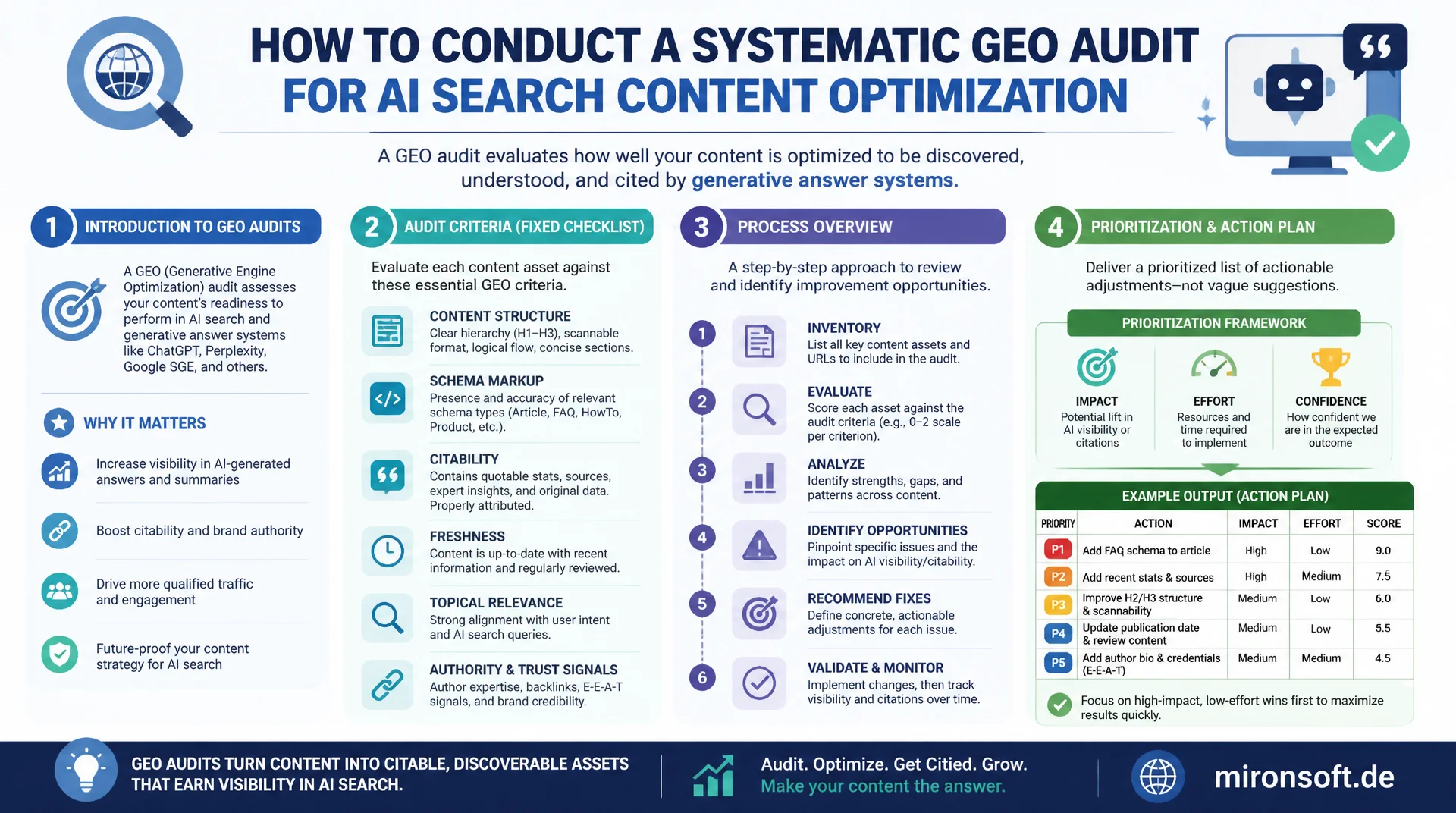
for AI Search Through a GEO Audit
Producing new content for AI search is expensive; sharpening existing pages in a targeted way is usually the faster and cheaper path to more visibility in generative answer systems. A systematic GEO audit reviews existing content against fixed criteria, structure, schema markup, citability and freshness, and delivers a prioritized list of concrete adjustments instead of a vague feeling that "something is missing."
Table of contents
- 1. Why a GEO audit pays off for existing content
- 2. Selecting the right pages for the audit
- 3. Structure check: headings, paragraphs, answer proximity
- 4. Systematically checking and adding schema markup
- 5. Citability: fact density and standalone clarity
- 6. Checking and surfacing freshness
- 7. Ensuring technical accessibility for crawlers
- 8. Prioritizing findings and moving to implementation
- 9. Establishing the audit as a recurring process
- 10. Summary
- 11. FAQ
1. Why a GEO audit pays off for existing content
Most companies with a grown content base already have hundreds or thousands of pages that are substantively relevant but were written long before generative search systems appeared. A GEO audit systematically checks that existing base for how well suited it is to AI search, instead of blanket producing new content on topics that are already covered. This approach is usually far more cost efficient, because the substantive foundation, research, subject knowledge, examples, already exists and only the presentation needs sharpening.
The second reason for a GEO audit is the fact that many existing pages already carry established backlinks, domain authority and classic search engine ranking, three factors that also remain relevant for generative search systems. A page that already ranks well but is structurally not optimized for AI search is closer to a citation than a brand new page that still has to build up those authority signals. A targeted GEO audit surfaces this unused potential.
A GEO audit differs from a classic SEO audit in the criteria it checks: instead of focusing primarily on keyword density, meta tags and backlink profiles, a GEO audit evaluates how extractable and citable individual text passages are for a language model. This shift in focus requires its own structured checklist, which gets built up step by step below.
2. Selecting the right pages for the audit
A complete GEO audit across an entire content base is rarely practical for larger domains. A prioritized selection is more sensible, guided by three criteria: existing visibility in classic search engines, topical relevance for questions potential customers would ask AI assistants, and the business value of the topic in question. Pages that meet all three criteria go first in the audit queue.
A practical selection method: cross-reference the results of a competitive analysis on AI citations against your own top landing pages from classic search. Pages that rank well on Google but never show up as a source in test queries on ChatGPT or Perplexity are ideal candidates for a GEO audit, because the gap between classic ranking and AI visibility is largest and easiest to close there.
#!/usr/bin/env bash
# audit-candidates.sh: cross-reference top organic landing pages with
# a manually maintained list of pages that never appear as AI citations

set -euo pipefail

readonly TOP_PAGES="top-organic-pages.txt"      # exported from analytics, one URL per line
readonly CITED_PAGES="known-ai-citations.txt"   # URLs observed as AI citations, one per line

echo "Pages ranking well but never seen as an AI citation:"
comm -23 <(sort "$TOP_PAGES") <(sort "$CITED_PAGES")
3. Structure check: headings, paragraphs, answer proximity
The first substantive check step of a GEO audit concerns text structure. For every target page you check: does the direct answer to the assumed user question sit close to the start of the relevant section, or does it get lost in a long introduction? Are headings concrete questions or statements, or generic labels like "Overview" and "Details"? Both factors substantially influence whether a language model can extract a passage in isolation.
A second aspect of the structure check is paragraph length and self-containment. Long, nested paragraphs that reference earlier text ("as explained above") don't extract well as a standalone answer. A GEO audit flags such passages for revision: shorter, self-contained paragraphs of at most three to four sentences considerably increase citability without the overall text losing subject matter depth.
The structure check also includes evaluating lists and tables. Content currently phrased as prose even though it actually represents an enumeration or comparison, "first X matters, second Y, and third Z" for example, should get converted into real HTML lists or tables as part of the GEO audit. This semantic structure is much easier for language models to process than embedded enumeration text.
4. Systematically checking and adding schema markup
Structured data is a central building block of every GEO audit, because it explicitly tells search systems what kind of content they're dealing with. The audit checks for every page whether schema markup exists at all, and if so, whether it's filled in correctly and completely. Common gaps: an article without datePublished and dateModified, an FAQ section without accompanying FAQPage schema, or a comparison article without structured product data.
Beyond the basics, it pays to check for more specific schema types that classify content more precisely: HowTo schema for guides, TechArticle for technical content, DefinedTerm for glossary entries. The more precisely the schema reflects the actual content type, the more clearly a language model can classify what the page is suited to serve as a source for.
<!-- GEO audit finding: missing FAQPage schema for an existing FAQ section -->
<!-- Before: FAQ content exists visually but has no structured markup -->
<div class="faq-section">
  <h3>How long does a migration take?</h3>
  <p>Typically 4 to 8 weeks, depending on data volume.</p>
</div>

<!-- After: same content, now paired with FAQPage schema -->
<script type="application/ld+json">
{
  "@context": "https://schema.org",
  "@type": "FAQPage",
  "mainEntity": [{
    "@type": "Question",
    "name": "How long does a migration take?",
    "acceptedAnswer": {
      "@type": "Answer",
      "text": "Typically 4 to 8 weeks, depending on data volume."
    }
  }]
}
</script>
5. Citability: fact density and standalone clarity
The core of a GEO audit is evaluating how citable individual passages actually are. Concretely, you check whether statements are supported with numbers, criteria or thresholds, or whether they remain vague, phrased as "usually good" or "mostly sufficient." The GEO audit flags such spots for sharpening with more concrete, verifiable figures, provided reliable data is available.
Another criterion for citability is tone. Promotional phrasing with unsupported superlatives stands out negatively in the audit and gets replaced with factual, nuanced statements. A GEO audit also checks whether a page states its own limits, what a solution is not suited for, for example, because that differentiation raises perceived credibility with language models.
<!-- GEO audit finding: vague claim without a verifiable number -->
<!-- Before -->
<p>Implementation is usually completed quickly.</p>

<!-- After: concrete range replaces the vague claim -->
<p>
  Implementation typically takes 2 to 3 weeks for standard integrations,
  and 6 to 8 weeks for complex data models.
</p>
| Audit criterion | Typical finding | Sharpening |
|---|---|---|
| Answer proximity | Answer only appears in the third paragraph | Pull the core statement into the first two sentences |
| Schema markup | No dateModified present | Add a current change date |
| Fact density | "Usually fast" without a number | Add a concrete value or range |
| Accessibility | Core statement hidden behind a form | Provide an excerpt as open HTML content |
6. Checking and surfacing freshness
A GEO audit checks for every page whether a change date is visibly present in the content itself, not just in the backend or in schema markup. A language model, and a human reader too, should be able to tell at a glance when content was last reviewed. Pages without a recognizable date get flagged as a risk in the audit, especially for topics with a high rate of change.
Beyond the mere presence of a date, a GEO audit also checks the content itself for freshness: outdated version numbers, superseded legal frameworks, product names that no longer exist. This substantive check is more work than a pure structural review, but especially important, because a language model that visibly cites outdated information harms both your own domain and the user.
7. Ensuring technical accessibility for crawlers
The best sharpened content is useless if AI crawlers can't reach it. The GEO audit therefore also checks technical factors: is the page accessible via robots.txt to relevant AI crawlers, does core content load without mandatory JavaScript execution, are core statements not hidden behind a cookie banner or login that many crawlers can't get past.
A frequently overlooked point in a GEO audit: content that only becomes visible via lazy loading or client-side rendering after user interaction is harder for many crawlers to access than server-rendered text. For pages of high strategic importance, it's worth checking whether the core content is already present in the initial HTML, independent of JavaScript execution.
#!/usr/bin/env bash
# render-check.sh: fetch a page without executing JavaScript and
# compare against the visible word count to spot client-side-only content

set -euo pipefail

readonly URL="$1"
readonly RAW_HTML=$(curl -s "$URL")
readonly RAW_WORDS=$(echo "$RAW_HTML" | sed 's/<[^>]*>//g' | wc -w)

echo "URL: $URL"
echo "Words present in raw server HTML (no JS executed): $RAW_WORDS"

if [[ "$RAW_WORDS" -lt 150 ]]; then
  echo "[WARN] Core content may depend on client-side rendering"
fi
8. Prioritizing findings and moving to implementation
A GEO audit across several dozen pages quickly produces a long list of findings that's hard to act on without prioritization. A simple effort versus expected impact matrix has proven useful: adjustments with low effort and high expected impact, adding a missing change date or sharpening a vague statement with a concrete number, for example, go into implementation first. Structural rewrites with high effort, a complete restructuring of a long expert article for example, get planned separately.
The business value of each page also matters for prioritization. A GEO audit sorted purely by a technical defect list ignores that a page with high revenue relevance should take precedence over a page with low strategic importance even at moderate effort. The final priority list therefore combines audit finding, implementation effort and business value into a traceable order.
{
  "audit_run": "2026-07",
  "findings": [
    {
      "url": "/resources/api-first-vs-monolith",
      "issues": ["missing dateModified", "vague claim in paragraph 3"],
      "effort": "low",
      "business_value": "high",
      "priority": 1
    },
    {
      "url": "/resources/legacy-migration-guide",
      "issues": ["outdated version numbers", "no FAQPage schema", "answer buried"],
      "effort": "high",
      "business_value": "medium",
      "priority": 3
    }
  ]
}
9. Establishing the audit as a recurring process
A one time GEO audit loses value as content, language models and retrieval systems keep evolving. A fixed cadence makes sense, a full audit of the most important pages every six months for example, complemented by an automated baseline check that continuously monitors simple criteria like missing schema markup or outdated dates.
A recurring GEO audit can also be linked directly to the competitive analysis of AI citations described in a separate article: after every audit cycle, you check whether sharpened pages actually appear more often as an AI citation than before the revision. This feedback loop makes the GEO audit more precise over time, because it shows which types of adjustments have the biggest effect on actual citation frequency in practice.
Mironsoft
GEO audits, content sharpening and schema markup for existing pages
How many of your pages are already GEO ready?
We run a structured GEO audit across your most important pages, prioritize the findings by effort and business value, and implement the sharpening directly.
Audit checklist
Structure, schema, citability and freshness systematically checked
Prioritized rollout
Adjustments implemented sorted by effort and business value
Recurring process
Fixed audit cycles with feedback into citation tracking
10. Summary
A GEO audit systematically reviews existing content on structure, schema markup, citability, freshness and technical accessibility, instead of producing new content on topics already covered. The check criteria differ from a classic SEO audit: instead of keyword density, the extractability of individual passages for language models takes center stage, direct answers close to the top, concrete facts instead of vague statements, complete and precise schema markup.
The right prioritization combines audit finding, implementation effort and business value of each page, so the most valuable adjustments get implemented first. A GEO audit is not a one time project, it's a recurring process, ideally coupled with tracking AI citations that shows whether the sharpening actually has an effect.
GEO audit checklist at a glance
Structure
Answer close to the top, short self-contained paragraphs, real lists and tables instead of embedded enumerations.
Schema markup
Complete, precise structured data: date, FAQPage, HowTo or TechArticle depending on content type.
Citability
Concrete numbers instead of vague statements, factual tone, openly stated limits raise credibility.
Technical & freshness
Visible change date, accessibility without JavaScript dependency, no core statements behind forms.