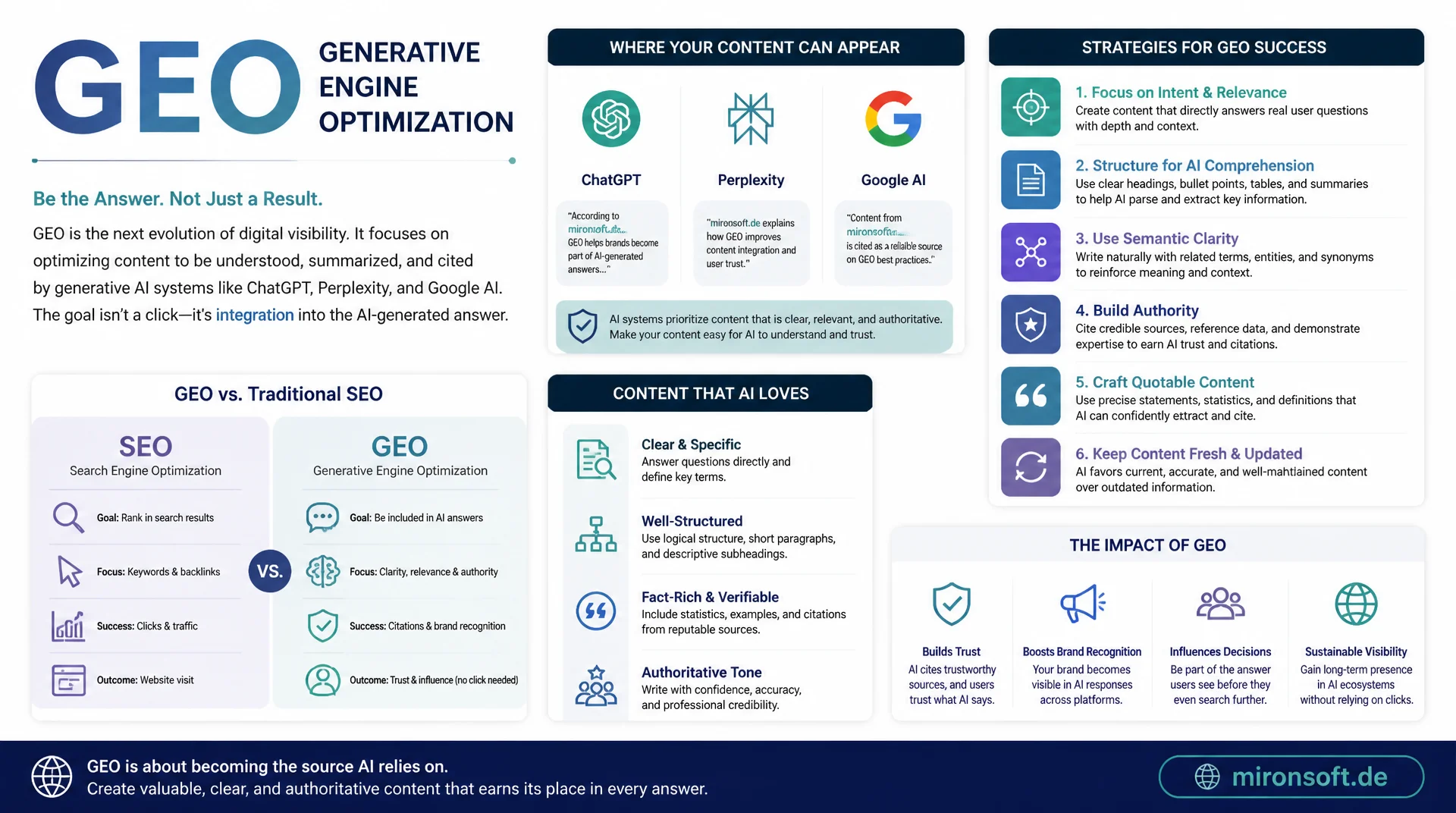
Rankings are no longer the goal, citations are
GEO is the discipline of shaping content so that ChatGPT, Perplexity, Google AI Overviews and other generative systems select it as a source, summarize it correctly and cite it. Unlike SEO, GEO does not aim for a position in a results list, it aims for a place inside a generated answer, where users often never visit the website yet still build trust and brand awareness.
Table of contents
- 1. What GEO actually is
- 2. Why GEO matters right now
- 3. How LLMs technically select sources
- 4. Citability: what makes content citable
- 5. Technical basics: crawlers, robots.txt, llms.txt
- 6. Content structure for generative engines
- 7. E-E-A-T and authority in a GEO context
- 8. Measuring GEO visibility without classic rankings
- 9. GEO versus SEO side by side
- 10. Summary
- 11. FAQ
1. What GEO actually is
GEO, short for Generative Engine Optimization, is the deliberate optimization of content for generative AI systems that formulate answers instead of presenting link lists. While classic SEO improves the position of a URL in a results list, GEO improves the probability that a language model pulls a section of a text into its generated answer and names the source. In many cases the user no longer sees a results list at all, only a finished, synthesized answer with one to three source references shown at the side or as a footnote.
The term was coined by a 2023 study from researchers at Princeton University and other institutions, and has since become the umbrella term for optimizing toward ChatGPT search, Perplexity, Google AI Overviews, Bing Copilot and similar systems. Some vendors also talk about Answer Engine Optimization, or AEO, the concept is essentially identical: content is no longer written only for crawlers and ranking algorithms, but for language models that extract text passages, rephrase them and present them in a new, generated interface.
The distinction matters: GEO does not replace SEO, it complements it. The technical foundation, meaning discoverability, load time, clean HTML structure and crawlability, stays identical. What changes is the goal of content optimization itself, no longer only click-through rate and position, but citation frequency, accurate reproduction and visibility inside an AI-generated answer that the user may never turn into a classic search results click at all.
2. Why GEO matters right now
ChatGPT search now processes several hundred million queries per week, Perplexity has established itself as a standalone AI search engine with a growing user base, and Google keeps rolling out AI Overviews across more countries and search intents. For websites this means a structural shift in traffic sources: a growing share of information needs gets satisfied directly inside the generative interface, without a classic click on a blue search result ever taking place. Studies from several analytics vendors already show measurable declines in classic organic clicks for informational queries, while new, if smaller, referral traffic from AI systems appears at the same time.
The second reason GEO is gaining relevance is a shift in user expectation. Anyone asking a complex question today increasingly expects a synthesized answer instead of ten blue links they have to sift through themselves. This expectation carries over into classic Google search too, where AI Overviews now appear above the organic results for a substantial share of informational queries. Websites that do not show up as a source inside these generated summaries lose visibility, even when they still rank well in the classic organic results.
Third, the competitive landscape itself changes. Because generative systems typically cite only two to five sources per answer, the competition for a citation slot is considerably tighter than the competition for a spot among ten organic results. Anyone who ignores GEO hands this narrowing shop window entirely to competitors who are already structuring their content specifically for language models.
3. How LLMs technically select sources
Most generative search systems follow a retrieval-augmented generation pattern, or RAG. On a user query, a classic or semantic search index is first queried to identify a set of potentially relevant documents. These documents are then converted into vector embeddings, numeric representations of their meaning, and compared against the embedding of the user query. Documents with high semantic proximity to the question get prioritized and passed to the language model, which then formulates a coherent answer from the selected text excerpts while referencing the sources individual statements came from.
Unlike the classic PageRank approach, this selection process does not primarily hinge on a page's link popularity, it hinges on how precisely a specific text passage matches the question semantically. A short, precisely worded paragraph that directly answers a question can be preferred for citation by a language model even if the overall page has fewer backlinks than a competitor. The JSON example below illustrates how such a retrieval system might internally score a text passage, with a semantic similarity value, an authority score and a final ranking signal.
{
  "query": "What sets GEO apart from classic SEO?",
  "candidate_passages": [
    {
      "source_url": "https://mironsoft.de/blog/geo-basics",
      "passage_id": "p-03",
      "semantic_similarity": 0.891,
      "authority_score": 0.74,
      "freshness_days": 4,
      "extractability": "high",
      "citation_probability": 0.63
    },
    {
      "source_url": "https://example-competitor.com/geo-article",
      "passage_id": "p-11",
      "semantic_similarity": 0.812,
      "authority_score": 0.81,
      "freshness_days": 210,
      "extractability": "medium",
      "citation_probability": 0.41
    }
  ],
  "note": "Illustrative values, not a real model output format"
}
This mechanic explains why GEO prioritizes differently than SEO: a single, excellently worded paragraph can outweigh the overall authority of the domain. At the same time, authority, measured in part by mentions on other trustworthy pages, remains a factor in the scoring, which is why GEO does not replace classic off-page signals, it extends them with passage-level relevance signals.
4. Citability: what makes content citable
Citability, often called extractability, describes how easily a language model can isolate a self-contained, correct statement from a text passage. A paragraph with high citability answers a concrete question in one to three sentences without requiring prior context from the reader, and avoids vague references such as "as mentioned above" or "see below". For GEO this means every paragraph should, in principle, still make sense when lifted out of the rest of the article.
Concrete numbers, definitions, step-by-step instructions and comparisons count as especially citable because they contain clearly bounded, verifiable statements. A sentence like "GEO-optimized content gets cited significantly more often in studies" is less extractable than "In a 2024 study, GEO-optimized answer blocks were cited in 40 percent of cases, unstructured prose only in 15 percent of cases." The second phrasing gives the language model a concrete, independently usable statement complete with source and context.
<!-- Citable content block: self-contained answer with clear scope -->
<h3>What does a GEO optimization typically cost?</h3>
<p>
  A GEO optimization for an existing content library of 50 to 100
  articles typically costs between 3,000 and 12,000 euros, depending
  on the scope of structural rework and the number of new answer
  blocks that need to be written.
</p>
<ul>
  <li>Content audit and prioritization: 1 to 2 weeks</li>
  <li>Structural rework per article: 1 to 3 hours</li>
  <li>Technical setup (llms.txt, schema): 2 to 4 hours one-time</li>
</ul>
5. Technical basics: crawlers, robots.txt, llms.txt
Before a language model can cite content at all, the associated crawler needs permission to visit the page. OpenAI runs GPTBot for training data and a separate OAI-SearchBot specifically for ChatGPT search, Anthropic runs ClaudeBot, Perplexity runs PerplexityBot, and Google uses parts of the same Googlebot index for AI Overviews as for classic search, complemented by Google-Extended for training purposes. Anyone who blanket-blocks one of these crawlers in robots.txt actively excludes themselves from citability in exactly that system, a step that deserves careful consideration.
Alongside classic robots.txt, an llms.txt file convention has emerged since 2024, a format not yet officially standardized but already supported by several larger vendors, summarizing a domain's most important pages and resources in markdown style for language models. Unlike robots.txt, llms.txt does not control access, it delivers a curated overview that helps a model identify a domain's most relevant content faster, similar to a sitemap but written in natural, model-friendly language.
# robots.txt: explicitly allow AI crawlers instead of blanket blocking
User-agent: GPTBot
Allow: /

User-agent: OAI-SearchBot
Allow: /

User-agent: ClaudeBot
Allow: /

User-agent: PerplexityBot
Allow: /

User-agent: Google-Extended
Allow: /

Sitemap: https://mironsoft.de/sitemap.xml

# llms.txt: curated overview of the most important resources
# https://mironsoft.de/llms.txt
# Mironsoft
# > Magento and Hyva agency focused on performance and GEO.

## Guides
- [GEO Basics](https://mironsoft.de/blog/generative-engine-optimization-geo-basics): definition and how it differs from SEO
- [Optimizing ChatGPT search](https://mironsoft.de/blog/chatgpt-search-visibility-optimization): visibility in ChatGPT search
Server-side rendering or a reliable hydration fallback matters for GEO just as much as for classic SEO, because not every AI crawler executes JavaScript fully. A page that loads its core content only client-side risks the crawler seeing an empty shell, and the content becomes invisible for citation purposes even if it is excellent once rendered.
6. Content structure for generative engines
Structured data based on schema.org helps language models correctly classify the type and relationship of content elements. An FAQPage schema explicitly signals which text blocks are question-answer pairs, a HowTo schema marks step-by-step instructions, and an Article or TechArticle schema supplies metadata about author, publication date and topic. This markup does not replace content quality, but it significantly reduces the chance of misinterpretation by the model, because the structure is machine-readable and explicit instead of implicit in running prose.
Beyond structured data, the visual and semantic HTML structure matters: clear H2 and H3 headings acting as question or topic anchors, short paragraphs of three to five sentences, bullet lists for enumerations and comparisons, and tables for structured side-by-side comparisons. A GEO-optimized article reads fluently for a human, yet is segmented enough that a model can isolate individual sections without distorting their meaning.
{
  "@context": "https://schema.org",
  "@type": "FAQPage",
  "mainEntity": [
    {
      "@type": "Question",
      "name": "What is the difference between GEO and SEO?",
      "acceptedAnswer": {
        "@type": "Answer",
        "text": "SEO optimizes the position of a URL in a results list. GEO optimizes the probability that a text passage gets cited inside a generated AI answer. Both disciplines share much of the same technical foundation."
      }
    }
  ]
}
7. E-E-A-T and authority in a GEO context
Google's E-E-A-T concept, Experience, Expertise, Authoritativeness and Trustworthiness, also applies in a GEO context, though with different weighting. Language models demonstrably prefer sources with clearly identifiable authorship, date stamps and evidence such as studies or primary sources for controversial or factually sensitive topics. Anonymous or undated content gets cited less often, because the model cannot gauge the reliability of the statement, which carries a higher risk of a faulty reproduction that AI system providers actively try to avoid.
In practice this means for GEO: author boxes with a real name and demonstrable expertise, visible publication and update dates, and references to primary sources and studies all increase citation probability. Mentions of your own brand or domain on other trustworthy sites, for instance in trade publications or industry directories, also flow into many retrieval systems as an authority signal, similar to backlinks in classic SEO, though often without an actual link being required, plain textual mention can already be enough.
8. Measuring GEO visibility without classic rankings
Because GEO has no classic ranking position, measuring success requires new metrics. A first approach is manual or semi-automated sample checking: relevant queries are regularly entered into ChatGPT search, Perplexity and Google AI Overviews, and it gets logged whether and how your own domain is cited. Several specialized tools, such as Otterly.AI, Profound or Peec AI, now automate this process and deliver trend reports over time, comparable to classic rank tracking tools, just for citation share instead of position numbers.
A second, technical approach is server log analysis: requests from GPTBot, OAI-SearchBot, ClaudeBot and PerplexityBot can be filtered by user agent header and evaluated over time. An increase in this crawl frequency often, though not always, correlates with rising relevance for retrieval systems. Referral traffic from chat.openai.com or perplexity.ai in Google Analytics adds an indirect but reliable signal for actual citations that led to a click.
// Simple Node.js log filter to spot AI-crawler visits by user agent
const fs = require('fs');
const readline = require('readline');

const AI_BOTS = ['GPTBot', 'OAI-SearchBot', 'ClaudeBot', 'PerplexityBot', 'Google-Extended'];

async function countAiCrawlerHits(logFilePath) {
  const counts = Object.fromEntries(AI_BOTS.map((bot) => [bot, 0]));
  const rl = readline.createInterface({ input: fs.createReadStream(logFilePath) });

  for await (const line of rl) {
    for (const bot of AI_BOTS) {
      if (line.includes(bot)) {
        counts[bot] += 1;
      }
    }
  }
  return counts;
}

countAiCrawlerHits('/var/log/nginx/access.log').then(console.log);
// { GPTBot: 412, 'OAI-SearchBot': 289, ClaudeBot: 133, PerplexityBot: 501, 'Google-Extended': 96 }
9. GEO versus SEO side by side
GEO and SEO share a common technical foundation but differ clearly in target unit, competitive logic and success measurement. The table below sets out the most important differences to give content teams a clear basis for prioritization.
| Dimension | Classic SEO | GEO |
|---|---|---|
| Target unit | Entire URL / page | Individual text passage |
| Success metric | Ranking position, click-through rate | Citation frequency, share of answers |
| Competition | Up to 10 spots per page | Usually 2 to 5 citations per answer |
| Central signal | Backlinks, link popularity | Semantic match, extractability |
| Traffic effect | Direct click on a result | Brand mention, click is rarer |
The table shows both disciplines are complementary, not mutually exclusive. A website optimized for backlinks and rankings but lacking clearly extractable answer blocks leaves GEO potential on the table. A website perfectly optimized for citability but technically uncrawlable or thin on content will not be favored by generative systems either.
Mironsoft
GEO strategy, content structure and technical setup for AI search
Ready to get cited inside AI answers instead of just ranking?
We audit your content for citability, set up robots.txt and llms.txt correctly, and restructure articles so ChatGPT search, Perplexity and Google AI Overviews reliably recognize and reference them as a source.
GEO audit
Check existing content for citability and technical crawlability
Content restructuring
Build answer blocks, schema markup and clear question-answer structure
Monitoring
Set up citation tracking and bot traffic analysis as ongoing reporting
10. Summary
GEO shifts the focus of content optimization from a position in a results list toward the citability of individual text passages inside generated AI answers. The technical foundation, crawlability, clean HTML structure and load time, remains identical to classic SEO, extended with new elements such as robots.txt allowances for GPTBot and PerplexityBot, an llms.txt file, and consistent schema markup. Citable content answers questions in a self-contained way, with concrete numbers and clear definitions, instead of vaguely pointing to surrounding context.
Measuring success in a GEO context requires new tools: sample checks inside ChatGPT search and Perplexity, specialized citation tracking tools, and server log analysis of AI crawlers replace classic rank tracking. Anyone pursuing both disciplines, SEO and GEO, in parallel secures visibility both in classic results lists and in the growing number of generated answers that increasingly decide brand awareness and trust, even without a single click.
GEO Basics: the essentials at a glance
Definition
GEO optimizes text passages for citability in generative AI answers, instead of optimizing URLs for ranking positions.
Technical foundation
robots.txt with explicit allowances for GPTBot, ClaudeBot, PerplexityBot, complemented by an llms.txt overview.
Content structure
Short, self-contained answer blocks with concrete numbers, complemented by FAQPage and Article schema.
Measurement
Citation tracking tools like Otterly.AI or Profound, combined with server log analysis of AI crawlers.