Evolve Through 2030
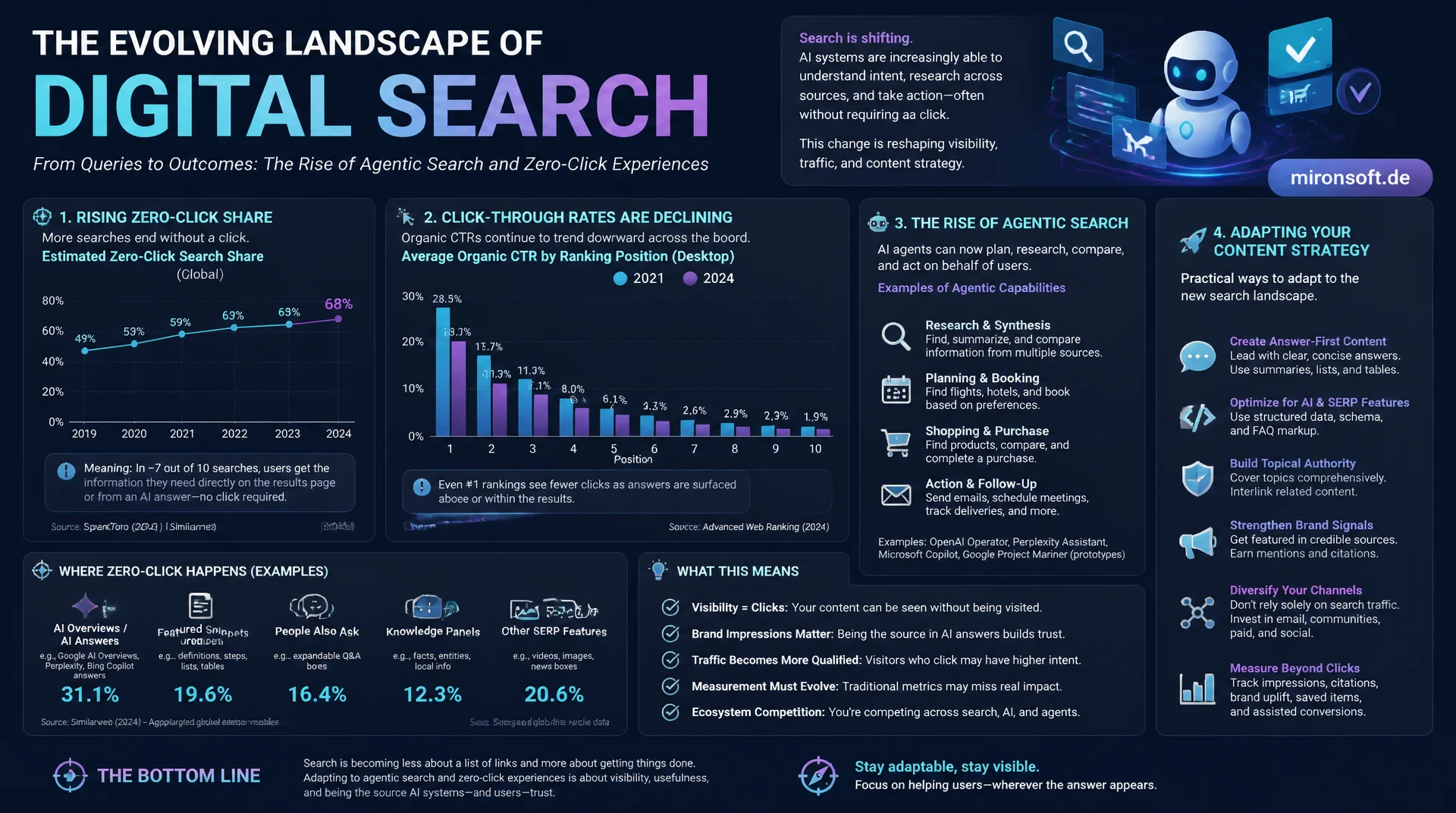
The future of search cannot be predicted with certainty, but the direction of observable trends allows for a reasoned assessment: agentic search, where AI systems research and act independently, declining click-through rates on classic search results, and a growing zero-click share are already changing how visibility works today. This article walks through these trends and derives what makes sense for content strategy right now, without selling predictions as certainties.
Table of contents
- 1. Why predictions about the future of search deserve caution
- 2. The growing zero-click share
- 3. Declining click-through rates on classic results
- 4. Agentic search: from answer to action
- 5. Multimodal and conversational search
- 6. Fragmentation of the search landscape
- 7. Concrete implications for content strategy today
- 8. Measuring success in a zero-click world
- 9. What deliberately remains uncertain
- 10. Summary
- 11. FAQ
1. Why predictions about the future of search deserve caution
Anyone talking about the future of search today inevitably moves on uncertain ground. The history of search engine optimization is full of predictions that turned out wrong, or at least significantly overstated, from the "end of keywords" to the repeatedly announced "death of SEO." A credible outlook on the future of search should therefore not present itself as certainty, but as a reasoned assessment of observable trends that are already visible today in user behavior and the product decisions of the major search providers.
The difference between a solid trend analysis and speculation lies in the evidence base. When Google has been rolling out AI Overviews for years, when OpenAI, Anthropic and Perplexity continuously expand their products with web search features, when usage data shows a growing share of search queries without a subsequent click, these are observable developments from which trend lines can be drawn, even if the exact speed and the precise end state of these developments remain open.
This article therefore deliberately limits itself to trends that can be extrapolated from today's observable developments, and explicitly flags in several places where uncertainty is particularly high. The future of search through 2030 is a time frame long enough to allow for substantial shifts, but short enough to still meaningfully inform today's strategic decisions.
2. The growing zero-click share
One of the best supported developments in the future of search is the growing share of search queries that end without a click on an organic result. Direct answers in featured snippets, knowledge panels and increasingly in AI generated summaries already answer many questions right on the search results page, without a user needing to visit a further page. This trend is not new, but generative answer systems clearly accelerate it, because they deliver more detailed, directly consumable answers than classic snippets.
For content strategy this means a shift in value proposition: pure informational content that answers a simple factual question increasingly decouples from the click, because the answer already gets delivered beforehand. Content that serves more complex, multi-step needs, requires individual advice, or enables a concrete action like a purchase or an appointment booking, stays click relevant, because a pure text answer cannot fully satisfy these needs.
This development should not be understood as a pure threat. The brand or domain that serves as a source for the zero-click answer gains visibility and brand awareness even without a click, an effect that escapes classic traffic metrics but is real. The challenge lies in making this indirect value measurable, without relying exclusively on click numbers as a success metric.
3. Declining click-through rates on classic results
Closely tied to the zero-click trend is the observation of declining click-through rates on classic organic search results, especially for informational queries. Several independent analyses from SEO tool vendors and publishers have documented a decline in click-through rate for top positions over recent years, correlating with the introduction of AI Overviews and similar features. This development does not affect all queries equally, informational questions are more affected than transactional or strongly brand related queries.
An important caveat about this observation: the available data mostly comes from individual tool vendors and publishers with their own methodological limits, not from a central, independent source with full market transparency. The direction of the trend, declining click-through rates for informational queries, is considered reasonably well supported, the exact magnitude and pace vary considerably by study and industry, which is why individual percentage figures should be treated with caution.
| Trend | Evidence level | Likely development through 2030 |
|---|---|---|
| Zero-click growth | High | Further growth for informational queries |
| Declining click-through rates | Medium to high | Ongoing, varies by query type |
| Agentic search | Medium, early stage | Growing but still limited adoption |
| Search channel fragmentation | Medium | Increasing, pace uncertain |
4. Agentic search: from answer to action
Perhaps the least mature but strategically most significant trend in the future of search is agentic search, where an AI system does not just answer a question but independently carries out multi-step tasks: combining information from several sources, comparing options, and ideally even carrying out actions like bookings or orders on the user's behalf. Early approaches of this kind are already visible in products from several major providers, but they still sit at an early, experimental stage.
For companies, a growing agentic search share means a fundamentally new challenge: no longer just a human user, but an AI agent acting on a user's behalf, evaluates offers, compares options and possibly even makes preselections. Structured, machine readable product data, clear, verifiable comparison criteria and technically accessible interfaces gain importance in this scenario, because an agent depends on clear, extractable signals to compare and decide reliably.
A realistic assessment of the time horizon matters: agentic search at full scale, with reliable, broad usage for complex, multi-step transactions, is as of today still at an early development stage. Substantially wider adoption is plausible by 2030, but a complete replacement of classic search interactions within that timeframe is by no means certain and should not serve as a baseline assumption for today's strategic decisions.
{
  "@context": "https://schema.org",
  "@type": "Product",
  "name": "Example product with agent-friendly data markup",
  "description": "Clearly structured product data an AI agent can reliably extract",
  "offers": {
    "@type": "Offer",
    "price": "249.00",
    "priceCurrency": "EUR",
    "availability": "https://schema.org/InStock"
  },
  "additionalProperty": [
    { "@type": "PropertyValue", "name": "Delivery time", "value": "2-4 business days" },
    { "@type": "PropertyValue", "name": "Warranty", "value": "24 months" }
  ]
}
5. Multimodal and conversational search
Alongside agentic search, a second, somewhat better supported trend is emerging: the shift from one-off keyword entry toward multimodal and conversational search. Users increasingly phrase full, naturally worded questions instead of keyword fragments, add images or voice to search queries, and hold multi-turn dialogues with a search system instead of issuing a single isolated query and manually browsing the results.
This shift is already visible today in how AI assistants get used for research purposes, and is expected to be reinforced further by improved multimodal models. For the future of search, this means an ongoing shift in emphasis from exact keyword optimization toward semantic topic coverage, where content covers a topic from multiple angles and at varying levels of depth in order to stay relevant across different stages of a conversational search dialogue.
{
  "note": "Example of a multi-turn conversational search session, illustrative only",
  "session": [
    { "turn": 1, "query": "What does a B2B integration solution typically cost?" },
    { "turn": 2, "query": "And how does that differ for complex pricing models?" },
    { "turn": 3, "query": "Show me providers that offer exactly that." }
  ],
  "implication": "Content should be prepared for several connected questions, not just the first isolated query."
}
6. Fragmentation of the search landscape
For decades, the search landscape was shaped by one dominant provider. A recognizable, though still moderate, trend in the future of search is a certain fragmentation: Perplexity, ChatGPT with web search, Claude, Gemini and specialized AI search products increasingly compete for research queries that used to land almost exclusively with one classic search engine. This fragmentation remains limited so far, but is already changing how visibility strategies have to be planned.
For companies, a fragmented search landscape means that a strategy optimized exclusively for a single platform becomes increasingly risky. The practice described in a separate article, checking AI citations across multiple platforms, gains importance against this backdrop, because visibility can no longer be pinned to a single source, it has to be assessed as distributed across a portfolio of search channels.
#!/usr/bin/env bash
# visibility-portfolio.sh: simple reminder script to check presence
# signals across multiple search channels, not just one dominant engine

set -euo pipefail

readonly DOMAIN="example.com"
readonly CHANNELS=("Google organic" "Google AI Overviews" "ChatGPT web search" "Perplexity" "Bing/Copilot")

echo "Visibility portfolio check for: $DOMAIN"
for channel in "${CHANNELS[@]}"; do
  echo "- [ ] $channel: manual spot-check due"
done

echo "Reminder: repeat this check quarterly as channel share shifts."
7. Concrete implications for content strategy today
Despite all the uncertainty about exact pace, these trends yield concrete recommendations for content strategy. First: content should be designed for layered value, a direct, extractable core answer for zero-click contexts, complemented by deeper content that justifies a click because it goes beyond the pure factual answer, through individual advice, interactive tools or concrete courses of action, for example.
Second: structured, machine readable data gains importance regardless of how fast agentic search actually develops, because classic search engines, generative systems and potential future agents all benefit from clear, extractable signals. Investing in clean schema markup and structured product data pays off across several possible future scenarios, independent of how quickly agentic search specifically catches on.
Third: diversifying visibility channels becomes more important than optimizing for a single dominant platform. A content strategy that relies exclusively on classic Google ranking ignores the real risk that a growing share of relevant search queries gets handled through other channels. Presence and citability across multiple search systems becomes a basic prerequisite for robust visibility.
<!-- Layered content pattern: short extractable answer first,
     deeper substance follows for readers who click through -->
<h2 id="price-integration-solution">What does a B2B integration solution cost?</h2>
<p>
  Depending on complexity, typical project costs range from 15,000 to
  80,000 euros for the initial implementation, plus ongoing maintenance.
</p>
<h3>What drives cost in detail</h3>
<p>
  The biggest cost drivers are the number of target systems, the complexity
  of the data models, and whether real-time or batch synchronization is needed...
</p>
8. Measuring success in a zero-click world
When a growing share of valuable user interactions happens without a click to your own site, success measurement has to adapt too. Pure traffic metrics increasingly become incomplete as the sole success indicator, because they systematically fail to capture the value of a brand mention in an AI answer or a zero-click citation. Complementary metrics such as brand awareness surveys, direct traffic increases, and the frequency of AI citations for relevant search queries deliver a more complete picture.
A practical approach combines classic visibility metrics with the GEO specific metrics described in other articles: citation frequency across multiple AI platforms, referral traffic from AI systems, and qualitative signals from sales and customer contact. This combination doesn't replace the need for further methodological maturation of success measurement, but already delivers a considerably more realistic picture than pure click numbers today.
// visibility-scorecard.js: combine classic and GEO-specific metrics
// into a single, more complete visibility picture (illustrative shape)
function buildScorecard(data) {
  return {
    organicClicks: data.organicClicks,
    aiCitationCount: data.aiCitationCount,          // across tracked platforms
    aiReferralSessions: data.aiReferralSessions,
    brandMentionsInAiAnswers: data.brandMentions,    // cited without a click
    combinedVisibilityIndex:
      data.organicClicks * 1.0 +
      data.aiCitationCount * 0.6 +
      data.brandMentions * 0.3,
  };
}

const monthlyData = {
  organicClicks: 4200,
  aiCitationCount: 38,
  aiReferralSessions: 61,
  brandMentions: 145,
};

console.log(buildScorecard(monthlyData));
9. What deliberately remains uncertain
Honesty toward one's own forecast requires clearly naming open questions. It remains uncertain how quickly agentic search actually reaches broad, everyday usage, what regulatory interventions could influence the development of generative search systems, in areas like copyright or competition law for example, and whether individual AI providers dominant today will prevail long term or get displaced by new players.
Also uncertain is the exact balance between classic search and generative systems in 2030. A complete disappearance of classic search result lists appears unlikely based on today's developments, a substantially shifted balance between both forms, however, seems plausible. Anyone making strategic decisions today should factor in this uncertainty, rather than committing to a single future scenario treated as certain.
Mironsoft
Future-proof content strategy between classic SEO and GEO
Is your content strategy prepared for multiple search futures?
We help build content and data structure so they stay robust across classic search engine ranking, AI citations and future agentic search scenarios.
Visibility portfolio
Presence across multiple search channels instead of single-platform dependency
Structured data
Machine readable product and content data for today's and future systems
Extended success metrics
Metrics beyond pure click numbers for a zero-click world
10. Summary
The future of search through 2030 cannot be predicted with certainty, but several trends are already well enough supported today to base strategic decisions on: a growing zero-click share, declining click-through rates for informational queries, the early but growing adoption of agentic search, a shift toward conversational, multimodal search, and increasing fragmentation of the search landscape across multiple platforms.
For content strategy today this means: layered content with a direct core answer and deeper substance, investment in structured, machine readable data, diversification of visibility channels instead of a single-platform focus, and extended success measurement beyond pure click numbers. Honest framing remains important: these trends are reasoned probabilities, not certainties, and their pace and exact magnitude remain subject to uncertainty.
Future of search through 2030 at a glance
Zero-click & click-through
Well supported trend: growing zero-click share and declining click-through rates for informational queries.
Agentic search
Early stage, plausible growth through 2030, pace and magnitude remain uncertain.
Recommended action
Layered content, structured data, channel diversification, extended success measurement.
Honest forecasting
Treat trends as reasoned probabilities, not misread as guaranteed facts.