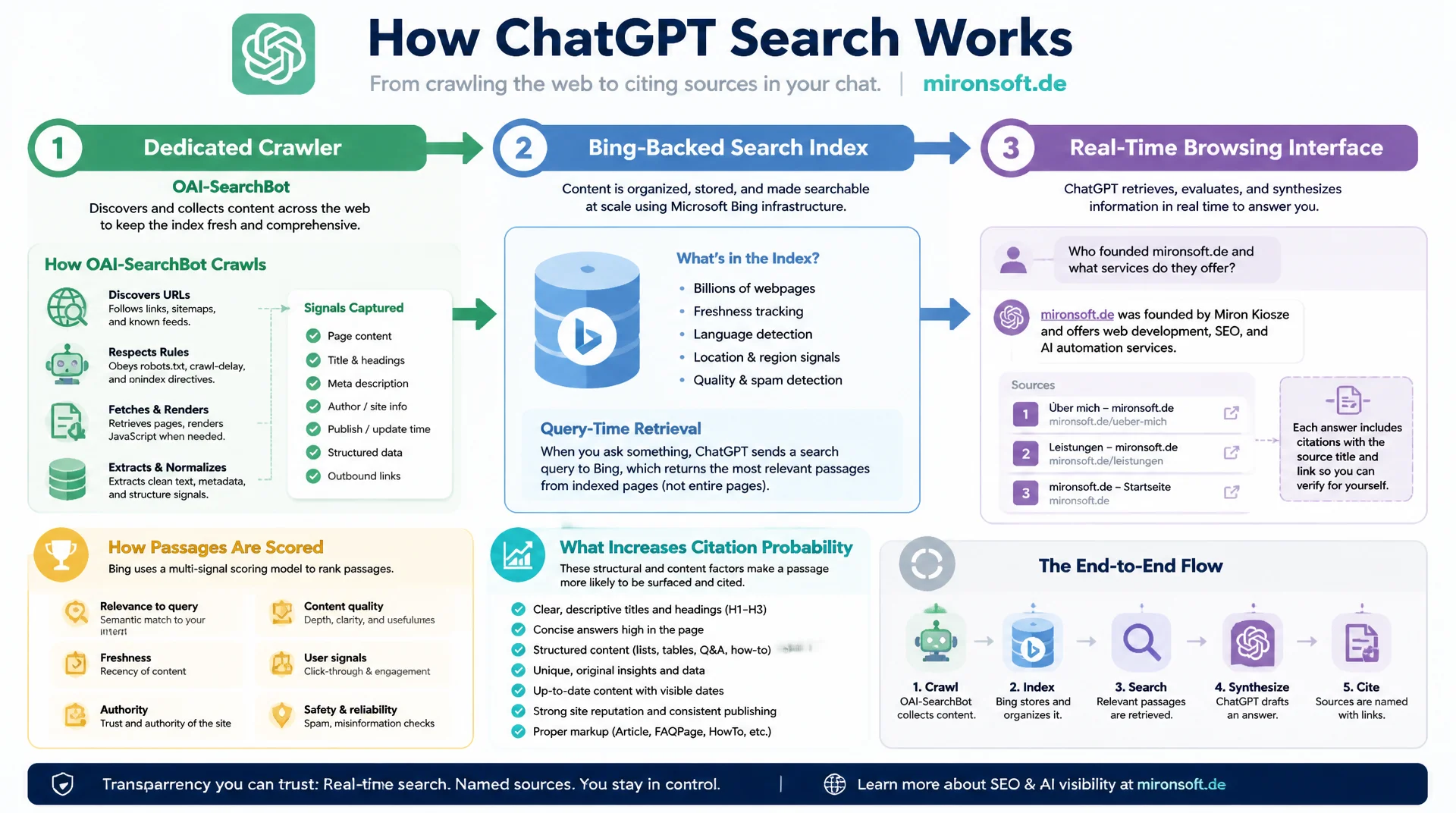
from OAI-SearchBot to the cited paragraph
ChatGPT search combines a dedicated crawler, a Bing-backed search index and real-time browsing into a system that formulates answers directly inside the chat while naming individual sources. Anyone who understands how OAI-SearchBot crawls, how passages get scored and which structure raises citation probability can work on their own ChatGPT search visibility on purpose, instead of hoping for luck.
Table of contents
- 1. How ChatGPT search technically works
- 2. GPTBot, OAI-SearchBot and ChatGPT-User compared
- 3. How sources get selected for an answer
- 4. Technical setup: robots.txt and crawl access
- 5. Content signals that favor citations
- 6. Practical example: reworking an article for ChatGPT
- 7. Special case: product data and shopping results
- 8. Monitoring visibility in ChatGPT search
- 9. ChatGPT search versus classic Google SEO
- 10. Summary
- 11. FAQ
1. How ChatGPT search technically works
ChatGPT search is not a single algorithm, it is a combination of several building blocks: a dedicated web index built through OAI-SearchBot, a partnership with Bing for supplementary results, and real-time browsing capabilities that fetch a URL live during a conversation when needed. When a user asks a question that requires current or very specific information, an internal classification model decides whether ChatGPT search gets activated instead of answering purely from the model's training knowledge.
Once ChatGPT search is active, several candidate pages get fetched and their content broken into compact text passages. The language model receives these passages as additional context and formulates an answer in natural language, complemented by clickable source references that usually appear as small numbered badges or source cards at the end of the answer. Unlike classic Google search, users rarely see more than three to five sources at once, which makes competition for one of these slots considerably more intense than for spot ten in classic rankings.
An important difference from classic search: ChatGPT search can search again for follow-up questions within the same conversation while taking the prior conversation context into account. A page that was not cited for the first question can suddenly become relevant for a refined follow-up if it matches the new, narrower topic exactly. That makes topical breadth and depth of a domain a relevant factor beyond a single query.
2. GPTBot, OAI-SearchBot and ChatGPT-User compared
OpenAI operates three different crawlers for different purposes that can be controlled separately in robots.txt. GPTBot collects content primarily for training future model versions. OAI-SearchBot is the crawler that specifically builds and keeps up to date the search index for ChatGPT search, independent of model training. ChatGPT-User finally gets triggered when a user explicitly names a URL during an active conversation, or when the model needs live, real-time access to a specific page to answer a question.
This separation matters in practice: a domain can block GPTBot to opt out of general model training while still allowing OAI-SearchBot to remain citable as a source in ChatGPT search. Many websites that blanket-blocked all OpenAI crawlers have accidentally lost their ChatGPT search visibility as a result, even though the actual goal was only excluding training data.
# robots.txt: differentiate between training, search index and live browsing
# Block training data collection
User-agent: GPTBot
Disallow: /

# Allow the ChatGPT-search index crawler
User-agent: OAI-SearchBot
Allow: /

# Allow live page access triggered by users inside a chat
User-agent: ChatGPT-User
Allow: /

Sitemap: https://mironsoft.de/sitemap.xml

# Optional: keep GPTBot allowed but exclude sensitive sections
# User-agent: GPTBot
# Disallow: /account/
# Disallow: /checkout/
3. How sources get selected for an answer
Passage selection in ChatGPT search follows a retrieval pattern similar to other generative search systems: semantic similarity between the user query and a text passage, combined with freshness, domain trustworthiness and text extractability. OpenAI has publicly confirmed that freshness is an especially strong signal when the user query contains time-sensitive phrasing such as "current," "2026" or "latest." For timeless, definitional questions, freshness recedes in favor of content precision and completeness.
A second important signal is a page's structural clarity. Domains with a clear topical focus, for instance a specialist site that consistently covers only one subject area, tend to be rated more trustworthy by ChatGPT search than sites with broadly scattered, unfocused content. That favors specialized content hubs over generalist topic sites, an effect that classic SEO can partially offset through other ranking factors, but that flows directly into passage scoring in ChatGPT search.
A third signal, often underestimated, is internal consistency across multiple pages of the same domain. When a domain states the same core fact, say a price or a technical specification, differently or even contradictorily across several subpages, the perceived reliability of the entire domain drops for ChatGPT search. A unified, centrally maintained content model that individual pages draw from reduces this risk structurally, instead of relying on manual editorial catch-up.
4. Technical setup: robots.txt and crawl access
Beyond a differentiated robots.txt configuration, technical reachability for OAI-SearchBot is decisive. The crawler does not perform full JavaScript rendering to the extent of a modern browser, which means content loaded only through client-side hydration can, in the worst case, stay invisible. Server-side rendering or statically generated HTML output of core content is therefore not a nice-to-have for ChatGPT search, it is a basic requirement for citability.
Another technical factor is server response time. Because ChatGPT search fetches several candidate pages in a short window to generate an answer, pages with high load times or timeouts get excluded from the selection process more often, even if their content would otherwise be a good fit. A time to first byte under 500 milliseconds is a practical target so pages get processed reliably within the limited time the crawler budgets per request.
5. Content signals that favor citations
Direct, self-contained answer paragraphs are the strongest content signal for ChatGPT search. A paragraph that concretely answers a likely user question in two to four sentences before branching into detail gets extracted noticeably more often than an introductory paragraph that first builds context without directly answering the core question. The proven practice of stating the most important point first and elaborating afterward, known from the journalistic inverted pyramid, works particularly well for ChatGPT search.
A second strong signal is explicitly answering questions in H2 or H3 headings. Headings phrased as complete questions themselves, for instance "How much does X cost" instead of just "Cost," make it considerably easier for the model to match a user question to the right text section. Complemented by FAQPage schema markup that machine-readably tags the same question-answer pairs, a double signal source emerges, delivering the same information both in visible HTML and in structured data.
{
  "@context": "https://schema.org",
  "@type": "FAQPage",
  "mainEntity": [
    {
      "@type": "Question",
      "name": "Does blocking GPTBot automatically block ChatGPT search too?",
      "acceptedAnswer": {
        "@type": "Answer",
        "text": "No. GPTBot and OAI-SearchBot are separate crawlers with separate robots.txt rules. Blocking GPTBot only affects model training, not the ChatGPT search index."
      }
    }
  ]
}
6. Practical example: reworking an article for ChatGPT
A practical example clarifies the difference: a classic SEO article about store opening hours often starts with a long introduction about company history before the actual opening-hours information follows. For ChatGPT search, the same article should start with a direct answer block: "Opening hours are Monday to Friday 9am to 6pm, Saturday 9am to 2pm, closed on Sunday." Only after that should supplementary information about holidays, special hours or company history follow.
This restructuring does not contradict classic SEO, it complements it. Google rewards concise, direct answer paragraphs as well, for instance for featured snippets, so a structure optimized for ChatGPT search usually benefits classic Google visibility too. The decisive difference lies in the degree of consistency: where classic SEO strikes a compromise between readability and snippet suitability, ChatGPT search consistently demands extractable, self-contained paragraphs throughout the entire article, not just in the opening section.
<!-- Before: context-heavy intro, answer buried deep in the text -->
<h2>Our story and our opening hours</h2>
<p>Since 1998 we have operated ... (several sentences of company
   history) ... Opening hours are further below.</p>

<!-- After: direct answer first, context afterwards -->
<h2>What are our opening hours?</h2>
<p>Monday to Friday 9am to 6pm, Saturday 9am to 2pm, closed on
   Sunday. The store stays closed on public holidays.</p>
<p>Since 1998 we have operated ... (company history as a supplement) ...</p>
7. Special case: product data and shopping results
For e-commerce websites, ChatGPT search adds an extra layer: product cards with price, availability and image that can be shown directly inside the chat as purchasable results. These product cards come primarily from structured data, specifically the Product schema from schema.org with correctly maintained fields for price, availability, brand and reviews. If this markup is missing or outdated, products show up less often as a concrete purchase option in ChatGPT search, even if the product page's content is otherwise complete.
An additional factor for product data is the freshness of price and stock levels. Because OpenAI works with several feed providers and partly with real-time data sources, stale or inconsistent price information between the structured data feed and the visible product page negatively affects a domain's trustworthiness in ChatGPT search. An automated reconciliation between the ERP system, product feed and website output noticeably reduces this risk.
{
  "@context": "https://schema.org",
  "@type": "Product",
  "name": "GEO Consulting Package Starter",
  "brand": { "@type": "Brand", "name": "Mironsoft" },
  "offers": {
    "@type": "Offer",
    "priceCurrency": "EUR",
    "price": "2900.00",
    "availability": "https://schema.org/InStock",
    "priceValidUntil": "2026-12-31"
  },
  "aggregateRating": {
    "@type": "AggregateRating",
    "ratingValue": "4.8",
    "reviewCount": "37"
  }
}
8. Monitoring visibility in ChatGPT search
Server logs deliver the most reliable technical foundation for monitoring: every visit from OAI-SearchBot or ChatGPT-User gets logged by its user agent header and can be evaluated over time to spot trends in crawl frequency. A sudden drop in crawl frequency can point to a technical problem, such as a faulty robots.txt change or a server error, before the effect shows up as measurably declining visibility in ChatGPT search.
A manual or tool-assisted sample check is a useful complement: relevant questions from your own topic area get asked in ChatGPT search regularly, and it gets documented whether and how your domain gets cited. Google Analytics or comparable tools additionally deliver referral data from chat.openai.com or chatgpt.com, giving an indirect but reliable hint at how many actual visitors reach your site from cited answers in ChatGPT search.
// Filter server logs for OAI-SearchBot and ChatGPT-User visits
const fs = require('fs');
const readline = require('readline');

async function trackChatGptCrawlers(logFilePath) {
  const hits = { 'OAI-SearchBot': 0, 'ChatGPT-User': 0 };
  const rl = readline.createInterface({ input: fs.createReadStream(logFilePath) });

  for await (const line of rl) {
    if (line.includes('OAI-SearchBot')) hits['OAI-SearchBot'] += 1;
    if (line.includes('ChatGPT-User')) hits['ChatGPT-User'] += 1;
  }
  return hits;
}

trackChatGptCrawlers('/var/log/nginx/access.log').then(console.log);
// { 'OAI-SearchBot': 318, 'ChatGPT-User': 94 }
9. ChatGPT search versus classic Google SEO
The table below sets out the most important differences between optimizing for ChatGPT search and classic Google SEO, to make the practical consequences for content planning tangible.
| Factor | Classic Google SEO | ChatGPT search |
|---|---|---|
| Crawler control | One Googlebot for most purposes | GPTBot, OAI-SearchBot, ChatGPT-User separately controllable |
| Result presentation | List of ten results | Prose answer with 3 to 5 sources |
| Product integration | Google Shopping, separate feed | Direct product cards inside chat via schema |
| Conversation context | Each search independent | Follow-up questions use prior chat context |
| Priority of freshness | One ranking factor among many | Heavily weighted for time-sensitive queries |
| Rendering requirement | Googlebot largely renders JavaScript | OAI-SearchBot prefers server-side HTML |
These differences show that ChatGPT search is not a plain copy of Google SEO, it sets its own technical and content priorities. Anyone serving both systems in parallel should use granular crawler control, maintain product data consistently, and consistently structure content around the answer-first principle.
In practice it pays off to reconcile both optimization directions within the same editorial process instead of maintaining two separate workflows. An editorial guideline that merges both classic SEO criteria and ChatGPT search requirements into a single shared checklist reduces duplicate work and ensures new content works for both systems from the start.
Mironsoft
GEO setup and content structure for ChatGPT search
Want to show up as a source in ChatGPT search?
We configure robots.txt granularly for GPTBot, OAI-SearchBot and ChatGPT-User, maintain Product schema for shopping results, and consistently structure content around the answer-first principle.
Crawler configuration
Set up robots.txt granularly for all OpenAI crawlers
Answer blocks
Direct answers first, complemented by FAQPage schema
Product data
Product schema and feed consistency for shopping results
10. Summary
Visibility in ChatGPT search depends on three factors: technical reachability for OAI-SearchBot, a content structure with direct, self-contained answers, and, for e-commerce, well-maintained product data following the schema.org standard. Separately controlling GPTBot, OAI-SearchBot and ChatGPT-User through robots.txt lets you manage training data use and search visibility independently, a detail many websites currently overlook and thereby accidentally give away visibility.
Anyone who consistently structures content around the answer-first principle, maintains freshness for time-sensitive topics, and monitors their own crawl frequency plus referral traffic from chatgpt.com through server logs and analytics builds a reliable overview of their own position in ChatGPT search, even without classic rank tracking.
Optimizing ChatGPT search: the essentials at a glance
Control crawlers separately
GPTBot for training, OAI-SearchBot for the search index, ChatGPT-User for live chat access.
Answer first
Direct, self-contained answer paragraphs instead of long introductions before the actual information.
Maintain product data
Keep Product schema with price, availability and brand current for shopping results in chat.
Monitoring
Analyze server logs for OAI-SearchBot frequency, track referral traffic from chatgpt.com.