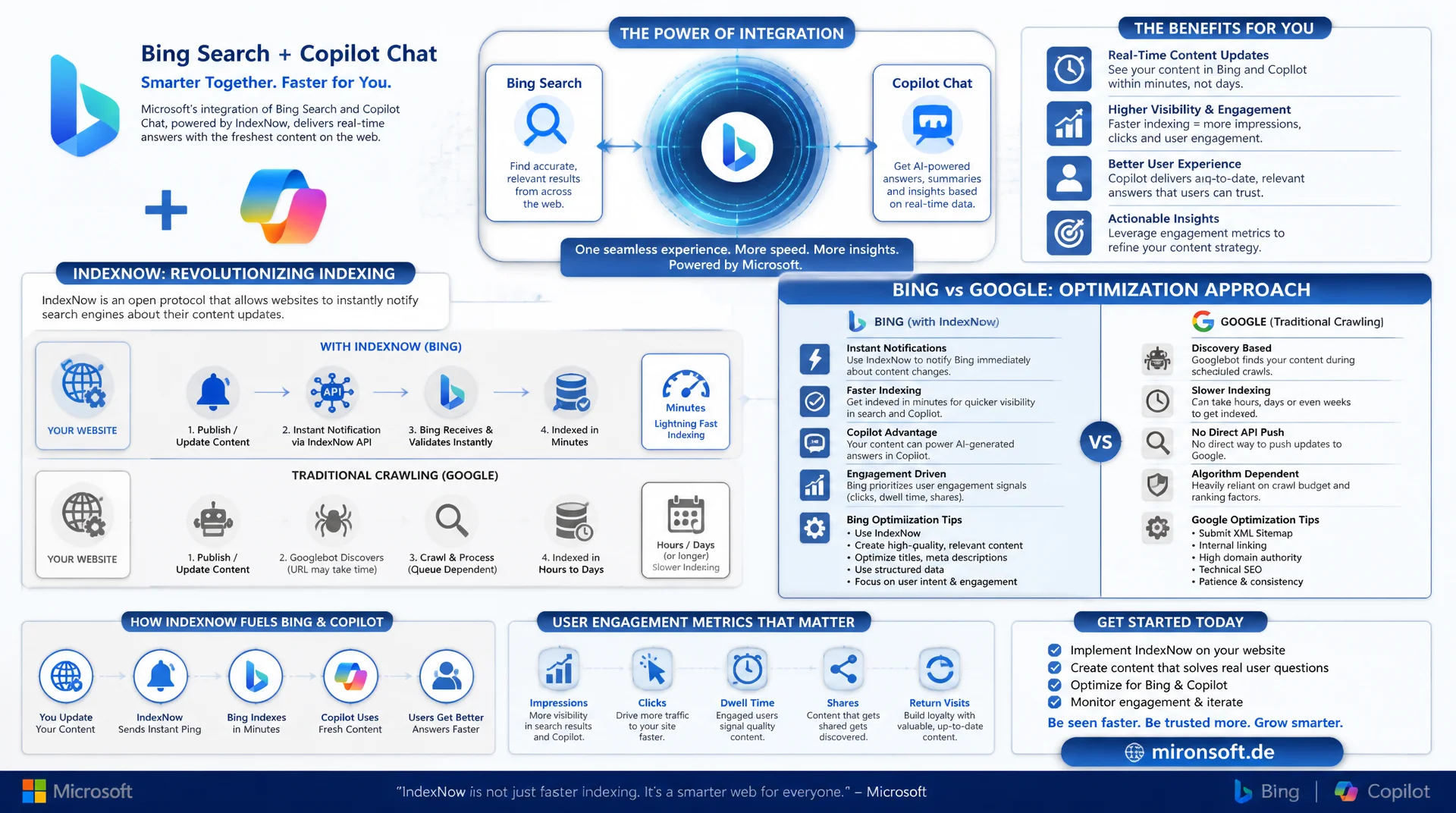
search and chat from one system instead of two separate ones
Microsoft ties Bing search and Copilot chat together more tightly than Google currently ties Google Search and Gemini, and additionally uses IndexNow, a protocol that gets new content into the index considerably faster than classic crawling. Anyone who understands this technical integration can optimize for Bing Copilot on purpose, instead of treating Bing as a smaller Google clone.
Table of contents
- 1. What Bing Copilot is and how it fits in
- 2. The technical architecture of search and chat
- 3. IndexNow: faster indexing as a competitive edge
- 4. How Copilot cites sources in chat
- 5. Bingbot, crawling and technical setup
- 6. Content signals that matter for Bing Copilot
- 7. Windows and Edge integration as a distribution lever
- 8. Measuring visibility on Bing and Copilot
- 9. Bing Copilot compared to Google
- 10. Summary
- 11. FAQ
1. What Bing Copilot is and how it fits in
Bing Copilot, formerly known as Bing Chat, is Microsoft's AI-powered extension of classic Bing search, built on OpenAI models combined with Microsoft's own technology. Unlike separate products such as ChatGPT search and classic Google search, Bing Copilot merges both interaction forms more tightly: users switch seamlessly within the same interface between classic search results and a chat pane that appears directly beside or instead of the results list.
This tight integration matters strategically because Microsoft does not offer Bing Copilot only as a standalone web product, it has embedded it deeply into Windows 11, the Edge browser and Microsoft 365. A user who opens the Windows taskbar can invoke Bing Copilot without a separate website visit, giving the feature a distribution that purely web-based AI search systems like Perplexity do not reach in this form.
For website operators this setup means: Bing Copilot is not an isolated add-on product that should be treated separately from classic Bing SEO, it is a direct extension of the same underlying search infrastructure. Anyone already well positioned for Bing has a structural advantage that carries over directly into Copilot visibility.
2. The technical architecture of search and chat
Technically, Bing Copilot uses the existing Bing search index as its primary data foundation, complemented by retrieval mechanisms necessary for the chat's conversational ability. When a user asks a question, the system searches the Bing index for relevant documents, extracts matching text passages, and passes them as context to the language model, which formulates an answer with embedded citations from them, a pattern structurally similar to the retrieval-augmented generation approach of other AI search systems.
The decisive architectural difference from Google lies in the organizational closeness between search index and chat product. While Google historically had to merge two separately developed product lines with Google Search and Gemini, Bing Copilot was designed from the start as an extension of the existing Bing infrastructure. That leads to shorter development cycles for new features and a more consistent data foundation between classic search and chat answers, which in practice also shows up as more consistent citation results across both modes.
{
  "query": "How does Bing Copilot differ from Google?",
  "index_source": "shared_bing_index",
  "retrieval_passages": 6,
  "citations_in_response": 4,
  "surface": "copilot_chat_pane",
  "note": "Illustrative structure, not a real Microsoft API format"
}
3. IndexNow: faster indexing as a competitive edge
IndexNow is a protocol jointly introduced by Microsoft and Yandex in 2021 that lets website operators actively inform search engines about new or changed URLs instead of waiting for the next regular crawl. Instead of passively waiting for Bingbot, the website sends an HTTP request to an IndexNow endpoint on every relevant change, which forwards the information immediately to all participating search engines. For Bing Copilot, that means a direct speed advantage: new or updated content can land in the index within minutes instead of days, and thereby become citable for chat answers too.
Google deliberately does not participate in IndexNow and instead points to its own mechanisms such as Search Console URL inspection and sitemap crawling, which in practice react considerably slower. This difference makes Bing Copilot potentially faster to show visibility for time-sensitive content, such as breaking news, price changes or recently published product information, than a comparable Google AI feature, an advantage many website operators currently leave unused because IndexNow is technically simple but rarely implemented.
// Simple IndexNow submission via HTTP GET request
// Register the key file at https://mironsoft.de/{key}.txt first
GET https://api.indexnow.org/indexnow
  ?url=https://mironsoft.de/blog/bing-copilot-search-integration
  &key=a1b2c3d4e5f6g7h8i9j0k1l2m3n4o5p6
  &keyLocation=https://mironsoft.de/a1b2c3d4e5f6g7h8i9j0k1l2m3n4o5p6.txt

// Bulk submission for multiple URLs at once
POST https://api.indexnow.org/indexnow
Content-Type: application/json

{
  "host": "mironsoft.de",
  "key": "a1b2c3d4e5f6g7h8i9j0k1l2m3n4o5p6",
  "urlList": [
    "https://mironsoft.de/blog/bing-copilot-search-integration",
    "https://mironsoft.de/blog/generative-engine-optimization-geo-basics"
  ]
}
4. How Copilot cites sources in chat
Bing Copilot typically shows citations as small superscript numbers directly in the answer text, comparable to footnotes in a scientific article, that lead to the respective source when clicked. This presentation form differs from Perplexity's numbered badges and from ChatGPT search, which more often shows sources as separate cards at the end of the answer. For website operators, this footnote-style presentation is relevant because it tends to allow more individual citations per answer than more compact card layouts, since each citation needs less space.
A Copilot-specific trait is the distinction between different conversation modes, which Microsoft calls "More Balanced," "More Precise" and "More Creative." The precise mode sticks more closely to the retrieved source passages and tends to cite more often and more concretely, while the creative mode leaves more room for the model's own independent phrasing and tends to include fewer direct citations as a result. For GEO purposes, the precise mode is the more relevant reference point, because it maps the citation logic most clearly.
<!-- Copilot renders citations as inline superscript footnotes -->
<p>
  IndexNow considerably speeds up indexing of new URLs<sup>1</sup>
  and is deliberately not supported by Google<sup>2</sup>.
</p>
<!-- [1] mironsoft.de/blog/bing-copilot-search-integration
     [2] learn.microsoft.com/bing/indexnow -->
5. Bingbot, crawling and technical setup
Bingbot is the primary crawler that builds the underlying search index for both classic Bing results and Bing Copilot. It can be controlled separately in robots.txt like other crawlers, and additionally respects the Bing Webmaster Tools, through which website operators can manage crawl frequency settings and URL removal requests among other things, a level of control not publicly available in this granular form for Google.
Technically, a similar recommendation applies to Bingbot as to other AI crawlers: server-side rendering or a reliable prerendering fallback matters, because Bingbot's JavaScript rendering capabilities have historically been considered less mature than Googlebot's. Websites that rely heavily on client-side rendering without a fallback thereby risk not only worse classic Bing rankings but also reduced citability in Bing Copilot, since both systems use the same index.
Another difference concerns transparency toward publishers: Microsoft created the Bing Chat Publisher Program, a format through which larger content providers can get direct feedback on their citation frequency, an approach Google has not offered in comparable scope for AI Overviews so far. This program usually stays inaccessible to smaller website operators, but it shows Microsoft prioritizes publisher relationships strategically differently than Google.
# robots.txt: allow Bingbot explicitly, submit via IndexNow for speed
User-agent: bingbot
Allow: /

Sitemap: https://mironsoft.de/sitemap.xml

<!-- Verify site ownership in Bing Webmaster Tools -->
<meta name="msvalidate.01" content="VERIFICATION_TOKEN_HERE" />

<!-- Article schema, helps Bingbot classify author and date -->
<script type="application/ld+json">
{ "@context": "https://schema.org", "@type": "Article",
  "headline": "Bing Copilot Search Integration", "datePublished": "2026-07-23" }
</script>
6. Content signals that matter for Bing Copilot
Microsoft has repeatedly emphasized in its own webmaster guidelines that E-A-T-like signals, authorship, freshness and topical authority, matter for Bing Copilot too, with somewhat stronger weighting of structural clarity than Google applies. Clear heading hierarchies, consistent internal linking within topical clusters and explicit date stamps are repeatedly named as preferred signals in Bing's own documentation.
Another factor traditionally weighted more heavily by Bing than by Google is social signal integration: because Microsoft operates its own social network with LinkedIn, mentions and discussions on LinkedIn demonstrably flow more strongly into Bing scoring than into Google rankings. For B2B-oriented companies already active on LinkedIn, that presents an additional, often unused lever for visibility in Bing Copilot.
{
  "@context": "https://schema.org",
  "@type": "Article",
  "headline": "Bing Copilot Search Integration",
  "author": { "@type": "Person", "name": "Author XY", "sameAs": "https://linkedin.com/in/author-xy" },
  "datePublished": "2026-07-23",
  "dateModified": "2026-07-23"
}
7. Windows and Edge integration as a distribution lever
The deep integration of Bing Copilot into Windows 11 and the Edge browser means a substantial share of usage does not start with a classic search query in a browser tab, it starts through the Windows taskbar, the Edge sidebar, or directly inside Microsoft 365 applications such as Word or Outlook. These contexts produce different usage patterns than classic web search: queries are often more task-oriented, for instance "summarize this article" or "compare these two options," instead of classic keyword searches.
For content strategy this means content well suited for summarization and comparison gets used disproportionately often in these integrated contexts. An article with a clear comparison structure or a concise summary at the top therefore benefits not only from classic Bing search but also from task-oriented usage inside the Microsoft product ecosystem, an aspect that has no direct equivalent in purely web-based AI search systems.
8. Measuring visibility on Bing and Copilot
Bing Webmaster Tools offer partly more granular insight into crawl statistics and URL indexing status compared to Google Search Console, though it does not yet offer dedicated Copilot-specific citation reports at the scope Google has introduced for AI Overviews. For practical monitoring, a combination of server log analysis of Bingbot visits and manual sample checking of relevant queries directly inside Bing Copilot remains the most reliable approach.
Referral traffic from bing.com and copilot.microsoft.com in Google Analytics or comparable tools adds an indirect signal for actual citation clicks. A rise in this referral traffic alongside successful IndexNow submission of new content counts as a practical early warning signal for growing visibility inside the Bing Copilot ecosystem.
9. Bing Copilot compared to Google
The table below sets out the most important structural differences between optimizing for Bing Copilot and classic Google SEO.
| Trait | Bing Copilot | |
|---|---|---|
| Indexing protocol | Sitemap, Search Console inspection | Additionally IndexNow for instant notification |
| Search and chat | Google Search and Gemini historically separate | Integrated from the start, one index |
| Citation presentation | Source cards below the text | Superscript footnotes within the text |
| Operating system integration | No own operating system | Deeply integrated into Windows 11 and Edge |
| Social signal | No own social network | LinkedIn signals demonstrably factor in |
| Publisher programs | No comparable AI Overview program | Bing Chat Publisher Program for larger providers |
The comparison shows Bing Copilot benefits from tighter technical and organizational integration, which shows up as faster indexing, more consistent citation results and additional signal sources such as LinkedIn. A dedicated Bing strategy pays off for website operators even though overall search volume comes in lower than Google's.
Precisely because many competitors treat Bing as secondary and optimize primarily for Google, a targeted Bing Copilot optimization can have a disproportionate effect: competition for citation slots is often lower here, while the technical measures, IndexNow integration and Bingbot allowance, are comparatively easy to implement.
Mironsoft
IndexNow integration and GEO setup for Bing Copilot
Want to become visible in Bing Copilot faster?
We set up IndexNow for instant indexing notifications, verify the domain in Bing Webmaster Tools, and optimize content structure and LinkedIn signals specifically for Bing Copilot.
IndexNow setup
Automated submission of new and changed URLs
Bing Webmaster Tools
Set up verification, crawl settings and monitoring
Content & social
Align structure and LinkedIn presence specifically for Copilot
10. Summary
Bing Copilot differs from Google's approach primarily through the tight technical integration of search index and chat product, faster indexing via IndexNow, and deep integration into Windows 11, Edge and Microsoft 365. This combination gives Bing Copilot advantages for time-sensitive content and for task-oriented usage contexts that have no direct equivalent in purely web-based AI search systems.
A dedicated optimization pays off for website operators: integrate Bingbot correctly, implement IndexNow for instant indexing notifications, verify in Bing Webmaster Tools, and actively work LinkedIn as an additional signal channel. These steps can be implemented well alongside existing Google and GEO optimization, without replacing existing strategies.
Given the comparatively low additional effort and the noticeably lower competition for citation slots on Bing Copilot, this optimization ranks among the most efficient building blocks of a comprehensive GEO strategy that considers classic SEO, ChatGPT search, Perplexity and Google AI Overviews alike.
Optimizing Bing Copilot: the essentials at a glance
Use IndexNow
Report new and changed URLs instantly via IndexNow instead of waiting for regular crawling.
One index for search and chat
Bingbot optimization directly affects both classic Bing results and Copilot.
LinkedIn signals
Mentions and discussions on LinkedIn demonstrably flow more strongly into Bing scoring than into Google's.
Windows integration
Task-oriented usage in Windows and Edge favors summary-friendly content.