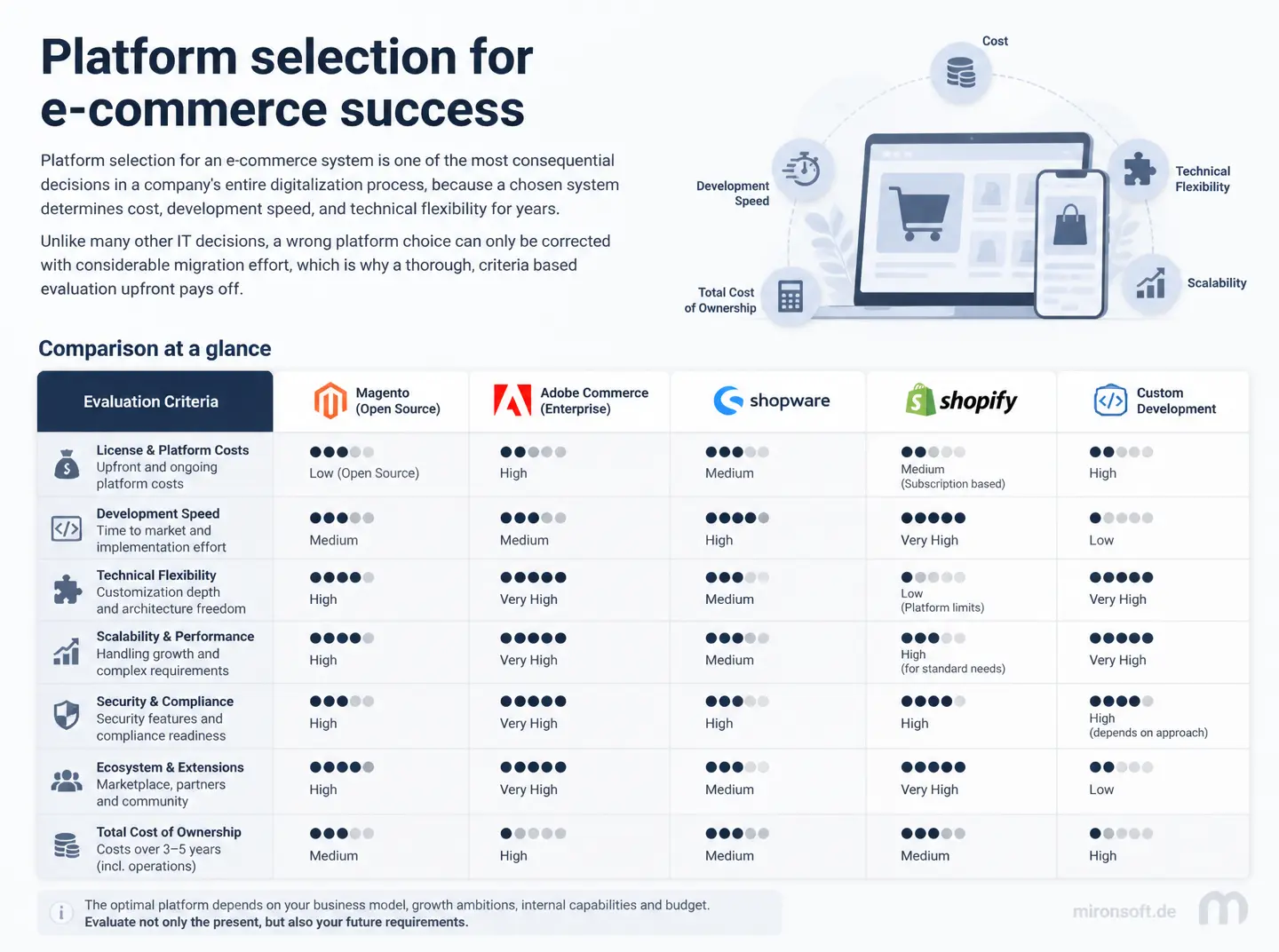
Which evaluation criteria actually matter for platform selection and how Magento, Shopware, Shopify, and custom development compare
Platform selection for an e-commerce system is one of the most consequential decisions in a company's entire digitalization process, because a chosen system determines cost, development speed, and technical flexibility for years. Unlike many other IT decisions, a wrong platform choice can only be corrected with considerable migration effort, which is why a thorough, criteria based evaluation upfront pays off. This article places the key evaluation criteria and compares Magento and Adobe Commerce against the common alternatives Shopware, Shopify, and custom development.
Table of Contents
- 1. Why platform selection determines cost and flexibility for years
- 2. Evaluation criteria for platform selection: scalability, TCO, and ecosystem
- 3. Placing Magento and Adobe Commerce
- 4. Placing Shopware as an alternative
- 5. Placing Shopify and other SaaS platforms
- 6. Custom development as the extreme case of platform selection
- 7. Weighing B2B versus B2C requirements in platform selection
- 8. Migration effort as an often underrated factor
- 9. E-commerce platforms compared
- 10. Summary
- 11. FAQ
1. Why platform selection determines cost and flexibility for years
An e-commerce system is rarely an isolated application, it integrates deeply with ERP, PIM, payment providers, and marketing tools, meaning a later platform switch affects far more than the storefront frontend code alone. Every one of those integrations has to be rebuilt on a switch, which regularly gets underestimated in the actual migration effort when platform selection is decided purely on visible frontend features.
On top of that, license models, available developer resources on the market, and the cost of custom adjustments differ considerably between platforms, meaning the same business requirement can cause a completely different implementation effort depending on the chosen system. A careful platform selection upfront therefore saves not just migration costs but ongoing development costs across the store's entire lifetime.
2. Evaluation criteria for platform selection: scalability, TCO, and ecosystem
Scalability covers both the technical ability to handle growing traffic and catalog size, and the organizational ability to add new country storefronts, brands, or sales channels without fundamental architecture changes. Total cost of ownership, meaning total cost over several years, should include license and hosting costs as well as development costs for custom adjustments and the effort for maintenance and updates, instead of only comparing initial project costs.
A platform's ecosystem, meaning the availability of qualified developers, agencies, and ready made third party extensions, significantly influences how quickly and at what cost new requirements can be implemented in the future. A technically superior system with a very small developer ecosystem can in practice be more expensive and slower to extend than a somewhat simpler system with broad market availability of skilled professionals.
3. Placing Magento and Adobe Commerce
Magento Open Source offers a very flexible, deeply customizable architecture with service contracts, plugins, and an extensive ecosystem of extensions, but demands qualified development resources and a higher initial implementation effort than many SaaS alternatives. Adobe Commerce, the commercial variant with additional B2B, PWA, and marketing features, suits companies with more complex B2B requirements or very high traffic best, where the extra license cost pays off through saved custom development.
For companies with high customization needs, complex ERP integrations, or specific B2B requirements, Magento or Adobe Commerce usually remains the technically superior choice, provided the company is willing to invest in qualified development resources and a reasonable implementation timeline instead of prioritizing the fastest possible initial launch above everything else.
4. Placing Shopware as an alternative
Shopware positions itself, especially in German speaking markets, as a Magento alternative with a modern, Symfony based architecture and often lower initial implementation effort for standard requirements. For companies with a predominantly German speaking target market and a strong focus on fast time to market, Shopware offers a serious alternative, particularly when B2B requirements are not as complex as a typical Magento B2B project.
For very complex, highly customized requirements, or when extensive Magento specific know-how already exists in the company, Shopware's comparatively smaller developer ecosystem can be a limiting factor for international enterprise projects.
5. Placing Shopify and other SaaS platforms
SaaS platforms such as Shopify offer the fastest route to a production store without running dedicated server infrastructure, but require compromises on deep custom adjustments, since the platform's core architecture cannot be modified. For companies with modest, largely standardized requirements and limited in-house development resources, that compromise is often sensible, since time to market and operating effort turn out considerably lower.
For growing, more complex B2B requirements or deep ERP integrations, as described in the other articles of this series, SaaS platforms instead hit clear limits, since deep changes to the core logic are either impossible or only possible through costly workarounds.
6. Custom development as the extreme case of platform selection
A fully custom build offers maximum flexibility without any constraints from someone else's architecture decisions, but requires an in-house development team that rebuilds, over years, functionality established platforms already bring, such as checkout logic, tax calculation, or search indexing. That effort is frequently underestimated in the initial cost estimate, since the real challenge lies not in the initial build but in long term maintenance and further development.
Custom development in practice pays off almost exclusively for companies whose business model differs fundamentally from classic e-commerce and for which no existing platform offers a sensible foundation, not for a desire for slightly more individual design or slightly different standard features.
7. Weighing B2B versus B2C requirements in platform selection
The requirements of a B2B onlineshop, such as company accounts, approval workflows, and individual price lists, as described in detail in the corresponding article in this series, are supported very differently across platforms. Magento and Adobe Commerce offer a clear head start here with their dedicated B2B module compared to many alternatives, where complex B2B features often have to be retrofitted through costly third party extensions.
For a pure B2C business model with a simple pricing structure, that head start matters considerably less, meaning platform selection in that case should depend more on other criteria such as time to market and ecosystem than on B2B specific feature depth.
8. Migration effort as an often underrated factor
When switching from an existing platform, migration effort is regularly underestimated, since besides pure product data migration, existing SEO rankings have to be preserved through URL redirects, customer accounts transferred cleanly, and every existing system integration rebuilt from scratch. An insufficiently planned migration process frequently leads to noticeable revenue loss in the weeks after the switch, even when the new platform is technically superior.
A realistic migration plan should therefore build in enough buffer time for parallel operation, extensive testing, and a gradual rather than fully abrupt cutover, especially for stores with high ongoing order volume, where even short disruptions become immediately felt economically.
9. E-commerce platforms compared
The table below compares the main platform options across key decision criteria.
| Platform | Flexibility | Typical Implementation Effort | Best Suited For |
|---|---|---|---|
| Magento / Adobe Commerce | Very high | High | Complex B2B requirements, custom ERP integration |
| Shopware | High | Medium | German speaking market, moderate customization |
| Shopify / SaaS platforms | Low to medium | Low | Standardized requirements, fast time to market |
| Custom development | Maximum | Very high | Business models without a fitting existing platform |
Mironsoft
Magento development, module consulting, and system architecture
A Magento project that needs a second opinion or experienced execution?
We build custom Magento modules, advise on architecture decisions, and take on complex implementations, from service contract planning to production-ready deployment.
Architecture Consulting
Have module and system architecture thought through properly before you build.
Custom Module Development
Build custom Magento modules cleanly, following best practices.
Code Review & Audit
Have existing modules reviewed for performance, security, and maintainability.
10. Summary
Platform Selection: The Essentials at a Glance
Core idea
Platform selection determines cost and flexibility for years, a later switch is correspondingly expensive.
Key distinction
Magento and Adobe Commerce offer the most depth for complex B2B requirements, SaaS platforms the fastest time to market.
Biggest risk
Choosing a platform based solely on visible frontend features, without considering integrations and TCO.
Success criterion
The chosen platform fits both the business requirements and the internally available resources.