Why the online store is the practical starting point and how ERP and PIM integration work as concrete building blocks of digital transformation
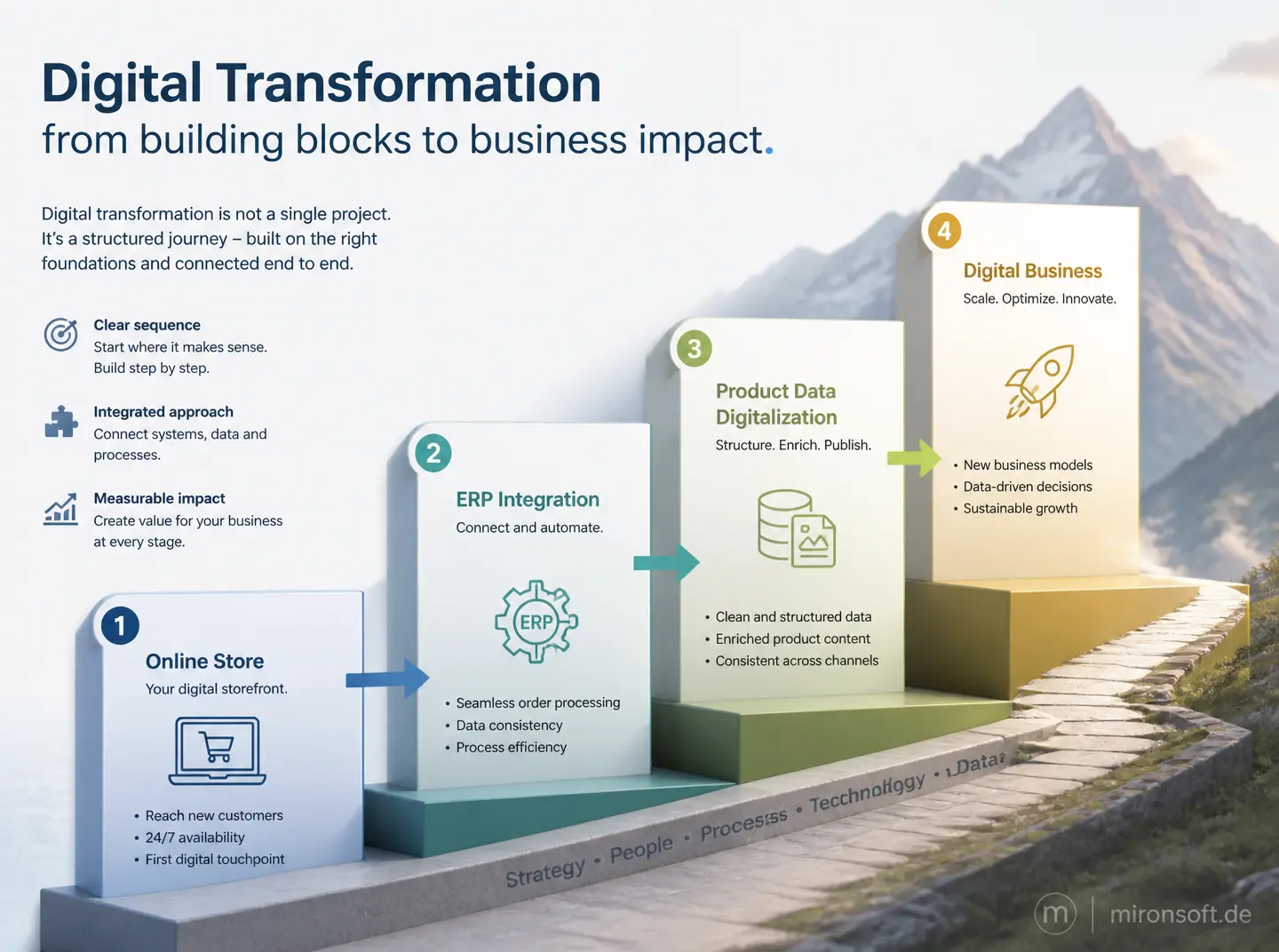
Digital transformation is one of the most frequently used and simultaneously worst defined buzzwords in consulting conversations with midsize companies. Management is often left unclear on where to even start, while IT departments end up with a list of individual digitalization projects lacking a coherent thread. This article grounds the term in concrete, technically tangible building blocks, starting with the online store, moving through ERP integration, to product data digitalization, and shows a sensible sequence for implementation.
Table of Contents
- 1. Why digital transformation in midsize companies often stays too abstract
- 2. The online store as a practical starting point for concrete digitalization
- 3. ERP integration as the first concrete building block
- 4. Product data digitalization through a PIM as the second building block
- 5. Process automation instead of isolated point solutions
- 6. Change management: bringing staff along instead of just rolling out software
- 7. Prioritization: which building block should come first
- 8. Common pitfalls in midsize digitalization projects
- 9. Digitalization maturity levels at a glance
- 10. Summary
- 11. FAQ
1. Why digital transformation in midsize companies often stays too abstract
Many strategy papers formulate digital transformation as an overarching vision without deriving concrete, prioritized individual steps from it. That abstraction feels tangible for management as long as it stays on a slide, but becomes a problem once budget and staff actually need to be allocated for implementation, because it remains unclear which project should be tackled first.
A more pragmatic approach does not start with strategy but with concrete operational pain points: duplicate data maintenance between the storefront and ERP, manual order entry, or inconsistent product data across multiple channels. Each of these pain points maps to a concrete technical building block, turning digital transformation from an abstract goal into a series of clearly implementable projects. That translation from buzzword to concrete project also matters because it is the only way to formulate a realistic business case with measurable benefit that management can actually approve.
2. The online store as a practical starting point for concrete digitalization
A Magento storefront already brings structured data, defined interfaces, and a clear process framework, making it a natural starting point for further digitalization steps. Once the storefront is established as the central frontend, gaps to other systems become immediately visible, for instance when stock levels do not update automatically or orders need manual transfer into the ERP.
That visibility is valuable because it no longer requires justifying further digitalization steps abstractly, they can instead be prioritized based on concrete friction points felt in daily operations. A company that manually transfers orders between the storefront and the ERP every day has an obvious, easily quantified reason for an ERP connection as the next step.
3. ERP integration as the first concrete building block
Once orders, stock levels, and customer data sync automatically between the storefront and the ERP, one of the biggest sources of error in daily operations disappears, namely manually entering the same information twice across two systems. How such a connection to Microsoft Dynamics or SAP is technically built is described in detail in this series' respective ERP integration articles.
What matters for the digitalization strategy here above all is recognizing that an ERP connection is not an isolated IT project, it directly changes processes in sales, warehousing, and accounting that need to be prepared accordingly before the technical integration goes live.
4. Product data digitalization through a PIM as the second building block
Once order and stock data flow automatically, the next weak spot often becomes visible: product data gets maintained redundantly and inconsistently across multiple systems, especially once several languages, brands, or sales channels enter the picture. A central PIM system such as Pimcore, described in detail in the corresponding article in this series, solves that problem by maintaining product data in one place and distributing it from there to every target system.
This sequence, ERP integration first, then PIM integration, has proven itself in practice, because both projects touch different departments and tackling them simultaneously usually exceeds most midsize companies' change management capacity.
5. Process automation instead of isolated point solutions
A common mistake in digitalization projects is looking at individual systems in isolation, without considering the end to end process across system boundaries. An automated ERP connection that transfers orders but still requires manual invoice review only solves part of the actual problem and leaves most of the original effort untouched.
Successful digitalization projects therefore first define the desired end to end process, from customer order through delivery to invoicing, and only then identify which individual system connections are actually necessary for that continuous process, instead of digitalizing systems independently of each other.
6. Change management: bringing staff along instead of just rolling out software
Every technical integration changes established workflows, and staff who have been used to manual order entry for years often initially experience an automated connection as a loss of control rather than relief. Without early involvement of the affected departments in the concept phase, resistance builds up that can make a technically flawless project fail in day to day operations anyway.
A proven approach is involving affected staff already at the requirements definition stage, instead of only informing them once a finished solution exists, and running new processes in parallel with the existing workflow before switching the old process off entirely.
7. Prioritization: which building block should come first
The right sequence depends on the biggest current pain point, not a one size fits all blueprint. A company with heavy manual order transfer effort should start with the ERP connection, while a company with inconsistent product data across multiple country storefronts benefits first from a PIM integration.
An honest inventory of the actual operational pain points, ideally quantified with concrete time or error costs, delivers a considerably more solid basis for prioritization than an abstract digitalization roadmap disconnected from daily operations.
8. Common pitfalls in midsize digitalization projects
A frequent pitfall is expecting a single project to solve every digitalization problem at once, which in practice leads to bloated project scopes and delayed results. Equally problematic is too short a testing phase before going live, since data quality problems from legacy systems often only surface once actual synchronization with a new system happens.
A third, often underestimated pitfall is missing internal knowledge after project completion: if only an external service provider understands the new integration, a dependency develops that causes unnecessary time and cost for any future adjustment.
9. Digitalization maturity levels at a glance
The table below maps typical starting situations of midsize companies to a maturity level and recommended next step.
| Maturity Level | Typical Starting Situation | Biggest Pain Point | Recommended Next Step |
|---|---|---|---|
| Basic | Storefront and ERP completely separate | Manual order transfer | ERP integration for order sync |
| Intermediate | ERP connected, product data redundant | Inconsistent product data across channels | PIM integration |
| Advanced | ERP and PIM connected, processes fragmented | Missing end to end view | Process automation across system boundaries |
| Mature | Systems integrated, adoption lacking | Low usage in daily operations | Targeted change management |
Mironsoft
Magento development, module consulting, and system architecture
A Magento project that needs a second opinion or experienced execution?
We build custom Magento modules, advise on architecture decisions, and take on complex implementations, from service contract planning to production-ready deployment.
Architecture Consulting
Have module and system architecture thought through properly before you build.
Custom Module Development
Build custom Magento modules cleanly, following best practices.
Code Review & Audit
Have existing modules reviewed for performance, security, and maintainability.
10. Summary
Digital Transformation: The Essentials at a Glance
Core idea
Digital transformation becomes tangible once it is grounded in concrete building blocks like ERP and PIM integration.
Key distinction
Operational pain points provide a more solid basis for prioritization than an abstract digitalization roadmap.
Biggest risk
Missing change management can make a technically flawless project fail in day to day operations anyway.
Success criterion
A continuous end to end process emerges, instead of isolated, individually digitalized systems.