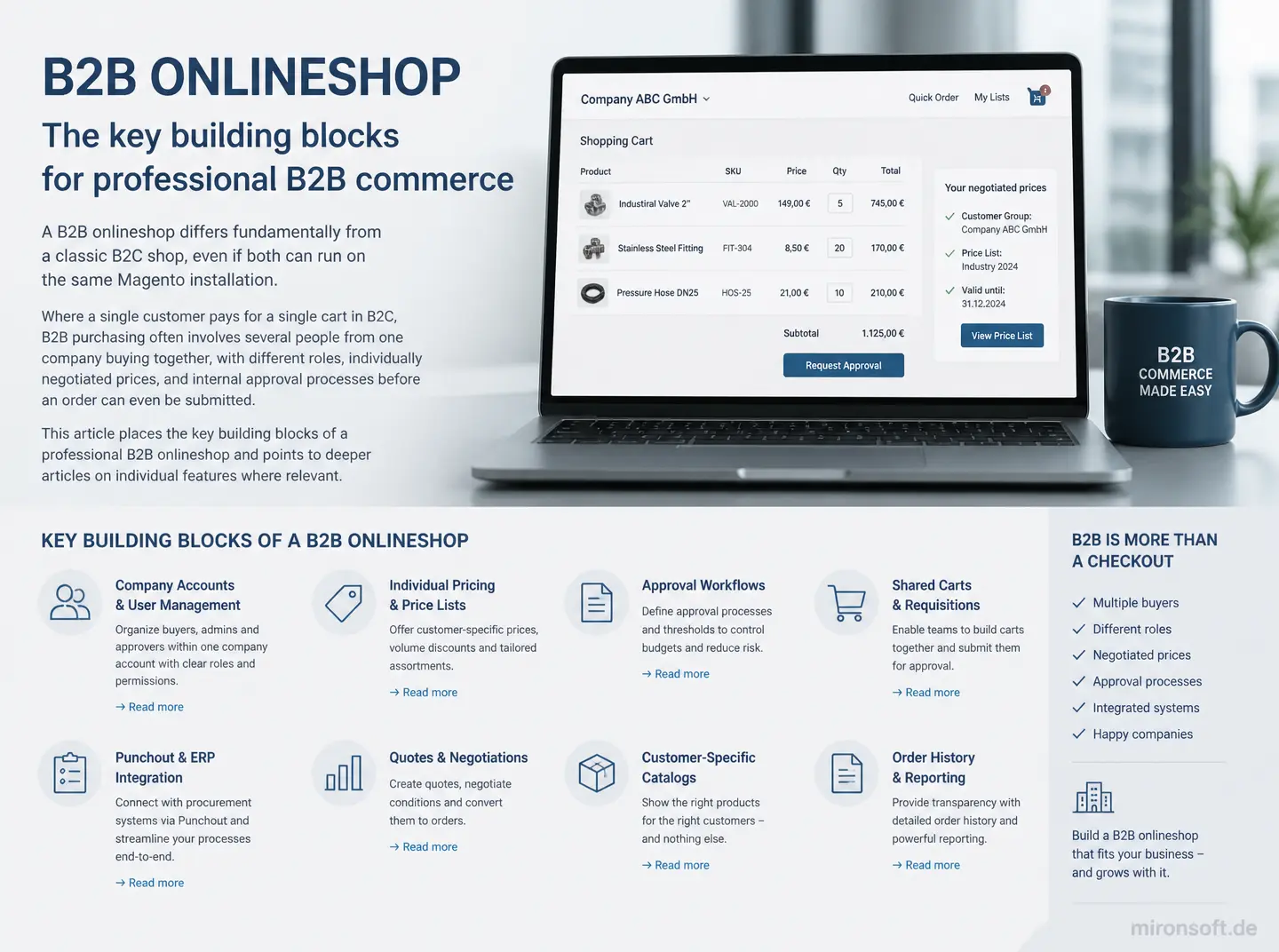
Which building blocks a professional B2B onlineshop actually needs, from company accounts through tiered pricing to approval workflows
A B2B onlineshop differs fundamentally from a classic B2C shop, even if both can run on the same Magento installation. Where a single customer pays for a single cart in B2C, B2B purchasing often involves several people from one company buying together, with different roles, individually negotiated prices, and internal approval processes before an order can even be submitted. This article places the key building blocks of a professional B2B onlineshop and points to deeper articles on individual features where relevant.
Table of Contents
- 1. What sets a B2B onlineshop apart from a classic B2C shop
- 2. Company accounts and user roles as the foundation
- 3. Tiered pricing and customer specific price lists
- 4. Planning order approval workflows properly
- 5. Quick order and reorder for frequent buyers
- 6. Visibility and catalog control per customer group
- 7. Payment methods in B2B: invoice purchases and credit limits
- 8. Technical foundation in Magento: the B2B module and alternatives
- 9. B2B versus B2C requirements at a glance
- 10. Summary
- 11. FAQ
1. What sets a B2B onlineshop apart from a classic B2C shop
In B2C, a single person makes the purchase decision, pays immediately by card or a comparable instant method, and expects the same catalog price as every other customer. A B2B onlineshop, by contrast, has to model a company buying as a legal entity, several employees acting under one account with different permissions, and prices that are frequently negotiated individually instead of publicly listed.
These structural differences cannot be solved by cosmetically adjusting a B2C shop, they require dedicated data models for company accounts, price lists, and approval processes. Anyone trying to bolt B2B requirements onto a pure B2C architecture afterward runs into clear technical limits at the latest once approval workflows and customer specific catalogs enter the picture.
2. Company accounts and user roles as the foundation
A company account bundles several individual user accounts under a shared corporate structure, with each user getting a clearly defined role, for instance buyers with ordering rights up to a set limit, approvers for higher amounts, and administrators who can manage further employees. That role structure needs to flexibly match the customer company's actual organization instead of forcing a rigid, identical scheme onto every customer.
Magento's B2B functionality models company accounts through a dedicated company module that structures employees, roles, and permissions cleanly, kept separate from classic customer management. For companies with more complex hierarchies, for instance several departments with their own budgets, it is worth clarifying early how granular the role structure actually needs to be, since excessive granularity needlessly complicates administration.
3. Tiered pricing and customer specific price lists
In B2B, volume discounts and individually negotiated prices are the rule rather than the exception, so a B2B onlineshop has to support both quantity based tiered pricing per product and entirely separate price lists for individual key accounts. Those price lists should be maintainable centrally, without manually adjusting product prices for every customer one by one, since that effort becomes unmanageable as the customer base grows.
Magento's shared catalogs functionality, covered in detail in a dedicated deep dive article in this series, supports exactly that kind of customer specific pricing by assigning individual customers or customer groups to their own catalog with adjusted prices, instead of applying global pricing rules equally to every B2B customer.
4. Planning order approval workflows properly
Once an employee is not allowed to freely draw on their company's entire purchasing budget, the shop needs an approval workflow that only actually places an order once an authorized person has signed off. That approval can depend on a fixed amount threshold or on more complex rules, such as multi stage approval for particularly high order values.
Related functionality such as negotiable quotes, where a customer submits their own price proposal for internal review and approval, is covered in detail in a separate, deeper article in this series. What matters most for the base architecture here is that approval workflows get baked into the data model from the start, instead of being bolted on as an afterthought.
5. Quick order and reorder for frequent buyers
B2B customers frequently reorder the same or very similar items, such as consumables or spare parts, which makes a plain category browsing search too slow for this audience. A quick order feature that lets item numbers be added to the cart directly or in bulk through a CSV upload speeds up that recurring order process considerably.
This feature can additionally be secured through a dedicated backend API that also enables programmatic orders from the customer's own procurement system, which is covered in a separate, more technical article in this series. For a B2B onlineshop's base feature set, a performant quick order form in the storefront is enough to start with.
6. Visibility and catalog control per customer group
Not every B2B customer should see the entire assortment, for instance because certain product lines are reserved exclusively for selected sales partners or a customer is contractually limited to a defined subset of the catalog. That visibility control has to be configurable per customer group or even per individual company account, without maintaining a separate category structure for every exception.
A separate, deeper article in this series covers catalog permissions and the technical implementation of such customer specific visibility rules in detail, including the performance implications of a large number of different visibility tiers.
7. Payment methods in B2B: invoice purchases and credit limits
While credit card or comparable instant payment methods dominate B2C, purchase on invoice with a fixed payment term is the most common payment method in B2B, often combined with an individual credit limit per customer. The shop therefore needs to check whether a new order value would exceed a customer's remaining credit limit before accepting the order.
This credit limit logic ties closely to an ERP connection, for instance to SAP or Microsoft Dynamics, since the actual available credit limit is usually maintained in the leading ERP system rather than duplicated in the shop, a point covered in more depth in this series' ERP integration articles.
8. Technical foundation in Magento: the B2B module and alternatives
Magento Commerce ships the B2B module with company accounts, shared catalogs, requisition lists, and quick order functionality already built in, which considerably reduces development effort for many standard requirements. For Open Source installations without that module, the equivalent functionality has to be rebuilt through third party extensions or custom development, noticeably increasing project scope.
When deciding for or against the B2B module, it is worth clarifying early which of the described features are actually needed, instead of assuming a full B2B feature set is required across the board when the business model may not need that depth at all.
9. B2B versus B2C requirements at a glance
The table below compares the key differences between B2B and B2C requirements for a Magento onlineshop.
| Requirement | B2C Onlineshop | B2B Onlineshop | Typical Magento Feature |
|---|---|---|---|
| Buyer structure | Individual person | Multiple users per company account | Company module with roles |
| Pricing | Uniform catalog price | Individual price lists, tiered pricing | Shared Catalogs |
| Order approval | Immediate payment | Multi stage internal approval | Approval workflows |
| Order behavior | Occasional purchase | Recurring bulk orders | Quick order, requisition lists |
Mironsoft
Magento development, module consulting, and system architecture
A Magento project that needs a second opinion or experienced execution?
We build custom Magento modules, advise on architecture decisions, and take on complex implementations, from service contract planning to production-ready deployment.
Architecture Consulting
Have module and system architecture thought through properly before you build.
Custom Module Development
Build custom Magento modules cleanly, following best practices.
Code Review & Audit
Have existing modules reviewed for performance, security, and maintainability.
10. Summary
B2B Onlineshop: The Essentials at a Glance
Core idea
A B2B onlineshop needs dedicated data models for company accounts, price lists, and approval workflows, not a retrofit of a B2C shop.
Key distinction
Prices get negotiated individually in B2B and orders are often approved internally in multiple stages.
Biggest risk
Bolting B2B requirements onto a pure B2C architecture afterward instead of planning for them from the start.
Success criterion
Company accounts, price lists, and approval workflows work together without slowing down ordering for frequent buyers.