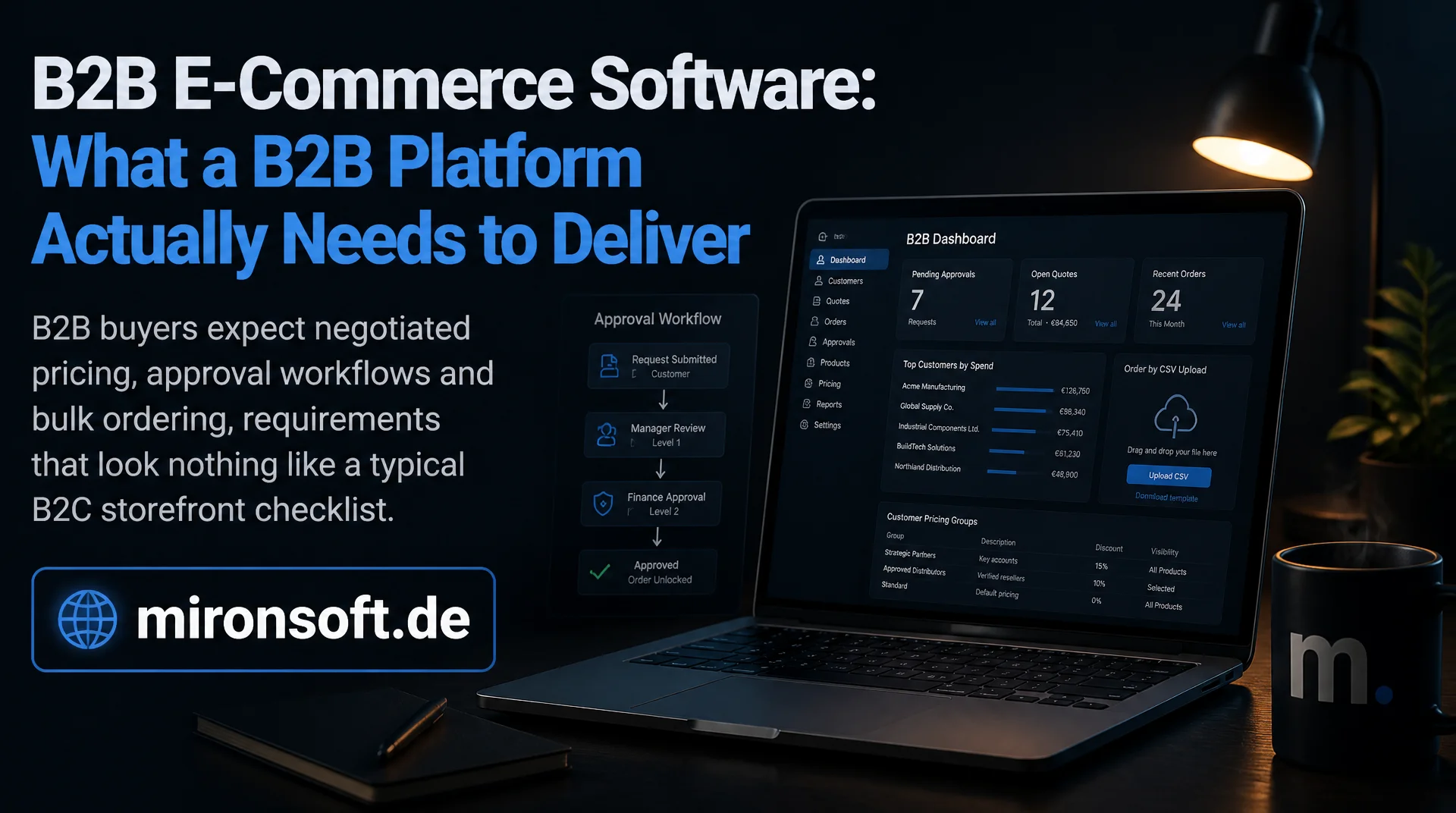
What a B2B platform needs beyond a classic online store, from company accounts to ERP integration
B2B e-commerce differs more fundamentally from classic B2C retail than it might seem at first glance, even when both run on the same technical platform. Where a single B2C customer pays for a single cart, B2B purchasing often involves several people from one company buying together, with different roles, individually negotiated prices, and internal approval processes before an order can even be submitted. This article places the core requirements for B2B e-commerce software and shows what actually matters when selecting or building such a platform.
Table of Contents
- 1. Why B2B e-commerce has different requirements than B2C
- 2. Modeling company accounts and multi user structures
- 3. B2B pricing: tiered pricing, contract pricing, and credit limits
- 4. Modeling approval processes and order workflows
- 5. ERP integration as the backbone of B2B e-commerce
- 6. Quick order and recurring orders
- 7. Content and catalog design for B2B buyers
- 8. A typical rollout roadmap for a B2B e-commerce launch
- 9. Selection criteria for B2B e-commerce software at a glance
- 10. Summary
- 11. FAQ
1. Why B2B e-commerce has different requirements than B2C
In B2C retail a single person usually decides on a purchase spontaneously, while B2B e-commerce often runs a multi step procurement process with a buyer, a department, and an approval instance before an order is actually placed. A platform designed purely for B2C typically does not model that process at all, forcing companies to organize it manually outside the store, for instance through email approvals or a separate quoting process.
On top of that, B2B customers almost never pay the same price as other customers, but rather individually negotiated terms, framework contracts, or volume based tiered pricing that a plain B2C pricing model simply cannot represent. Real B2B e-commerce software has to account for that reality from the ground up, instead of bolting it on as an afterthought to a B2C system.
2. Modeling company accounts and multi user structures
A defining feature of any B2B e-commerce platform is the company account, under which several individual user accounts with different roles and permissions are grouped, instead of every employee creating an isolated, unrelated customer account. Typical roles include buyers who may create orders, approvers who must confirm orders above a certain value, and administrators who create new users within the company account and manage permissions.
This structure also has to support multiple shipping addresses, cost centers, and sometimes multiple billing addresses per company account, since larger companies often order through the same platform across several locations. Without that flexibility, purchasing departments frequently fall back on shadow IT solutions such as shared spreadsheets, undermining the whole point of a central B2B platform.
3. B2B pricing: tiered pricing, contract pricing, and credit limits
B2B pricing is considerably more complex than a single sale price per product: volume tiers lower the unit price above certain order quantities, individually negotiated contract prices apply only to a specific company account, and some customers receive special terms only for selected product categories. A B2B e-commerce platform has to support all of these pricing rules simultaneously and prioritize them correctly, without administrators having to fight through contradictory rules.
Credit limits add a financial control layer on top of pricing: a company account with a configured limit may keep ordering as long as the sum of open orders stays below that limit, and the platform has to react automatically both when the limit is exceeded and as it is being approached. This logic ties closely into ERP integration, for instance with SAP or Microsoft Dynamics, since credit limits are usually maintained in the ERP as the leading system.
4. Modeling approval processes and order workflows
An approval process defines the order value above which an order does not go directly to fulfillment, but is first presented to one or more approval instances for confirmation. Technically that means an order passes through an intermediate state between cart and actual order, in which it can be viewed, commented on, rejected, or approved by an authorized person.
For multi step approvals, such as a departmental approval followed by a financial approval from purchasing, the platform needs to model several approval stages in sequence, including a clear notification to whoever is responsible at each stage. Without native workflow support like this, parallel email based approval processes emerge in practice, making the actual order status in the store effectively invisible.
5. ERP integration as the backbone of B2B e-commerce
Almost every B2B e-commerce platform stays in close exchange with an ERP system, since item master data, price lists, credit limits, and order status are maintained there anyway, and duplicate data handling in the store would lead to inconsistencies. What such an integration looks like technically differs a lot depending on the ERP system in use, such as SAP, Microsoft Dynamics, or industry specific inventory systems, and is covered in dedicated, more technical integration articles.
For choosing a B2B e-commerce platform, it is enough at this point to recognize that a solid, well documented API to the ERP system in use is not an optional add-on, but a basic requirement without which credit limits, contract prices, and order status in the store simply cannot stay current.
6. Quick order and recurring orders
B2B buyers frequently reorder the same or very similar items, such as consumables or spare parts, which is why a quick order feature by item number or CSV upload matters far more for B2B e-commerce than in classic B2C retail with its more exploratory shopping behavior. A good quick order feature allows entering several item numbers together with quantities directly in a single view, without having to navigate the category tree separately for every product.
On top of that, many B2B customers expect a reorder feature that recreates a past order as a new order with a single click, ideally with updated prices and a check against current availability. This feature significantly cuts the time needed for recurring orders and is often a deciding factor in whether purchasing departments actually use a B2B platform or fall back on the phone instead.
7. Content and catalog design for B2B buyers
Before ordering, B2B buyers often research technical details that rarely matter in B2C retail, such as data sheets, compliance certificates, CAD drawings, or minimum order quantities. A B2B e-commerce platform has to manage such documents in a structured way per product and make them easy to find for logged in company accounts, instead of treating them as just one of many generic product descriptions.
It is also often useful for B2B assortments to make certain products or prices visible only to logged in, authorized company accounts, instead of showing them publicly in the catalog, for instance with project specific special terms or confidentially negotiated framework contracts. This visibility control should work granularly at the product, category, or price level.
8. A typical rollout roadmap for a B2B e-commerce launch
Launching a B2B e-commerce platform should not start with the full assortment and every company account at once, but with a manageable pilot group of a few cooperative existing customers who can give early feedback on approval processes and pricing logic. That pilot phase surfaces typical configuration mistakes, such as incorrectly set credit limits or incomplete price lists, before they affect the entire customer base.
After a successful pilot phase, further company accounts get migrated step by step, usually staggered by revenue volume or sales region, so support effort for questions about the new platform stays manageable. In parallel, ERP integration should already be fully live, since activating ERP synchronization only after the rollout tends to produce data inconsistencies that require extra effort to clean up afterward.
9. Selection criteria for B2B e-commerce software at a glance
The table below summarizes the most important requirements to guide the selection of a B2B e-commerce platform.
| Requirement | Why It Matters | Typical Risk Without It | Priority |
|---|---|---|---|
| Company accounts with roles | Reflects real purchasing structures | Users create private customer accounts | High |
| Tiered and contract pricing | Individual terms per company account | Manual discounting outside the store | High |
| Approval processes | Enforce internal procurement rules | Parallel approval by email instead of in the store | Medium |
| ERP integration | Current prices, limits, stock | Stale data in the store | High |
A Magento project that needs a second opinion or experienced execution?
We build custom Magento modules, advise on architecture decisions, and take on complex implementations, from service contract planning to production-ready deployment.
Architecture Consulting
Have module and system architecture thought through properly before you build.
Custom Module Development
Build custom Magento modules cleanly, following best practices.
Code Review & Audit
Have existing modules reviewed for performance, security, and maintainability.
10. Summary
B2B E-Commerce Software: The Essentials at a Glance
Core idea
B2B e-commerce software has to model company accounts, approval processes and individual pricing from the ground up.
Key distinction
Unlike B2C, a single person rarely decides on an order alone.
Biggest risk
Missing native approval and pricing logic pushes parallel shadow processes outside the store.
Success criterion
Purchasing departments actively use the platform instead of falling back on phone or email.