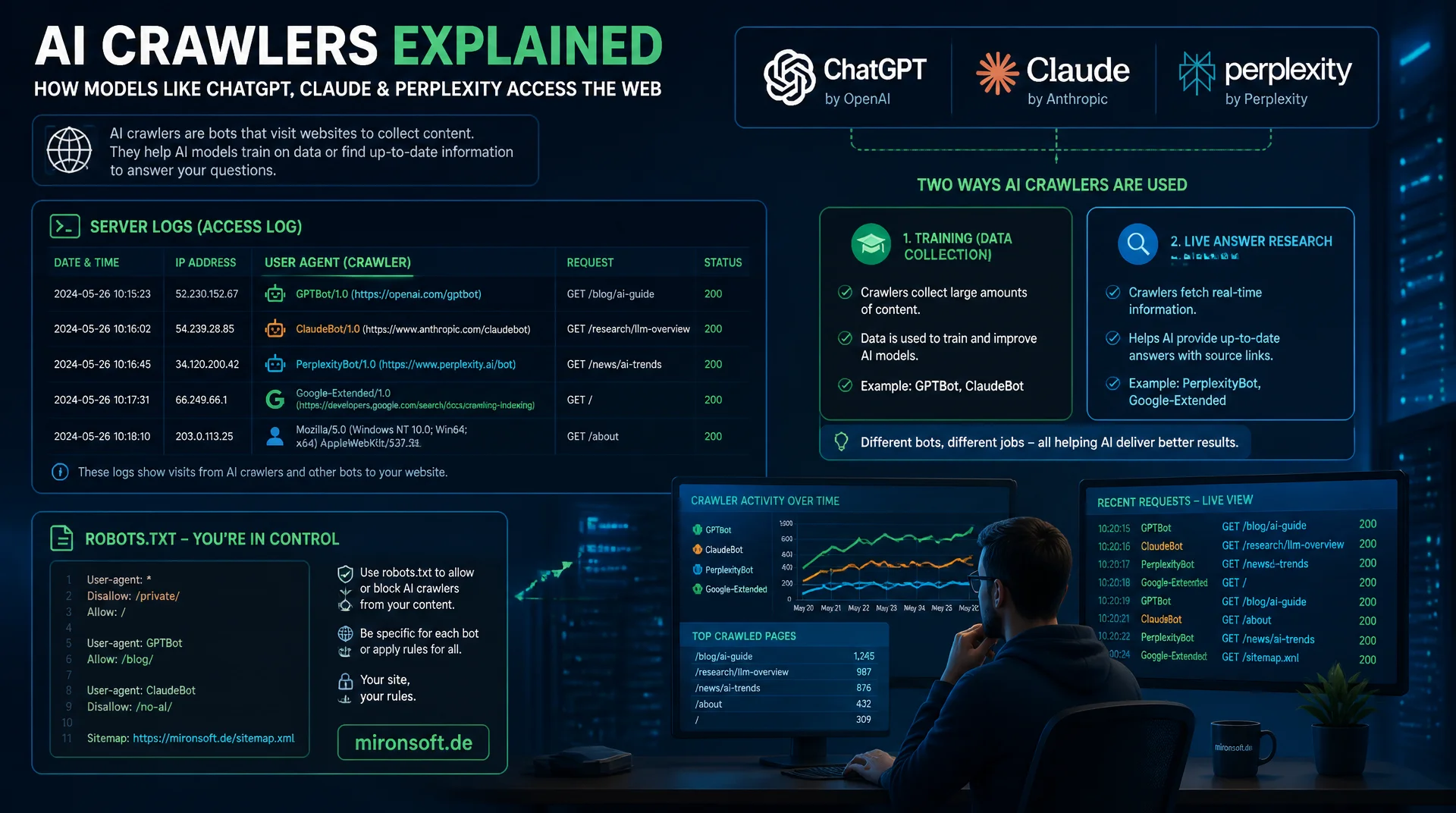
Understanding and Controlling AI Crawlers
Behind every citation that ChatGPT, Claude or Perplexity generates from a website sits an AI crawler that read the page beforehand. Anyone who knows the user agent strings of GPTBot, ClaudeBot, PerplexityBot and Google-Extended can distinguish in the server log whether a model is currently training or researching a live answer, and can open or block that traffic deliberately through robots.txt and llms.txt.
Table of Contents
- 1. Why AI Crawlers Behave Differently From Classic Search Engine Bots
- 2. The Most Important AI Crawlers at a Glance
- 3. Recognizing User Agent Strings and Identifying Them in Server Logs
- 4. Training vs. Live Retrieval: Two Different Purposes
- 5. robots.txt: Controlling AI Crawlers Deliberately
- 6. llms.txt: The New Standard for AI Access Control
- 7. Server Log Analysis: Evaluating AI Traffic
- 8. IP Verification and Detecting Bot Spoofing
- 9. AI Crawlers Compared Directly
- 10. Summary
- 11. FAQ
1. Why AI Crawlers Behave Differently From Classic Search Engine Bots
A classic search engine bot like Googlebot pursues a single goal: capture pages for an index, from which a results list of ten blue links is later generated. An AI crawler pursues several different goals at once, and that is exactly what makes technical classification more complicated. Some AI crawlers collect training data for future model generations, others fetch content in real time to answer a specific user question in ChatGPT, Claude or Perplexity. Both actions look similar in the server log but have completely different consequences for visibility and citation frequency.
For website operators this means: a blanket decision of "block AI bots" or "allow AI bots" falls short. Anyone who blocks AI crawlers across the board prevents not only training data collection but often also the live retrieval hits needed for a citation in a current chat answer. Anyone who allows all AI crawlers loses control over which content ends up in training corpora. Differentiated control requires recognizing individual bots by their user agent string and understanding their respective purpose.
This article classifies the most important AI crawlers technically: which user agent strings they use, how to distinguish them from normal traffic in the server log, and how robots.txt as well as the newer llms.txt format can be used to distinguish granularly between training and live retrieval.
2. The Most Important AI Crawlers at a Glance
The currently most relevant AI crawlers come from the major providers of generative AI systems. GPTBot is OpenAI's training crawler that collects content for future model versions. Distinct from it is OAI-SearchBot, which indexes pages so ChatGPT can reference them in its web search feature, as well as ChatGPT-User, which only fetches a page when a user shares a link in a specific chat or the model looks something up live during the conversation.
ClaudeBot from Anthropic plays a comparable role for training the Claude model family, while separate, user-triggered fetches run under their own user agent identifiers when a user actively asks Claude about current content. PerplexityBot is Perplexity AI's crawler and operates in a more retrieval-oriented way than pure training crawlers, because Perplexity, as an answer engine, must fetch current sources for nearly every query. Google-Extended is not a standalone crawler but an additional control token that lets website operators decide, separately from the regular Googlebot, whether content may be used for training Gemini and for AI Overviews.
CCBot belongs to Common Crawl, a nonprofit organization that publishes an open web corpus. This corpus is used by numerous AI labs as training material, even though Common Crawl itself is not an AI company. That makes CCBot an indirect but influential AI crawler, because blocking it potentially affects several downstream training applications at once. Providers update their bot lists regularly, so checking the current documentation before configuring robots.txt is mandatory.
3. Recognizing User Agent Strings and Identifying Them in Server Logs
Every AI crawler identifies itself through a unique user agent string sent in the HTTP request header. These strings usually follow the pattern of a base identifier, followed by a version number and a URL to the provider's documentation. Identification in the server log is the first step of any GEO analysis, because without clean attribution you can neither determine how often a model reads your website nor whether a robots.txt rule actually takes effect.
A common mistake is searching the log only for the obvious name such as "GPT". That misses variants like ChatGPT-User or differing capitalization. Robust search patterns therefore use regular expressions that cover several known tokens at once, and are updated regularly as soon as a provider introduces a new AI crawler or renames an existing one.
# Identify AI crawler hits in an nginx access log
# Common access log format: IP - - [date] "METHOD path HTTP/1.1" status size "referer" "user-agent"

grep -E -i '(GPTBot|OAI-SearchBot|ChatGPT-User|ClaudeBot|Claude-User|PerplexityBot|Google-Extended|CCBot)' \
  /var/log/nginx/access.log | tail -n 20

# Count hits per AI crawler over the current log file
grep -E -o -i '(GPTBot|OAI-SearchBot|ChatGPT-User|ClaudeBot|Claude-User|PerplexityBot|Google-Extended|CCBot)' \
  /var/log/nginx/access.log | sort | uniq -c | sort -rn

# Example output:
#   842 GPTBot
#   311 ClaudeBot
#   198 PerplexityBot
#    76 OAI-SearchBot
#    12 ChatGPT-User
4. Training vs. Live Retrieval: Two Different Purposes
The most important conceptual difference between the AI crawlers lies in the timing and purpose of the access. Training crawlers such as GPTBot, ClaudeBot or CCBot visit a website independently of specific user queries, in periodic waves, to incorporate content into a training corpus for future model versions. A hit from these crawlers does not immediately affect anything visible, but potentially only months later, once a new model training run has been completed and rolled out.
Live retrieval crawlers such as OAI-SearchBot, PerplexityBot or user-triggered variants like ChatGPT-User work fundamentally differently: they are triggered in real time by a specific query, fetch the current page, and the content flows directly, usually within seconds, into an answer the user sees immediately. This difference has direct GEO consequences: a website blocked for live retrieval effectively cannot be cited in current chat answers, even if its content is included in the training corpus, because the model must not confuse the underlying training state with a live, currently verified source.
In practice this means: anyone who wants current prices, availability or news to be visible through AI search systems must primarily allow the live retrieval AI crawlers, while the decision about training crawlers is a separate, often more strategic or legal question that can be made independently of short term GEO visibility.
5. robots.txt: Controlling AI Crawlers Deliberately
The robots.txt file remains the primary control instrument for AI crawlers as well, because most reputable providers respect the Robots Exclusion Protocol. The decisive advantage over controlling classic search engine bots: because every AI crawler purpose has its own user agent token, you can distinguish granularly between training access and live retrieval access without blocking all AI traffic at once.
A typical configuration allows live retrieval crawlers because they generate direct visibility in chat answers, but blocks pure training crawlers if an operator does not want their content to end up uncontrolled in future model generations. This split is a deliberate strategic decision, not a purely technical one, because it concerns the question of whose long term control over your own content matters more than short term GEO visibility.
# robots.txt, differentiated control of AI crawlers
# Placed at https://example.com/robots.txt

User-agent: Googlebot
Allow: /

# Training crawlers, blocked to keep content out of future model training
User-agent: GPTBot
Disallow: /

User-agent: ClaudeBot
Disallow: /

User-agent: CCBot
Disallow: /

# Live retrieval crawlers, allowed to enable citations in chat answers
User-agent: OAI-SearchBot
Allow: /

User-agent: ChatGPT-User
Allow: /

User-agent: PerplexityBot
Allow: /

# Separate opt-out token for Gemini / AI Overviews training
User-agent: Google-Extended
Disallow: /

Sitemap: https://example.com/sitemap.xml
6. llms.txt: The New Standard for AI Access Control
Alongside robots.txt, a supplementary, voluntary standard called llms.txt has emerged that does not primarily block access, but provides AI systems with a structured, machine readable overview of a website's most important content. The file lives, analogous to robots.txt, in the root directory at /llms.txt and contains, in Markdown syntax, a curated list of key pages with brief descriptions, so an AI crawler with a limited time budget captures the most relevant content first.
Unlike robots.txt, llms.txt does not replace access control but adds a prioritization layer to it. While robots.txt answers the binary question of "may this be crawled", llms.txt answers the question of "what is content wise most important on this website". For large sites, such as documentation pages or extensive blogs, a well maintained llms.txt file reduces the risk that an AI crawler exhausts its time budget on less relevant subpages before reaching the core content.
# /llms.txt, structured overview for AI crawlers with limited crawl budget
# Markdown syntax, placed in the site root next to robots.txt

# Mironsoft

> Magento 2 & Hyvä development agency based in Germany,
> specializing in performance, GEO and headless commerce.

## Core Pages

- [Services](https://mironsoft.de/leistungen): Magento development,
  Hyvä theme implementation, performance audits
- [Blog](https://mironsoft.de/blog): technical articles on Magento,
  SEO, GEO and DevOps
- [Contact](https://mironsoft.de/contact): direct inquiry form

## Optional

- [About](https://mironsoft.de/ueber-uns): company background
7. Server Log Analysis: Evaluating AI Traffic
Simply identifying individual lines in the server log is not enough for a solid GEO analysis. Only aggregation over time shows whether an AI crawler regularly fetches new content, whether certain page types are favored, and whether the frequency increases after a content change. This evaluation provides one of the few direct, server side pieces of evidence that a website is even being considered as a retrieval source, regardless of whether it is ultimately cited.
In practice, a simple script pays off that periodically parses the log files, groups hits by crawler type and requested URL, and stores the results in a structured form that can be correlated with the timing of content updates. Noticeably high access numbers from an AI crawler on a single page, followed by repeated weekly visits, indicate a page being held as a potential citation source in the live retrieval index.
#!/usr/bin/env bash
# ai-crawler-report.sh, weekly summary of AI crawler activity per URL
set -euo pipefail

LOG_FILE="/var/log/nginx/access.log"
PATTERN='(GPTBot|OAI-SearchBot|ChatGPT-User|ClaudeBot|PerplexityBot|Google-Extended|CCBot)'

echo "== AI crawler hits by bot =="
grep -E -o -i "$PATTERN" "$LOG_FILE" | sort | uniq -c | sort -rn

echo
echo "== Top 10 URLs visited by AI crawlers =="
grep -E -i "$PATTERN" "$LOG_FILE" \
  | awk '{print $7}' \
  | sort | uniq -c | sort -rn | head -n 10
8. IP Verification and Detecting Bot Spoofing
A user agent string alone is not a reliable identification, because it can be set freely on the client side. Some scrapers deliberately claim to be GPTBot or ClaudeBot to bypass access restrictions or to fake a positive effect in statistics. Reliable verification of a genuine AI crawler therefore requires an additional step: matching the source IP address against the officially documented IP range of the respective provider, usually via a reverse DNS lookup followed by a forward check.
Large providers publish their IP ranges or a verification procedure in their own bot documentation, similar to what Google has practiced for Googlebot for years. Anyone who wants to collect solid GEO metrics, for example to measure the effect of a content update on the crawling frequency of a specific AI crawler, should filter out spoofed hits before evaluation, since they otherwise distort the statistics and suggest false conclusions about a page's actual GEO relevance.
#!/usr/bin/env bash
# verify-crawler-ip.sh, reverse DNS verification to detect UA spoofing
set -euo pipefail

IP="$1"

# Step 1: reverse lookup to hostname
HOSTNAME=$(dig +short -x "$IP" | sed 's/\.$//')

if [[ -z "$HOSTNAME" ]]; then
  echo "[WARN] No PTR record for $IP, likely spoofed or unverifiable"
  exit 1
fi

# Step 2: forward lookup must resolve back to the same IP
FORWARD_IP=$(dig +short "$HOSTNAME" | tail -n 1)

if [[ "$FORWARD_IP" == "$IP" ]]; then
  echo "[OK] $IP verified as $HOSTNAME"
else
  echo "[FAIL] $IP claims $HOSTNAME but forward lookup returns $FORWARD_IP"
fi
9. AI Crawlers Compared Directly
The following overview summarizes the purpose, typical user agent token and recommended control for the most important AI crawlers. It does not replace an up to date check of provider documentation, but serves as quick orientation when configuring robots.txt.
| Crawler | Provider | Purpose | Typical Control |
|---|---|---|---|
| GPTBot | OpenAI | Training future models | Optional block |
| OAI-SearchBot | OpenAI | Live retrieval for ChatGPT search | Allow |
| ClaudeBot | Anthropic | Training the Claude models | Optional block |
| PerplexityBot | Perplexity AI | Retrieval for answer generation | Allow |
| Google-Extended | Training Gemini / AI Overviews | Decide strategically | |
| CCBot | Common Crawl | Open corpus for third party training | Optional block |
The table shows the central pattern: live retrieval AI crawlers should remain allowed in most cases because they generate direct visibility, while training crawlers require a strategic tradeoff between long term content control and potential future visibility in new model generations.
Mironsoft
GEO audits, AI crawler control and technical visibility analysis
Do you know which AI crawlers actually read your website?
We analyze your server logs, identify GPTBot, ClaudeBot, PerplexityBot and more, and configure robots.txt as well as llms.txt so live retrieval access is deliberately encouraged.
Log Audit
Identify, verify and evaluate AI crawler traffic over time
robots.txt & llms.txt
Set up granular control between training and live retrieval
Monitoring
Regular reports on crawl frequency and citation potential
10. Summary
AI crawlers are not a homogeneous group but serve different functions: GPTBot, ClaudeBot and CCBot collect training data for future model generations, while OAI-SearchBot, PerplexityBot and ChatGPT-User fetch content in real time for specific user queries. This distinction is the basis of any meaningful control decision, because only those who know the purposes can weigh long term content control against short term GEO visibility in robots.txt.
The technical implementation rests on three building blocks: a differentiated robots.txt configuration, a supplementary llms.txt file for prioritized crawling, and regular server log analysis including IP verification to rule out spoofed hits. Anyone who combines these three building blocks gains real insight into which AI crawlers actually visit their website, and can decide based on data instead of gut feeling.
Understanding and Controlling AI Crawlers, the Essentials at a Glance
Two Purpose Types
Training crawlers (GPTBot, ClaudeBot, CCBot) collect for future models. Live retrieval crawlers (OAI-SearchBot, PerplexityBot) answer current queries immediately.
Use robots.txt Granularly
Every AI crawler has its own user agent token, blocking training while allowing live retrieval is the typical GEO configuration.
llms.txt Supplements, Doesn't Replace
Prioritizes content for crawlers with a limited time budget, but is not access protection like robots.txt.
Don't Forget IP Verification
User agent strings can be faked. Reverse DNS matching protects statistics from spoofed traffic.