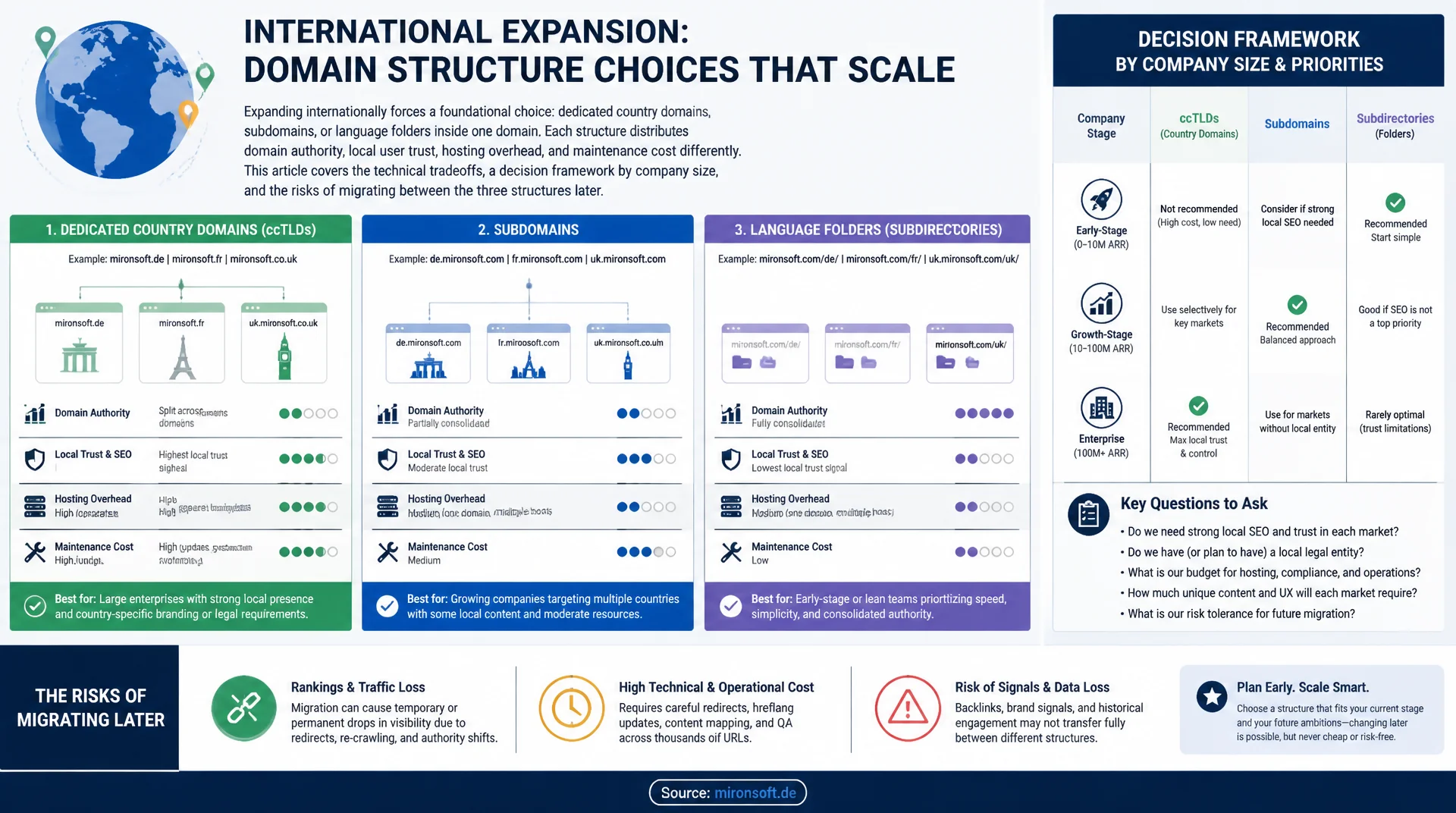
Choosing the Right International Structure
Expanding internationally forces a foundational choice: dedicated country domains, subdomains, or language folders inside one domain. Each structure distributes domain authority, local user trust, hosting overhead, and maintenance cost differently. This article covers the technical tradeoffs, a decision framework by company size, and the risks of migrating between the three structures later.
Table of Contents
- 1. Why the international URL structure is a strategic SEO decision
- 2. ccTLD in detail: local trust and maximum separation
- 3. Subdomain in detail: flexibility with separation costs
- 4. Subdirectory in detail: consolidating domain authority
- 5. Trust signals and user behavior by structure
- 6. Hosting, CDN, and server location implications
- 7. Maintenance overhead and technical complexity
- 8. Decision framework by company size and market strategy
- 9. Migrating between structures: risks and process
- 10. Summary
- 11. FAQ
1. Why the international URL structure is a strategic SEO decision
Choosing between ccTLD, subdomain, and subdirectory looks like a purely technical detail at first glance, but it is actually one of the most consequential SEO decisions in a store's international growth. It determines how backlinks, ranking history, and domain authority spread across country markets, how much trust local users place in the site, and how high the ongoing operating cost for hosting, SSL certificates, and content maintenance turns out to be. Unlike many other SEO levers, this decision can only be corrected later with significant effort and temporary traffic loss, because any structural change is effectively a full URL migration with 301 redirects, new Search Console verification, and rebuilding trust signals from scratch.
There are fundamentally three structural patterns to choose from: the country-specific top-level domain such as mironsoft.fr, the subdomain such as fr.mironsoft.de, and the language folder such as mironsoft.de/fr/. Google technically treats each variant differently, and each has specific strengths in trust signals, hosting flexibility, and consolidation of ranking signals. The right choice does not follow a blanket best practice, it depends on company size, the number of target markets, the available development budget, and whether legal or logistical reasons such as separate legal entities per country require distinct domains anyway.
2. ccTLD in detail: local trust and maximum separation
A country-specific top-level domain such as mironsoft.fr or mironsoft.co.uk signals unambiguously to Google and to users which country a page addresses, with no additional geotargeting needed in Search Console. Users recognize the local domain immediately and tend to trust it more than a generic domain with a foreign-language folder, which can translate into measurably higher conversion rates. For Magento, a ccTLD strategy typically means a dedicated website scope per country with its own base_url, its own store, and its own store view, so pricing, tax logic, and payment methods stay cleanly separated per country.
The price for that is structural separation: domain authority does not consolidate, each ccTLD effectively starts at zero for backlinks and ranking history and has to be built up independently. On top of that come recurring costs for registering and renewing every domain, sometimes country-specific registration requirements, a dedicated SSL certificate per domain, and a separate Google Search Console property with its own crawling and indexing status. For teams with limited resources this quickly becomes a bottleneck, because every content change has to be maintained separately on every domain.
3. Subdomain in detail: flexibility with separation costs
A subdomain such as fr.mironsoft.de formally stays under the main domain but can be hosted completely independently, with its own server, its own CDN configuration, and its own data center location. That makes subdomains the natural choice when infrastructure needs to be separated per region for compliance or latency reasons, for instance when customer data must be processed in a specific region for regulatory reasons without registering an entirely new domain. Google has aligned its treatment of subdomains over the years and increasingly crawls them similarly to subdirectories, but a guaranteed identical outcome for authority transfer cannot be assumed from that.
Technically, a subdomain stays closer to subdirectory overhead than to ccTLD overhead: a wildcard SSL certificate covers any number of subdomains, saving effort compared to N individual certificates. Google Search Console still requires a separately verified property per subdomain with its own international geotargeting, though, which increases maintenance effort compared to a pure subdirectory setup. In practice, the subdomain is a compromise that pays off mainly for mid-size companies with regional infrastructure requirements; for small stores with few target markets, the extra effort is often not justified.
4. Subdirectory in detail: consolidating domain authority
A language folder such as mironsoft.de/fr/ stays entirely under the same root domain, so every backlink, mention, and piece of ranking history pays into a shared authority pool, regardless of which language version received the link. That makes subdirectories by far the most SEO-efficient structure for new markets: a new language version immediately benefits from the existing domain authority instead of starting from zero. Technical overhead is minimal too, since a single SSL certificate, a single hosting setup, and a single Search Console property with international geotargeting per folder is enough.
The downside is local trust: users still recognize a .de domain as a German offering even when the content is fully translated into French, which can noticeably lower perceived credibility in some markets. Infrastructure also cannot be differentiated regionally, all language versions share the same hosting location and the same CDN configuration, which can become a disqualifying factor under strict data residency requirements. A market also cannot be sold off or transferred to a local partner independently later without restructuring the entire domain setup.
5. Trust signals and user behavior by structure
Local trust signals affect more than ranking alone, they directly influence conversion rate because users unconsciously check whether a store was actually built for their country. In markets with a strong domain culture such as Germany or France, a matching ccTLD generates noticeably more trust than a generic domain with translated content, while English-speaking or Nordic markets have traditionally been more tolerant of generic domains. This effect touches not just the click decision in search results, but also on-page behavior, such as whether users are willing to enter payment details.
Anyone choosing subdirectory or subdomain can partially compensate for the weaker domain signal with other local trust elements: a local phone number and address in the footer, country-typical payment methods such as Sofort in Germany or Bancontact in Belgium, correctly localized legal pages including imprint equivalents, and visible local customer reviews. None of these measures fully replace a genuine ccTLD, but together they noticeably narrow the trust gap.
6. Hosting, CDN, and server location implications
ccTLD and subdomain allow hosting location and CDN edge configuration to be chosen freely per region, relevant for example under GDPR requirements that mandate processing EU customer data within the EU, or for latency optimization for distant markets such as a US audience served from a US-based location instead of a European origin server. A subdirectory setup, by contrast, forces shared infrastructure, since the domain and DNS configuration stay identical for every language version, although modern CDNs are increasingly able to route traffic to regional edge locations based on path as well.
For Magento stores this translates directly into scope architecture: ccTLD and subdomain fit naturally with a dedicated website scope with its own base_url, its own store, and its own store view per country. A subdirectory approach, by contrast, typically uses a shared website with multiple store views under the same store, which simplifies administration but requires a carefully locale-differentiated Full Page Cache configuration in Varnish so language versions do not evict each other from cache or get served incorrectly.
7. Maintenance overhead and technical complexity
Ongoing operating overhead differs drastically between the three structures. A ccTLD strategy with five target markets means five domain renewals, five SSL certificates, five Google Search Console properties, five analytics property configurations, and often five sets of country-specific legal pages. The subdomain variant reduces domain administration overhead, since only one root domain needs to be registered, but still requires separate Search Console properties and independent geotargeting per subdomain. A subdirectory setup, by contrast, needs just one domain, one certificate, and one Search Console property with country-specific targeting per folder, which substantially lowers the administrative burden for development and content teams.
Beyond pure infrastructure, the structure also affects content governance: with separate domains there is a real risk that a promotion goes live on the main domain but gets forgotten on another ccTLD, because editorial processes are not centrally managed. A subdirectory setup with a shared Magento multi-store and a shared Hyvä theme, by contrast, allows new features, campaigns, or design changes to roll out to every language version simultaneously through a single deploy, which noticeably improves consistency and time to market.
8. Decision framework by company size and market strategy
For small teams entering two or three markets on a limited budget, subdirectory is the right choice in the vast majority of cases: lowest setup effort, fastest market entry, and full consolidation of existing domain authority. Mid-size companies with independent regional marketing budgets and a need to separate infrastructure or data residency by region often fare better with subdomains, since they combine technical flexibility with manageable extra effort. Large enterprises with independent country subsidiaries, dedicated country marketing, and a high need for local trust usually benefit the most from genuine ccTLDs despite the higher maintenance overhead.
Industry matters too: trust-sensitive segments such as financial services, healthcare, or high-end luxury goods often justify the extra effort of a ccTLD, since the local trust signal directly influences the purchase decision. For more commoditized products or international B2B business, the advantage of SEO consolidation through subdirectory usually outweighs it. The number of target markets is a hard factor as well: beyond roughly eight to ten parallel markets, the maintenance overhead of a pure ccTLD strategy becomes practically unsustainable for most teams.
9. Migrating between structures: risks and process
Changing structure later, for instance from subdirectory to ccTLD or the other way around, counts as a full domain migration in Google's eyes and carries corresponding risk. Requirements include a complete 301 redirect mapping for every single URL, re-verification and setup of a new Google Search Console property, updates to every hreflang reference and XML sitemap, and adjustments to internal linking. Even with a technically flawless implementation, expect temporary ranking volatility lasting several weeks to months while Google re-evaluates the new signals.
A staged approach has proven effective, migrating market by market rather than all domains at once, so problems surface early and stay limited to a bounded share of traffic. The 301 redirects should remain in place permanently rather than being disabled after a few months, and the old domain should stay registered and redirecting for years to avoid losing residual direct traffic and backlink value. Search Console coverage reports and indexing status should be monitored closely in the first weeks after migration to catch indexing errors or missing reindexing quickly.
<!-- hreflang tags in the head when using separate ccTLDs per market -->
<link rel="alternate" hreflang="de" href="https://mironsoft.de/">
<link rel="alternate" hreflang="fr" href="https://mironsoft.fr/">
<link rel="alternate" hreflang="en-gb" href="https://mironsoft.co.uk/">
<link rel="alternate" hreflang="en" href="https://mironsoft.com/">
<link rel="alternate" hreflang="x-default" href="https://mironsoft.com/">

<!-- Every domain must reference every other domain reciprocally, -->
<!-- including a self-referencing hreflang tag for its own URL -->
<!-- Scoped configuration exported via bin/magento app:config:dump -->
<!-- Separate website scope per ccTLD, own base_url and locale -->
<config>
    <websites>
        <de_website>
            <web>
                <unsecure>
                    <base_url>https://mironsoft.de/</base_url>
                </unsecure>
                <secure>
                    <base_url>https://mironsoft.de/</base_url>
                </secure>
            </web>
            <general>
                <locale>
                    <code>de_DE</code>
                </locale>
                <country>
                    <default>DE</default>
                </country>
            </general>
        </de_website>
        <fr_website>
            <web>
                <unsecure>
                    <base_url>https://mironsoft.fr/</base_url>
                </unsecure>
            </web>
            <general>
                <locale>
                    <code>fr_FR</code>
                </locale>
                <country>
                    <default>FR</default>
                </country>
            </general>
        </fr_website>
    </websites>
</config>
# Subdomain approach: one server block per region, own root/upstream,
# infrastructure can differ per market (server location, cache zone)
server {
    listen 443 ssl;
    server_name fr.mironsoft.de;
    root /var/www/mironsoft/pub;
    # Region-specific upstream or cache zone can be configured here
}

# Subdirectory approach: a single server block, path-based store view,
# same origin and infrastructure for every language version
server {
    listen 443 ssl;
    server_name mironsoft.de;
    root /var/www/mironsoft/pub;
    location /fr/ {
        # Magento resolves the store view from the URL path
        try_files $uri $uri/ /index.php$is_args$args;
    }
}
{
  "@context": "https://schema.org",
  "@type": "Organization",
  "name": "Mironsoft France",
  "url": "https://mironsoft.fr",
  "areaServed": "FR",
  "inLanguage": "fr-FR",
  "address": {
    "@type": "PostalAddress",
    "addressCountry": "FR"
  },
  "sameAs": [
    "https://mironsoft.de",
    "https://mironsoft.co.uk"
  ]
}
// Alpine.js component: compute the equivalent URL when switching markets,
// works across ccTLD, subdomain, and subdirectory structures
function marketSwitcher(currentPath, structureType) {
  const markets = {
    de: { cctld: 'https://mironsoft.de', subdomain: 'https://de.mironsoft.com', subdirectory: '/de' },
    fr: { cctld: 'https://mironsoft.fr', subdomain: 'https://fr.mironsoft.com', subdirectory: '/fr' },
  };

  return {
    target(marketCode) {
      const entry = markets[marketCode];
      if (!entry) return currentPath;
      if (structureType === 'subdirectory') {
        return entry.subdirectory + currentPath;
      }
      // ccTLD and subdomain both swap the origin, keep the path
      return entry[structureType] + currentPath;
    }
  };
}
Structure comparison
Each of the three structures has clear strengths and weaknesses in domain authority, local trust, infrastructure freedom, maintenance overhead, and migration complexity. The overview below summarizes the direct comparison.
| Criterion | ccTLD | Subdomain | Subdirectory |
|---|---|---|---|
| Consolidating domain authority | No consolidation, each domain starts separately | Partial, often weaker than subdirectory | Full consolidation on the root domain |
| Local trust signal | Strongest signal, clear country match | Medium, often less visible to users | Weakest signal, reads as foreign |
| Hosting/CDN flexibility | Full freedom per country | High freedom per subdomain | Shared infrastructure for every market |
| Setup and maintenance overhead | High: N domains, SSL, Search Console | Medium: N subdomains, usually one certificate | Low: one domain, one certificate |
| Migration effort on structure change | Very high: full domain move | Medium: new Search Console property | No change needed, already consolidated |
In practice these criteria are interconnected: a structure with strong authority consolidation such as subdirectory loses out on local trust, while a structure with strong local trust such as ccTLD spreads out authority and maintenance overhead. Matching the table consistently against your own company size, market count, and industry requirements usually leads to a clear recommendation instead of a matter of taste.
Mironsoft
International SEO structure, domain strategy, and migration planning for Magento stores
Ready to plan your international URL structure?
We analyze your target markets, brand requirements, and technical infrastructure and design the right ccTLD, subdomain, or subdirectory strategy, including hreflang setup, Magento multi-website configuration, and a low-risk migration plan.
Structure audit
Analysis of target markets, competitors, and existing domain authority
Magento multi-website setup
Website, store, and store view configuration for ccTLD, subdomain, or subdirectory
Migration planning
301 mapping, hreflang updates, and a staged rollout without losing rankings
10. Summary
The choice between ccTLD, subdomain, and subdirectory determines how domain authority, local trust, and operating overhead spread across international markets. Subdirectories consolidate SEO signals most efficiently and cause the lowest maintenance overhead, but deliver the weakest local trust signal. ccTLDs generate the strongest local trust but require building backlinks, SSL certificates, and Search Console properties separately per country. Subdomains sit in between and fit best when hosting or data residency needs to be separated by region.
There is no universally correct structure, only the right one for a given company size, number of target markets, and industry requirement. Anyone changing structure later should realistically plan for the effort of a full domain migration with 301 mapping, new Search Console verification, and temporary ranking volatility, and should carry out the migration in stages rather than all at once.
ccTLD vs. Subdomain vs. Subdirectory - The Essentials at a Glance
ccTLD
Strongest local trust, but no consolidation of domain authority and high maintenance overhead per country.
Subdomain
Good compromise for separate hosting and data residency requirements, though authority transfer stays uncertain.
Subdirectory
Best consolidation of domain authority, lowest overhead, but weaker local trust signal.
Migration
A structure change is a full domain move with 301 mapping, new verification, and temporary ranking volatility.