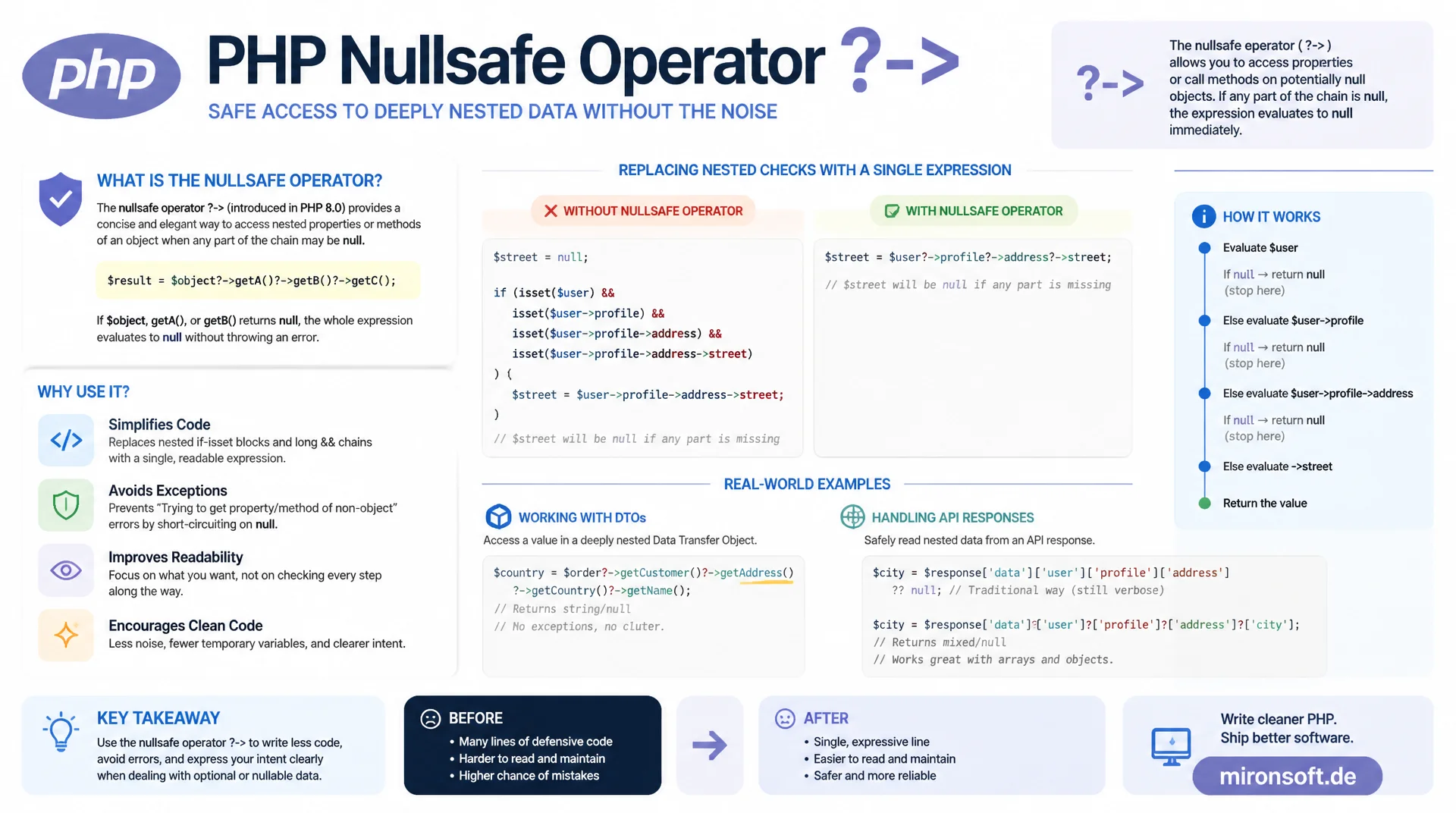
from the if-isset pyramid to a flat expression chain
The nullsafe operator ?-> replaces nested if-isset blocks and long && chains with a single, flat expression chain: as soon as one link in the chain is null, the entire evaluation stops immediately, without a warning, and returns null instead of throwing an exception, which makes code around deeply nested DTOs and API responses noticeably more readable.
Table of Contents
- 1. The problem of nested null checks
- 2. Syntax and short-circuit behavior of the nullsafe operator
- 3. Nullsafe operator vs. the null coalescing operator ??
- 4. Combining multiple nullsafe calls in one chain
- 5. Nullsafe with method calls, not just property access
- 6. Combining with match and other language constructs
- 7. Limits: no write access, no array access, no assignment
- 8. Interaction with the type system and nullable types
- 9. Practical examples: DTOs, API responses, object graphs
- 10. Summary
- 11. FAQ
1. The problem of nested null checks
Before PHP 8.0 introduced the nullsafe operator, every access to a potentially absent, nested object structure had to be explicitly guarded against null. A typical example: $order may have a customer, who may have an address, which may reference a country object. Without a guard, accessing $order->customer->address->country->name leads to a fatal error the moment any link of that chain is null.
The classic solution was a pyramid of nested if (isset(...)) blocks or a long chain of && combinations, each checking one link of the chain individually before the next access was even attempted. At four or five nested levels, this code quickly turns unreadable, and the actual intent, reading the final value, gets buried under the guard logic.
The nullsafe operator ?-> solves exactly this problem by folding the guard logic into the access syntax itself. Instead of checking upfront whether every link exists, each step of the chain is checked automatically, and evaluation stops immediately, with no error, at the first null. That reduces a multi-line pyramid to a single, readable expression line.
2. Syntax and short-circuit behavior of the nullsafe operator
The syntax of the nullsafe operator replaces the ordinary object access arrow -> with ?->. $order?->customer returns the value of customer if $order is not null, and returns null directly if $order itself is already null, without triggering a warning or an error. This behavior differs fundamentally from the ordinary ->, which throws a fatal error on access to null.
The key point is the short-circuit behavior in a chain: as soon as a single link in a chain of several ?-> accesses returns null, all subsequent accesses in the same expression chain are skipped, not evaluated individually. PHP does not need every single link marked with ?-> for the short-circuit logic to kick in, one ?-> at the start is enough to protect the entire remaining chain, as long as the following accesses are also written with ?-> instead of ->.
<?php

declare(strict_types=1);

final class Country
{
    public function __construct(public readonly string $name) {}
}

final class Address
{
    public function __construct(public readonly ?Country $country = null) {}
}

final class Customer
{
    public function __construct(public readonly ?Address $address = null) {}
}

final class Order
{
    public function __construct(public readonly ?Customer $customer = null) {}
}

$order = new Order();

// Without the nullsafe operator, this would throw a fatal error
// $countryName = $order->customer->address->country->name;

// Short-circuits at the first null link, returns null instead of crashing
$countryName = $order?->customer?->address?->country?->name;

var_dump($countryName); // null, no warning, no fatal error
3. Nullsafe operator vs. the null coalescing operator ??
The nullsafe operator and the null coalescing operator ?? solve two different problems that are frequently confused. ?? returns a fallback value when the left-hand expression is null or an unset variable, but it does not itself check a nested chain, only the single expression before it. The nullsafe operator, by contrast, guards exactly the access path within a chain, but never returns a fallback value itself, only null whenever a link is missing.
The two operators complement each other extremely well in practice: $order?->customer?->address?->country?->name ?? 'Unknown' combines the short-circuit logic of the nullsafe operator for the chain with a concrete fallback value via ??, in case the entire chain evaluates to null. Without this combination, the fallback value would either need to be assigned in a separate if check afterward, or the whole chain would need to be stored in a helper variable before it could be checked against null.
4. Combining multiple nullsafe calls in one chain
A chain of multiple nullsafe operators is not limited to two or three links, PHP allows chains of arbitrary length. What matters is consistently using ?-> instead of -> for every link that could itself be null. A mixed access, where only the first link is written with ?-> while later links still use ->, still leads to a fatal error the moment one of the later, unguarded links is null.
In practice, it makes sense to write only the genuinely nullable links of a chain with ?-> and to leave links that are guaranteed non-null by their type declaration with the ordinary ->. That makes it visible at a glance which spots in the chain are actually optional, instead of blanket-converting every single arrow to ?-> regardless of the underlying type information.
<?php

declare(strict_types=1);

final class ApiResponse
{
    public function __construct(
        public readonly ?ApiResponseBody $body = null,
    ) {
    }
}

final class ApiResponseBody
{
    public function __construct(
        public readonly ?ApiUser $user = null,
    ) {
    }
}

final class ApiUser
{
    public function __construct(
        // Non-nullable: guaranteed present once the user object exists
        public readonly string $email,
        public readonly ?ApiProfile $profile = null,
    ) {
    }
}

final class ApiProfile
{
    public function __construct(public readonly ?string $avatarUrl = null) {}
}

function extractAvatarUrl(?ApiResponse $response): ?string
{
    // Only truly nullable links use ?->, email itself uses -> since it
    // is guaranteed non-null once ApiUser exists
    return $response?->body?->user?->profile?->avatarUrl;
}
5. Nullsafe with method calls, not just property access
The nullsafe operator is not limited to property access, it works identically on method calls: $repository?->find($id)?->getName() only calls find() if $repository is not null, and only calls getName() if the result of find() itself is not null. This is especially useful for repository patterns, where a lookup can legitimately return null when no matching record exists.
Important to note: if a method is skipped via the nullsafe operator because the preceding object was null, the method body itself never executes at all, including any side effects contained in it, such as logging or counter increments. Anyone relying on a guaranteed method call, for instance for an audit log, should never place it behind a nullsafe operator, but perform the check explicitly beforehand instead.
6. Combining with match and other language constructs
The nullsafe operator combines easily with match expressions, for instance to make a case distinction based on a value that might be missing. match($order?->status) first evaluates the entire nullsafe chain and passes the result, which can be either a concrete value or null, directly to the match expression, which can then also cover an explicit null case.
The nullsafe operator is also useful in combination with array_map(), array_filter(), and other functional constructs, for instance to safely extract the respective country name from a list of orders, even if not every order has fully nested data: array_map(fn(Order $o) => $o->customer?->address?->country?->name, $orders) returns null for incomplete entries, instead of aborting the whole processing with an error.
<?php

declare(strict_types=1);

enum ShippingState
{
    case Pending;
    case Shipped;
    case Delivered;
}

final class Shipment
{
    public function __construct(public readonly ?ShippingState $state = null) {}
}

final class Order
{
    public function __construct(public readonly ?Shipment $shipment = null) {}
}

function describeShipment(Order $order): string
{
    // Nullsafe chain feeds directly into match, including a null arm
    return match ($order->shipment?->state) {
        ShippingState::Pending => 'Waiting to be shipped',
        ShippingState::Shipped => 'On its way',
        ShippingState::Delivered => 'Delivered',
        null => 'No shipment created yet',
    };
}
7. Limits: no write access, no array access, no assignment
The nullsafe operator is explicitly meant only for read access. $order?->customer = $newCustomer is not a valid expression, PHP does not allow assignment via ?->. The reason lies in the semantics themselves: assigning to a property of a null object makes no conceptual sense, there is no object for the assignment to happen on, so the language rules out this combination from the outset.
Nor does the nullsafe operator work for array access via square brackets. $order?->items[0] is valid, because ?-> only applies to the object access, and the following array access is evaluated separately, but a direct $array?['key'] for accessing a possibly non-existent array element does not exist as its own syntax. For that case, $array['key'] ?? null with the null coalescing operator remains the right approach.
Another restriction concerns chaining followed by further method execution when an intermediate result is not an object but a scalar or array. The nullsafe operator works exclusively for object access, never for accessing values that are not themselves objects. Anyone who wants to guard a chain with mixed object and array levels must still handle the array levels the classic way, with ?? or isset().
<?php

declare(strict_types=1);

final class Customer
{
    public function __construct(public readonly ?array $tags = null) {}
}

$customer = new Customer(tags: ['vip', 'newsletter']);

// NOT allowed: there is no nullsafe array-access syntax
// $firstTag = $customer?->tags?['0'];

// Correct: combine nullsafe object access with ?? for the array step
$firstTag = ($customer?->tags)[0] ?? 'no tag';

// NOT allowed: nullsafe operator cannot appear on the left side of an assignment
// $customer?->tags = ['new'];
| Task | Without the nullsafe operator | With the nullsafe operator | Benefit |
|---|---|---|---|
| Check 3 levels deep | 3 nested if blocks or an && chain | $a?->b?->c |
One line instead of several if blocks |
| Call a method on a possibly null object | isset() check plus a separate call | $obj?->method() |
Short-circuit with no warning or error |
| Default value when null appears in the chain | Nested ternary expressions | $a?->b?->c ?? 'default' |
Readable combination of both operators |
| Readability with deep object graphs | Pyramid of if(isset()) blocks | One flat expression chain | Noticeably less nesting depth |
| Error behavior on null | Warning when accessing a property of null | Silent null return for the whole chain | No warning noise in the logs |
8. Interaction with the type system and nullable types
The result of an expression using the nullsafe operator is always implicitly nullable, regardless of whether the last value in the chain is itself declared as nullable. A function that returns the result of a nullsafe chain must therefore consistently declare its return type as ?string instead of string, otherwise PHPStan already reports a type error at a low level, since the genuinely possible null case is not captured in the declared return type.
This interaction between the nullsafe operator and static analysis is an important advantage over manual guarding with isset(), where PHPStan cannot always correctly infer the nullability of the result. With ?->, on the other hand, nullability is structurally anchored in the language construct itself, so static analysis tools more reliably catch a null return value that is not handled correctly afterward.
9. Practical examples: DTOs, API responses, object graphs
The practical benefit of the nullsafe operator shows up most clearly with DTOs coming from external sources like a REST API or a database, whose structure is partly optional. A typical API response often contains several levels of nested, individually optional objects, and the nullsafe operator allows extracting a deeply nested value in a targeted way, without explicitly validating the entire structure beforehand.
The nullsafe operator also substantially reduces code for configuration objects assembled from several, partly optional sources, for instance environment variables combined with a configuration file. Instead of checking every level of the configuration hierarchy against null individually, a single expression line reads the desired value and automatically returns null if any intermediate stage is missing, combined with ?? for a sensible default value.
<?php

declare(strict_types=1);

final class DatabaseConfig
{
    public function __construct(public readonly ?string $host = null) {}
}

final class AppConfig
{
    public function __construct(public readonly ?DatabaseConfig $database = null) {}
}

final class ConfigLoader
{
    public function __construct(private readonly ?AppConfig $config = null) {}

    // One expression instead of a multi-level isset() pyramid
    public function databaseHost(): string
    {
        return $this->config?->database?->host ?? 'localhost';
    }
}

$loader = new ConfigLoader(new AppConfig());
echo $loader->databaseHost(); // "localhost", database was never set
10. Summary
The nullsafe operator ?-> replaces nested if-isset pyramids and long && chains with a single, flat expression chain with built-in short-circuit behavior. As soon as one link of the chain is null, the entire chain returns null, with no warning and no fatal error, for property access just as much as for method calls.
Combined with the null coalescing operator ??, a concrete fallback value can be supplied as well. The limits lie with write access, which the nullsafe operator fundamentally does not support, and with array access, for which ?? or isset() remain the right choice. For DTOs, API responses, and other deeply nested object graphs, the nullsafe operator is today the natural tool.
The Nullsafe Operator ?->, the Essentials
Short-circuit behavior
?-> stops the entire chain at the first null link and returns null, with no warning or error.
vs. null coalescing
?-> guards the access path, ?? provides a fallback value. Combining both operators is common practice.
Limits
No write access, no dedicated array syntax. For arrays, ?? or isset() remain the right choice.
Type system
The result is always implicitly nullable. Declare return types as ?type accordingly, PHPStan checks this reliably.
11. FAQ: The Nullsafe Operator
1Since which version does ?-> exist?
2Object in the middle of the chain is null?
3Difference from ??
4Call methods with ?->?
5Assignment with nullsafe possible?
6Does it work with arrays?
7Mark every link with ?->?
8Is the return value always nullable?
9Combination with match?
10When to avoid it?
Mironsoft
PHP architecture, code quality, and Magento development
Want to clean up nested null checks in your own code?
We review existing PHP code for if-isset pyramids and replace them with clean nullsafe chains combined with the null coalescing operator, including correct return type declarations and PHPStan coverage.
Code review
Analyzing nested null checks and proposing nullsafe refactorings
DTO design
Designing clean, nullable-aware data structures for API integrations
PHPStan coverage
Correct nullable type declarations and static analysis at level 5 and above